The showcase prompt, round 3, Opus 5.5
agent
+14:27reasoning
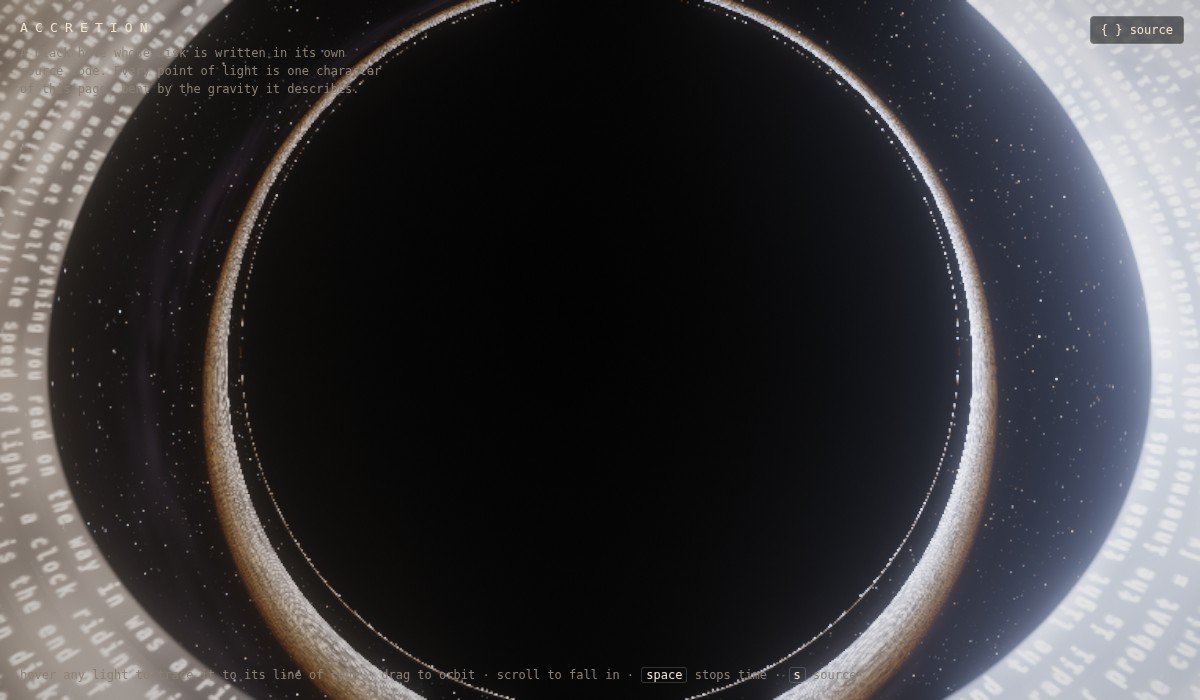
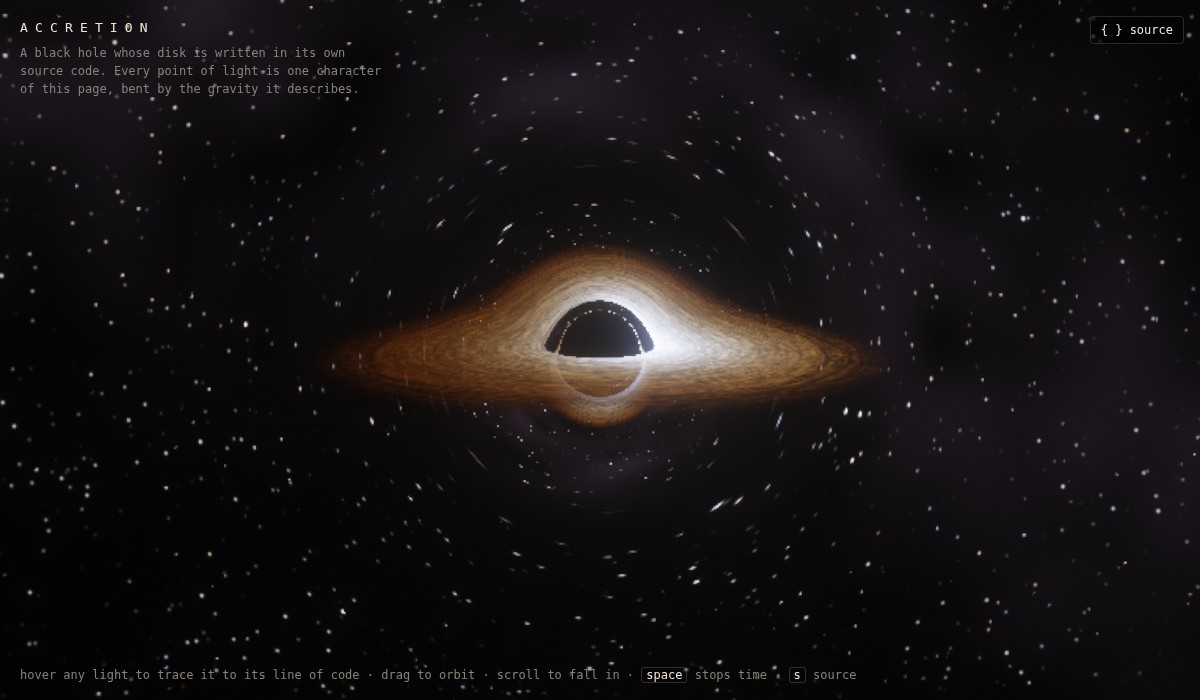
The black hole render now shows the photon ring, lensed far side, Doppler-brightened approaching side, and secondary image, though it still needs more contrast and colour. Next I'll zoom in to check the text orientation and readability.
Bashpython3 - <<'EOF'
command
python3 - <<'EOF' f='~/run/accretion.html'; s=open(f).read() s=s.replace(''' float T = 9500.0 * pow(r / R_IN, -0.75) * g; float I = 2.4 * pow(r / R_IN, -2.0) * pow(g, 3.0);''',''' float T = 10500.0 * pow(r / R_IN, -0.85) * g; float I = 3.2 * pow(r / R_IN, -2.4) * pow(g, 3.0);''') s=s.replace('float gas = 0.16 + 0.42 * noise(','float gas = 0.09 + 0.62 * noise(') open(f,'w').write(s) EOF cd /tmp/pw && node shot.mjs /tmp/pw/a.png "accretion.goal.dist=21" && node shot.mjs /tmp/pw/b.png "accretion.goal.dist=accretion.camera.dist=6.5; accretion.goal.el=accretion.camera.el=0.75;"result, 4 lines
{"n":40274,"R":71,"ringH":0.15492957746478872,"glyphs":103,"cam":{"az":0.6139534144218229,"el":0.17,"dist":47.82328351241923}} {"n":40274,"R":71,"ringH":0.15492957746478872,"glyphs":103,"cam":{"az":0.6337844789809584,"el":0.75,"dist":6.5}} Shell cwd was reset to ~/runRead/tmp/pw/b.png
input
{
  "file_path": "/tmp/pw/b.png"
}
result
no output
b.jpg Read/tmp/pw/a.png
input
{
  "file_path": "/tmp/pw/a.png"
}
result
no output
a_4.jpg
agent
+15:24reasoning
The close view is legible right at the ISCO, so I'm moving on to test the hover probe and line highlighting next.
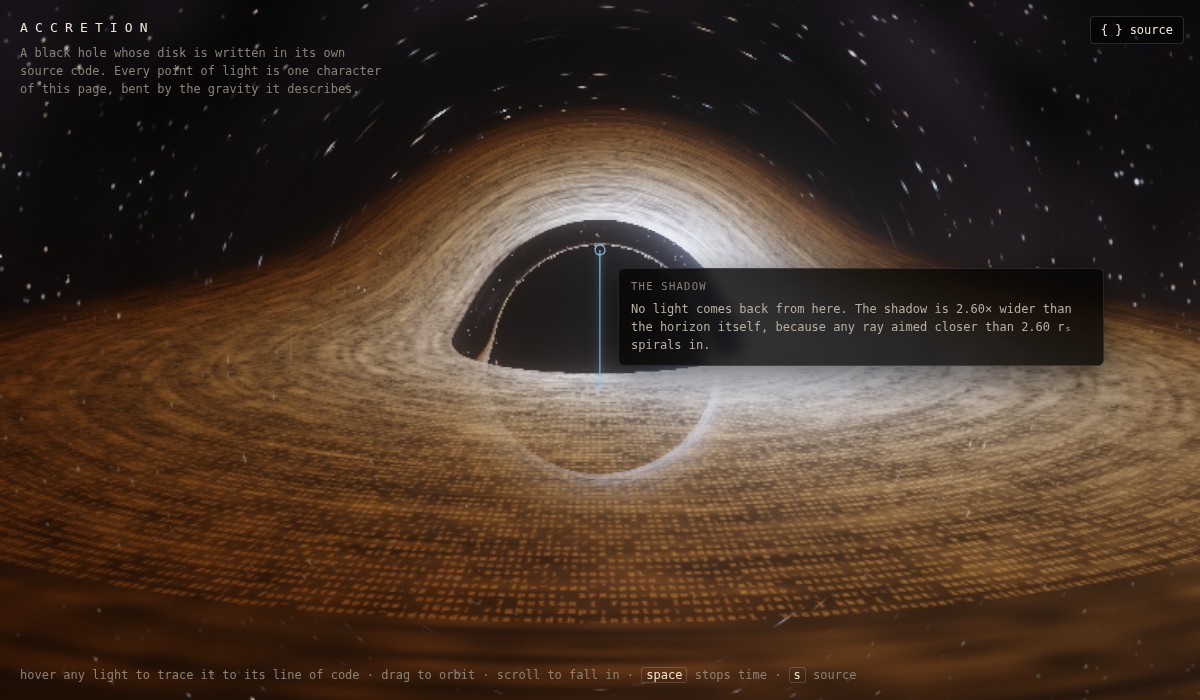
Bashcd /tmp/pw && sed -i 's#await p.screenshot#if (process.env.MOUSE) { const [mx,my]=process.env.MOUSE.split(",").map(Number); await p.mouse.move(mx,my); await new Promise(r=>setTimeout(r,5000)); }\nawait p.screenshot#' shot.mjs && MOUSE=600,250 node shot.mjs /tmp/pw/c.png "accretion.goal.dist=accretion.camera.dist=21" && MOUSE=420,440 node shot.mjs /tmp/pw/d.png "accretion.goal.dist=accretion.camera.dist=12; accretion.goal.el=accretion.camera.el=0.3"
command
cd /tmp/pw && sed -i 's#await p.screenshot#if (process.env.MOUSE) { const [mx,my]=process.env.MOUSE.split(",").map(Number); await p.mouse.move(mx,my); await new Promise(r=>setTimeout(r,5000)); }\nawait p.screenshot#' shot.mjs && MOUSE=600,250 node shot.mjs /tmp/pw/c.png "accretion.goal.dist=accretion.camera.dist=21" && MOUSE=420,440 node shot.mjs /tmp/pw/d.png "accretion.goal.dist=accretion.camera.dist=12; accretion.goal.el=accretion.camera.el=0.3"result, 4 lines
{"n":40274,"R":71,"ringH":0.15492957746478872,"glyphs":103,"cam":{"az":0.6096134861937067,"el":0.17,"dist":21}} {"n":40274,"R":71,"ringH":0.15492957746478872,"glyphs":103,"cam":{"az":0.639481394343475,"el":0.3,"dist":12}} Shell cwd was reset to ~/runRead/tmp/pw/c.png
input
{
  "file_path": "/tmp/pw/c.png"
}
result
no output
c.jpg Read/tmp/pw/d.png
input
{
  "file_path": "/tmp/pw/d.png"
}
result
no output
d.jpg
agent
+16:40reasoning
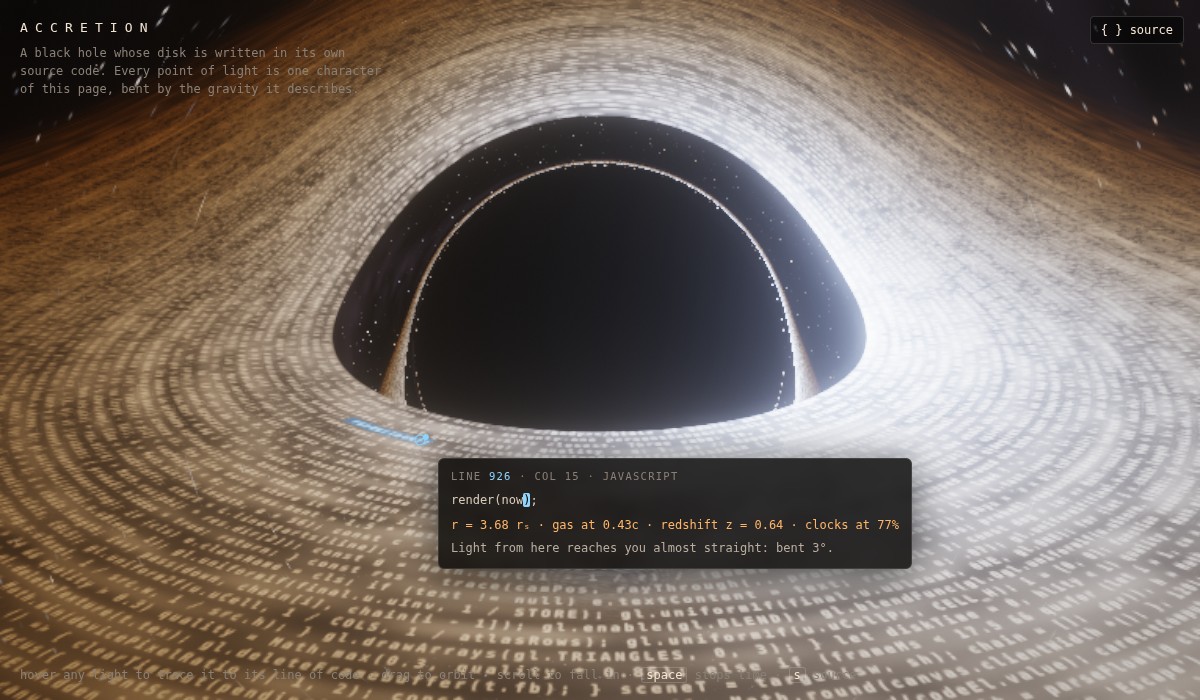
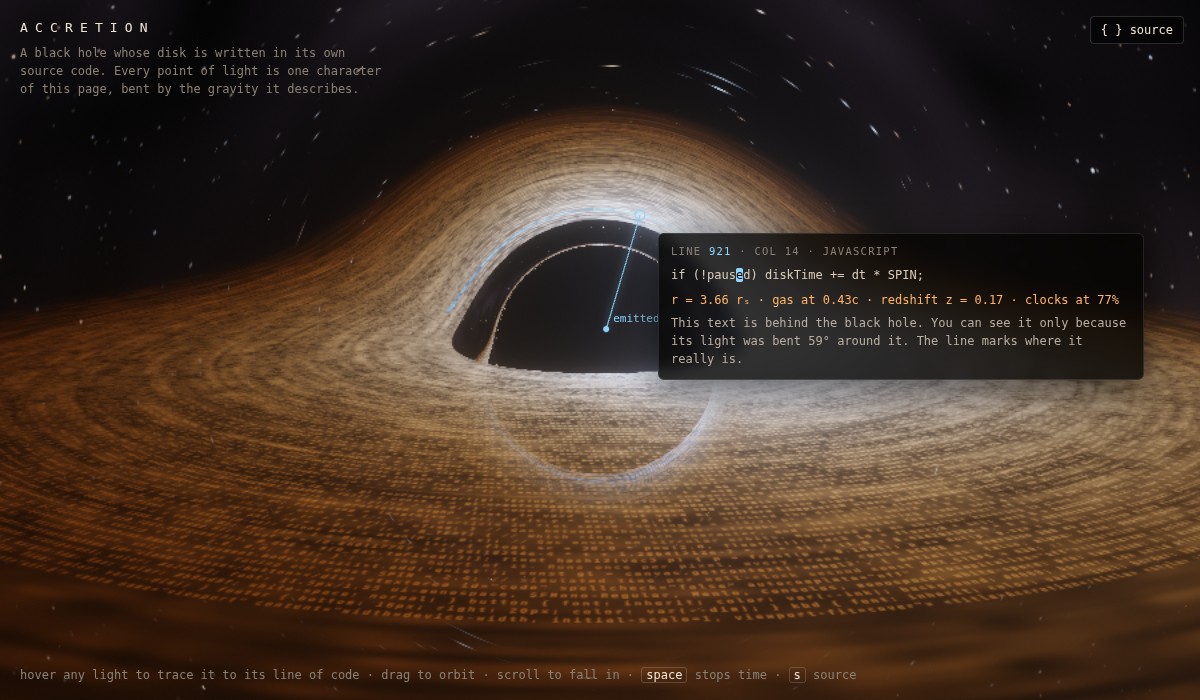
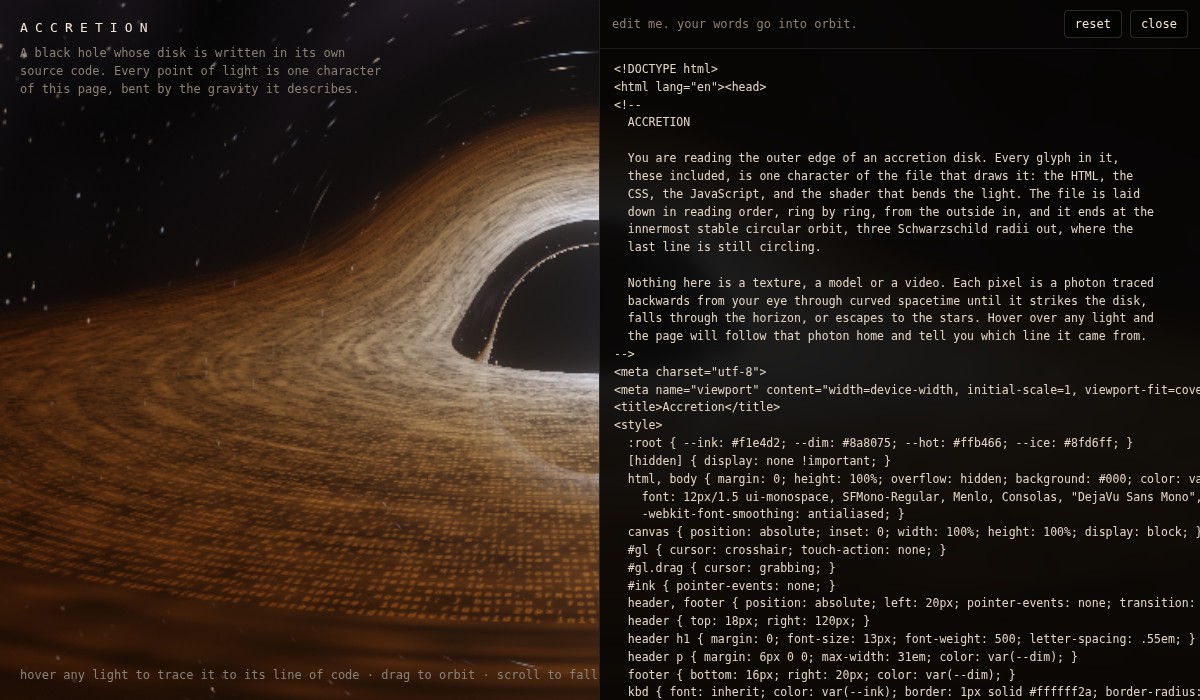
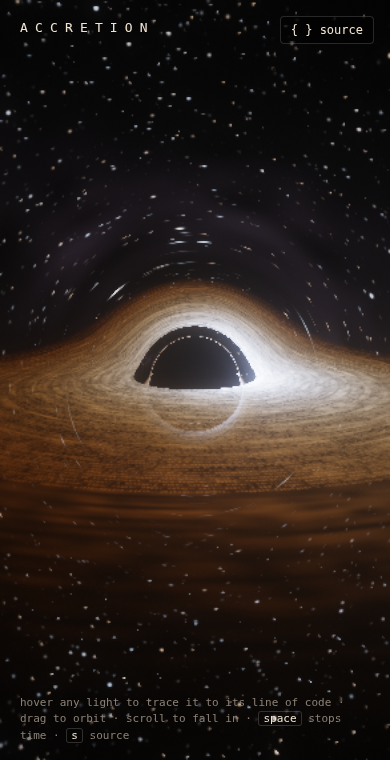
The close-up view works: the real code is readable on disk, the hovered line glows blue in orbit, and the probe card shows the line, redshift and clock rate. Next I'm checking the lensed far-side probe, the source panel and the portrait layout.
Bashpython3 - <<'EOF'
command
python3 - <<'EOF' f='~/run/accretion.html'; s=open(f).read() s=s.replace('if (h.x < 0.86) continue;','if (h.x < 0.9) continue; ') s=s.replace('float lum = pow(h.y, 6.0) * 2.2 /','float lum = pow(h.y, 6.0) * 1.6 /') open(f,'w').write(s) EOF cd /tmp/pw && MOUSE=640,215 node shot.mjs /tmp/pw/e.png "accretion.goal.dist=accretion.camera.dist=21" && node shot.mjs /tmp/pw/f.png "document.getElementById('open').click(); accretion.goal.dist=accretion.camera.dist=21" 1200 700 && node shot.mjs /tmp/pw/g.png "accretion.goal.dist=accretion.camera.dist=21" 390 760result, 6 lines
{"n":40273,"R":71,"ringH":0.15492957746478872,"glyphs":103,"cam":{"az":0.667421573338669,"el":0.17,"dist":21}} {"n":40273,"R":71,"ringH":0.15492957746478872,"glyphs":103,"cam":{"az":0.6581415777422884,"el":0.17,"dist":21}} {"n":40273,"R":71,"ringH":0.15492957746478872,"glyphs":103,"cam":{"az":0.7414563236495296,"el":0.17,"dist":21}} Shell cwd was reset to ~/runRead/tmp/pw/e.png
input
{
  "file_path": "/tmp/pw/e.png"
}
result
no output
e.jpg Read/tmp/pw/f.png
input
{
  "file_path": "/tmp/pw/f.png"
}
result
no output
f.jpg Read/tmp/pw/g.png
input
{
  "file_path": "/tmp/pw/g.png"
}
result
no output
g.png
agent
+18:05reasoning
The far-side probe now draws the hovered line as a blue arc over the shadow and marks where the text really sits, and the source panel and portrait layout are fine. Next I'll fix two robustness issues: adaptive resolution may oscillate on 60 Hz displays, and the starting quality needs to account for high-DPI screens.
Bashpython3 - <<'EOF'
command
python3 - <<'EOF' f='~/run/accretion.html'; s=open(f).read() old=''' let quality = touchy ? 0.5 : 0.7, sceneT = null, chain = [], frameMs = 16, lastAdapt = 0;''' new=''' const DPR = Math.min(devicePixelRatio || 1, 2); let quality = (touchy ? 0.5 : 0.75) / DPR, ceiling = 1, sceneT = null, chain = [], frameMs = 16, lastAdapt = 0;''' assert old in s; s=s.replace(old,new) old=''' const dpr = Math.min(devicePixelRatio || 1, 2); const w = Math.max(1, Math.round(canvas.clientWidth * dpr)), h = Math.max(1, Math.round(canvas.clientHeight * dpr));''' new=''' const w = Math.max(1, Math.round(canvas.clientWidth * DPR)), h = Math.max(1, Math.round(canvas.clientHeight * DPR));''' assert old in s; s=s.replace(old,new) old=''' // If frames run long, trace fewer photons; if there is headroom, trace more. function adapt(dt, now) { frameMs += (dt * 1000 - frameMs) * 0.08; if (now - lastAdapt < 900) return; lastAdapt = now; if (frameMs > 24 && quality > 0.3) quality = Math.max(0.3, quality * 0.85); else if (frameMs < 17.5 && quality < 1) quality = Math.min(1, quality * 1.07); }''' new=''' // If frames run long, trace fewer photons; if there is headroom, trace more. // A level that once proved too slow becomes a ceiling, so it doesn't flicker. function adapt(dt, now) { frameMs += (dt * 1000 - frameMs) * 0.08; if (now - lastAdapt < 900) return; lastAdapt = now; if (frameMs > 24 && quality > 0.25) { ceiling = quality * 0.97; quality = Math.max(0.25, quality * 0.85); } else if (frameMs < 17.5 && quality < ceiling) quality = Math.min(ceiling, quality * 1.06); }''' assert old in s; s=s.replace(old,new) old=''' probeEl.append(el('div', 'note', note));''' new=''' probeEl.append(el('div', 'note', note)); if (res.line != null && !touchy) probeEl.append(el('div', 'k', 'click to open this line in the source'));''' assert old in s; s=s.replace(old,new) s=s.replace("#probe .note { margin-top: 5px; color: #b9ad9f; white-space: normal; }","#probe .note { margin-top: 5px; color: #b9ad9f; white-space: normal; }\n #probe .note + .k { margin-top: 7px; }") open(f,'w').write(s) EOF grep -n "quality" accretion.html | head; wc -c accretion.htmlresult, 6 lines
729:  let quality = (touchy ? 0.5 : 0.75) / DPR, ceiling = 1, sceneT = null, chain = [], frameMs = 16, lastAdapt = 0;
736:    const sw = Math.max(2, Math.round(w * quality)), sh = Math.max(2, Math.round(h * quality));
753:    if (frameMs > 24 && quality > 0.25) { ceiling = quality * 0.97; quality = Math.max(0.25, quality * 0.85); }
754:    else if (frameMs < 17.5 && quality < ceiling) quality = Math.min(ceiling, quality * 1.06);
936:    set time(t) { diskTime = t; }, get time() { return diskTime; }, set quality(q) { quality = q; },
45245 accretion.html
agent
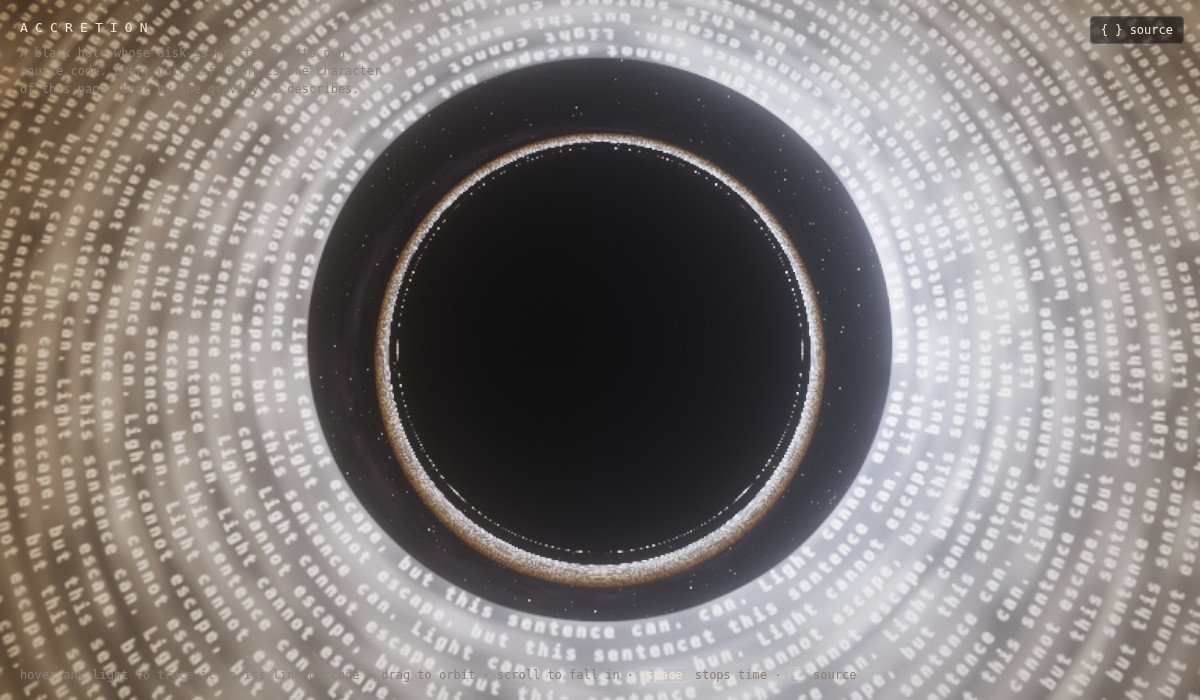
+18:15A final round: live editing (replacing the source with my own text), a top-down view, a high-DPI run, and the hero shot again.
Bashcd /tmp/pw && node shot.mjs /tmp/pw/h.png "const c=document.getElementById('code'); c.value='Light cannot escape, but this sentence can. '.repeat(400); c.dispatchEvent(new Event('input')); accretion.goal.dist=accretion.camera.dist=11; accretion.goal.el=accretion.camera.el=1.2" && node shot.mjs /tmp/pw/i.png "accretion.goal.dist=accretion.camera.dist=21; accretion.goal.az=accretion.camera.az=2.2; accretion.goal.el=accretion.camera.el=0.12" && sed -i 's/deviceScaleFactor:1/deviceScaleFactor:2/' shot.mjs && node shot.mjs /tmp/pw/j.png "window.__q=0.5" 600 400; sed -i 's/deviceScaleFactor:2/deviceScaleFactor:1/' shot.mjs
command
cd /tmp/pw && node shot.mjs /tmp/pw/h.png "const c=document.getElementById('code'); c.value='Light cannot escape, but this sentence can. '.repeat(400); c.dispatchEvent(new Event('input')); accretion.goal.dist=accretion.camera.dist=11; accretion.goal.el=accretion.camera.el=1.2" && node shot.mjs /tmp/pw/i.png "accretion.goal.dist=accretion.camera.dist=21; accretion.goal.az=accretion.camera.az=2.2; accretion.goal.el=accretion.camera.el=0.12" && sed -i 's/deviceScaleFactor:1/deviceScaleFactor:2/' shot.mjs && node shot.mjs /tmp/pw/j.png "window.__q=0.5" 600 400; sed -i 's/deviceScaleFactor:2/deviceScaleFactor:1/' shot.mjsresult, 6 lines
{"n":17599,"R":47,"ringH":0.23404255319148937,"glyphs":17,"cam":{"az":0.630078397500112,"el":1.2,"dist":11}} {"n":40563,"R":71,"ringH":0.15492957746478872,"glyphs":103,"cam":{"az":2.241541202890814,"el":0.12,"dist":21}} {"n":40563,"R":71,"ringH":0.15492957746478872,"glyphs":103,"cam":{"az":0.6668664781229621,"el":0.17,"dist":24.94216591984921}} Shell cwd was reset to ~/runRead/tmp/pw/h.png
input
{
  "file_path": "/tmp/pw/h.png"
}
result
no output
h.jpg Read/tmp/pw/i.png
input
{
  "file_path": "/tmp/pw/i.png"
}
result
no output
i.jpg Read/tmp/pw/j.png
input
{
  "file_path": "/tmp/pw/j.png"
}
result
no output
j.jpg
agent
+19:18reasoning
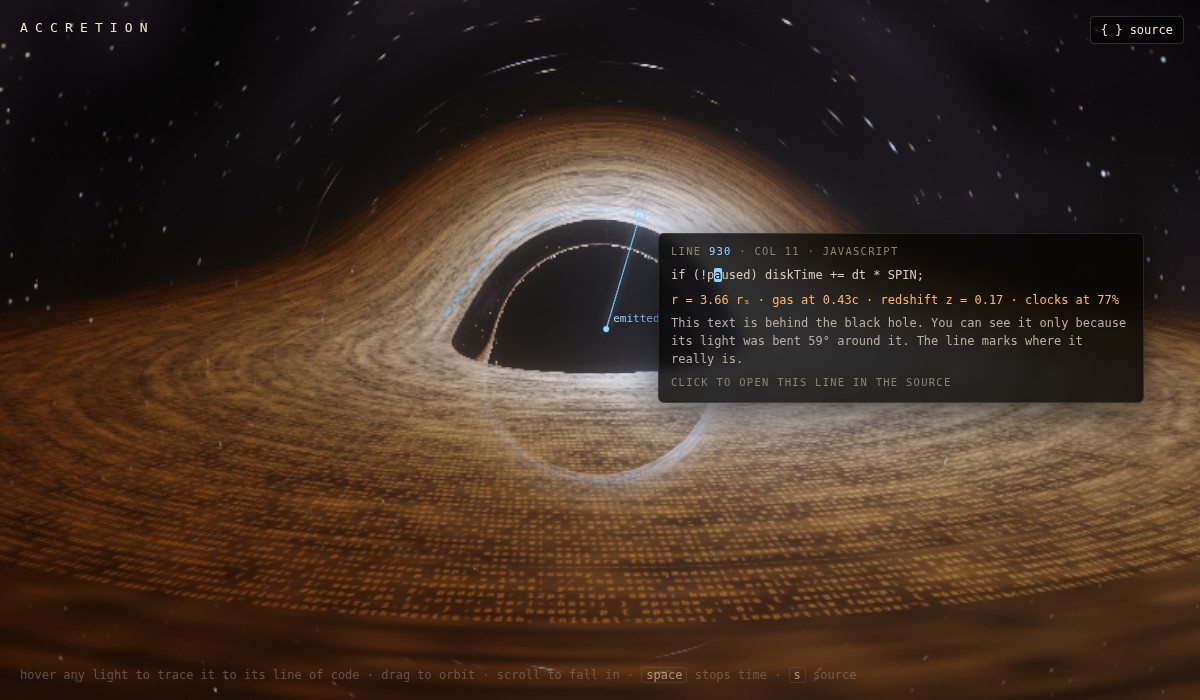
Live editing now rewrites the disk on each keystroke, and the top-down view shows text spiralling into the hole. Next I'll make the description fade out on small 600×400 embeds so it stops overlapping the disk.
Bashpython3 - <<'EOF'
command
python3 - <<'EOF' f='~/run/accretion.html'; s=open(f).read() old=" header p { margin: 6px 0 0; max-width: 31em; color: var(--dim); }" new=" header p { margin: 6px 0 0; max-width: 31em; color: var(--dim); transition: opacity 1.5s; }\n .calm header p { opacity: 0; }\n .calm footer { opacity: .55; }" assert old in s; s=s.replace(old,new) old=" if (/quiet/.test(location.hash)) document.body.classList.add('quiet');" new=""" if (/quiet/.test(location.hash)) document.body.classList.add('quiet'); // The caption has said its piece once you start exploring. const calm = () => document.body.classList.add('calm'); setTimeout(calm, 16000); addEventListener('pointerdown', calm, { once: true });""" assert old in s; s=s.replace(old,new) open(f,'w').write(s) EOF cd /tmp/pw && MOUSE=640,215 node shot.mjs /tmp/pw/k.png "accretion.goal.dist=accretion.camera.dist=21" && echo OKresult, 3 lines
{"n":40847,"R":72,"ringH":0.1527777777777778,"glyphs":103,"cam":{"az":0.6552915854459368,"el":0.17,"dist":21}} OK Shell cwd was reset to ~/runRead/tmp/pw/k.png
input
{
  "file_path": "/tmp/pw/k.png"
}
result
no output
k.jpg
agent
+20:00I built ~/run/accretion.html, a single 45 KB file with no dependencies, libraries or assets.
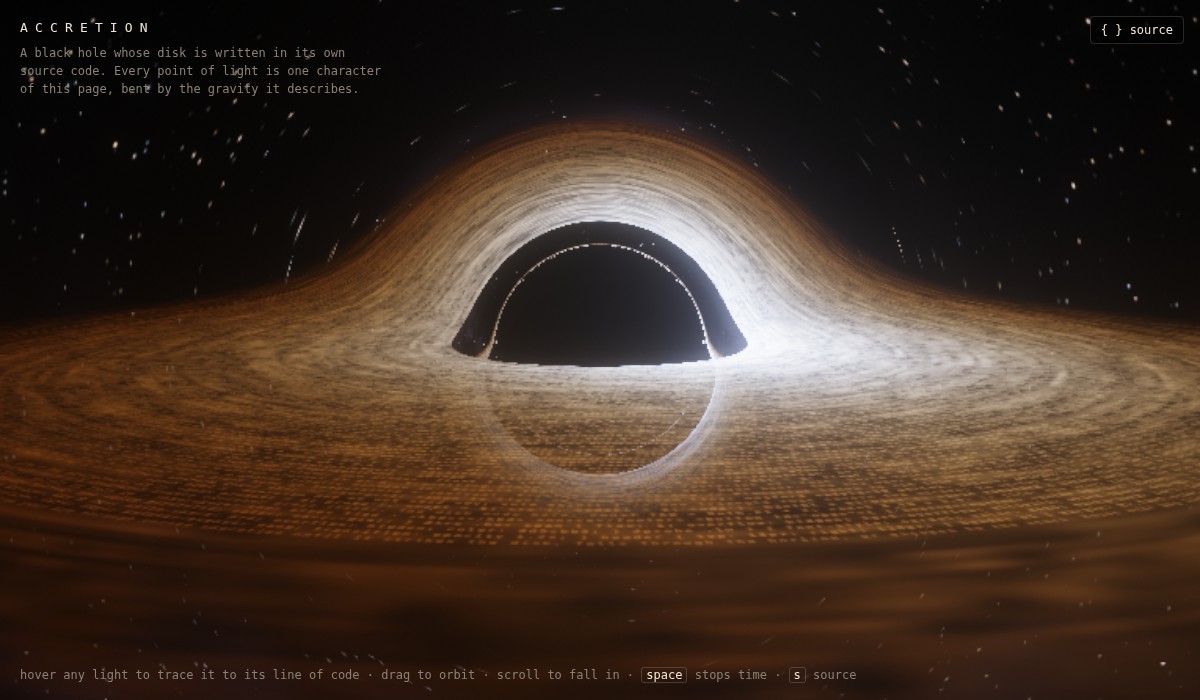
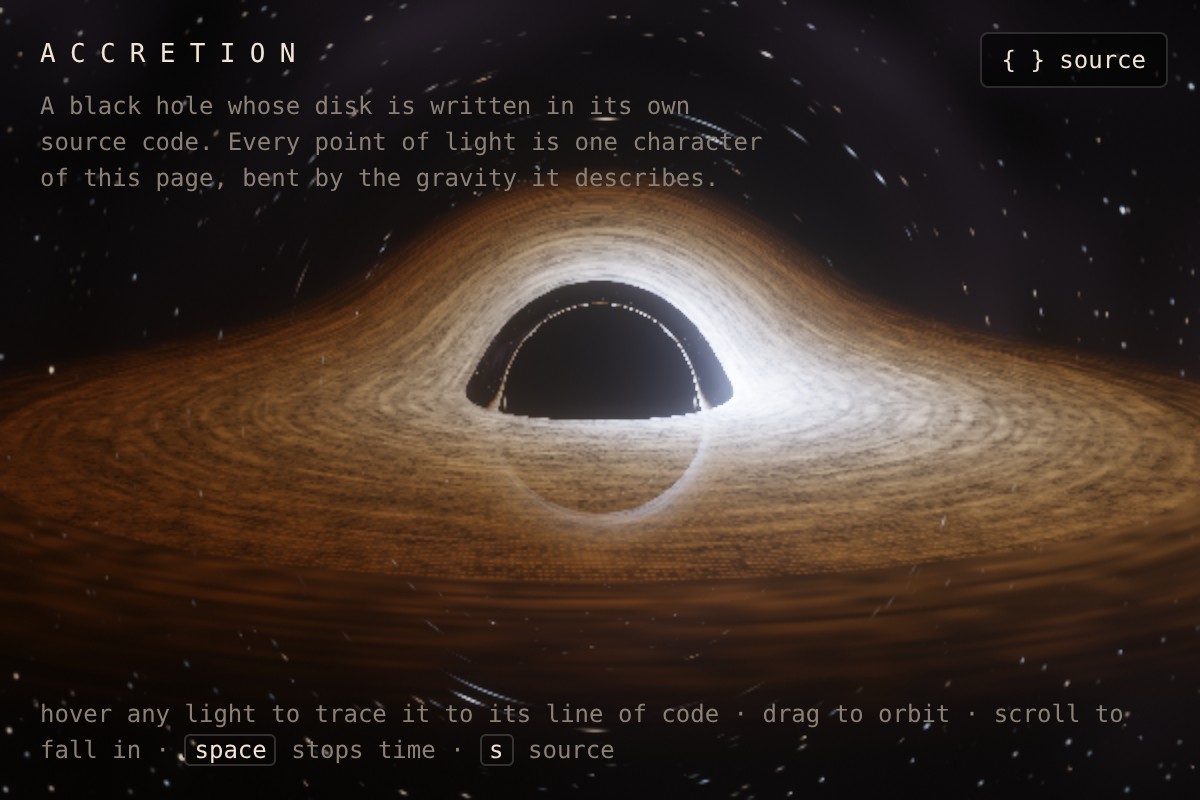
What people see first: a black hole, ray-traced in real time. Light bends over the top of the shadow, a thin photon ring circles it, and one side of the disk is bluer and brighter because that gas is moving toward you. It opens zooming in from deep space.
What they find when they look closer: the accretion disk is written in the page's own source code. The page reads its own HTML, CSS, JavaScript and shader code and lays it into rings, in reading order from the outside in. Each ring orbits at its own speed, so the inner text moves faster than the outer text.
- Hovering over any point of light traces that photon back. A card shows the file line and character it came from, plus the redshift, the gas speed and how slowly clocks run there. A line is drawn from where you see the light to where it actually came from. That source line also lights up blue wherever it appears, including the copies bent over the top of the hole.
- Zooming in makes the code readable as it orbits. The file's last comment sits on the innermost orbit, and it describes where it is ("This is the end of the file, so it orbits closest…"). The first comment, on the outermost ring, explains what the reader is looking at.
- Pressing
Sor clicking the disk opens the source. Anything you type is pulled into orbit as you type. - The physics is real, not just a look. Light paths use an exact trick from Schwarzschild geometry: the paths are computed as ordinary straight-space motion under a specific force, and they match the curved-spacetime paths exactly. The hover tool runs the same calculation on the CPU to trace back individual pixels. The numbers it shows check out (gas at 0.5c and clocks at 71% at the inner edge; the shadow is 2.6× wider than the horizon).
For embedding: host the file anywhere static (GitHub Pages, Netlify, etc.) and iframe it, for example <iframe src="…/accretion.html" style="width:100%;aspect-ratio:16/9;border:0">.
- Inside an iframe, scrolling still moves the post until the reader clicks the embed. After that, scrolling zooms.
- Adding
#quietto the URL hides all the on-screen text, for a clean hero shot. - Resolution adjusts to the GPU's speed, and rendering pauses when the embed is scrolled off screen or the tab is hidden.
What I tested: I only ran it in headless Chrome with software (CPU) rendering, at several sizes, angles and pixel densities. In those runs:
- the shaders compiled with no console errors;
- hover, highlighting, the source panel and live editing all worked;
- the GPU render and the CPU hover trace agreed on which character each pixel shows.
I haven't run it on a real GPU, in Safari or Firefox, or on an actual phone. Check speed and touch controls on your own devices before you post it.