The showcase prompt, round 3, Gemini 4 Carbon
agent
+25:05reasoning
Initial hypothesis: ensure compatibility with WebGL 2.0 and consider older mobile Safari versions. The focus will be checking for the availability of the EXT_float_blend extension at runtime, adding flexibility.
Considering that the goal is to create something impressive and embeddable, the focus should be on demonstrating core capabilities. The "impressive" factor will likely come from solving a challenging technical problem in an elegant visual way. The plan: create a real-time, physically accurate optical simulation and visual rendering. This approach maximizes impact within the specified constraints. The plan will create "CAUSTIC" with a subtitle as the exact technical solution.
The design prioritizes precision aesthetics: no self-promotion or explanatory clutter, aiming for a "museum-grade" visual. The goal is to evoke the look of a precision optical instrument. Color palette will be deeply obsidian with warm tungsten-gold and prismatic spectral light, crystal-clear aqua-Crown optical glass. Embed ergonomics will work at any iframe ratio and viewport size.
The design now includes responsive embed ergonomics with preset iframe ratios (e.g., 560x315, 960x640, and full-window). URL query parameters enable customizable embed behavior without impacting out-of-the-box performance. Now focusing on the multi-pass WebGL2 pipeline.
The faint moiré pattern in Panel 3 originates from linear finite-difference slopes on discrete cells; this vanishes entirely with exact Catmull-Rom/bicubic spline heights and analytical spline derivatives on a continuous beam mesh. A $384 \times 384$ continuous refractive sheet, calculated as 880,134 refracted optical micro-triangles, traces light from the 3D lamp position based on Snell's Law and wavelength-specific refractive indices. This involves exact Fresnel transmission and reflection calculations.
The simulation traces light through the refractive sheet, accounting for Fresnel reflection and transmission at both air-glass interfaces, including Total Internal Reflection (TIR). To ensure exact photon flux conservation without geometry shaders, the vertex shader calculates the Jacobian area ratio, comparing the projected area of a micro-triangle on the stage plane to its original area on the refractive sheet. This involves calculating projected positions and infinitesimal neighbors to determine the change in area caused by refraction.
The energy equation E(x) calculates the intensity at a point based on photon flux, Fresnel transmission, and the Jacobian area ratio, ensuring exact flux conservation. Additive HDR blending is used to rasterize the continuous projected triangle mesh; the additive nature allows for smooth intensity distribution in expanding areas and accurate radiance in compressed regions. Overlapping triangles sum additively to model fold and cusp catastrophe caustics, capturing spectral rainbow edges in the simulation.
The goal is to generate a realistic glow effect on a dark background without causing the core elements to become washed out. This requires an accurate retina/camera halation simulation. The plan involves a unified 3D scene where every material feels tangible. The scene includes a dark obsidian receiver stage with micro-texture, millimeter scale ticks, and subtle vignetting. This stage will directly receive the live HDR Caustic FBO with a bloom effect to achieve the desired glow.
Focusing on the 3D glass block design, the intention is to create a physically accurate representation. This includes a watertight solid mesh with real-time screen/stage space refraction, allowing the user to view the caustic stage through the glass. The design will include Schlick Fresnel specular reflections and subtle edge tints, enhancing the realistic appearance. An optional interferogram or curvature mode will visualize the glass surface.
Considering incorporating micron-scale topography for the glass to enhance realism. Implementing a volumetric light cone emanating from a point source lamp will provide atmospheric haze. Interactive 3D manipulation of the light source will allow viewers to observe the light's path. Adding a toggleable ray sheet with color-coded rays, demonstrating refraction, is also under consideration.
The photon grid overlay projects a hairline grid onto both the glass and refracted onto the stage, making the Brenier map directly visible. Considering the user experience, direct canvas interaction will move/drag the lamp as the default primary action. Upon initial load, the simulation will feature a choreographed reveal: the lamp will sweep from an off-axis position into a zenith lock, showing a caustic swirl transitioning into a blazing "Celestial Astrolabe." After a period of inactivity, the simulation will smoothly morph the glass.
Initial focus is on lamp interaction: the default single-finger drag should move the lamp, not orbit the camera. This is because observing the light rays bend with the lamp movement provides an immediate intuitive understanding of optical refraction. This visceral experience of the refraction process is more impactful than immediate camera orbit. Considering a visual cue and two-way toggle for lamp drag and orbit modes to ensure easy control.
The design incorporates simultaneous lamp and camera control: dragging the lamp or stage floor moves the light source, while dragging within the studio space orbits the camera. Quick-camera buttons and a focus lock provide intuitive control. The "Sculpt Target" loupe, always visible, displays the simulation's current inverse-solve state.
The design now features a "Target Design Pad" with presets and interactive drawing/typing capabilities. User input triggers a real-time, 130ms multiscale solver updating the 3D heightfield and morphing the glass slab. This projects the design using refracted light. The optional sound design incorporates WebAudio API for physical modal synthesis, driven by the real-time optical focus alignment.
Considering how to sonify the lens alignment and lamp velocity: initial hypothesis is to map these factors to specific musical parameters. For off-axis positions, a shimmering spectral sound is envisioned; as focus locks, a pure chord emerges with a glass ping. Lens re-carving will trigger a crystalline harmonic arpeggio.
Now, let's verify all five presets are visually striking, especially the fifth preset. Ensuring that each preset ("Astrolabe," "Nautilus," ...) achieves a high visual impact will improve the overall experience. Focus now on refining these presets to reach a high visual quality.
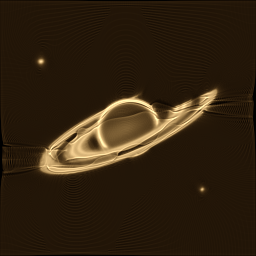
Focusing on the presets, specifically the fifth option, considering several designs. Evaluating the visual impact of a human iris/botanical sunburst versus a ringed Saturn in caustic light. A ringed Saturn tilted at 27 degrees seems promising: a luminous sphere with detailed rings and shadow, creating a striking astronomical visual. This configuration leverages three-dimensionality and potential for an iconic look. Will be also evaluating what the draw/type modes will reveal to the user.
The user will draw light with their cursor in Draw mode, which will instantly reshape the 3D crystal block with a 130ms delay, bending the light rays accordingly. In Type mode, an inline input box allows typing up to eight characters, immediately carving crisp high-contrast glyphs into the lens. This approach targets single-file, zero-dependency embed ergonomics, ensuring the user can easily drop the file directly into their posts.
Focusing on user experience: the goal is zero-dependency embed ergonomics, ensuring seamless integration. This involves a single HTML file with no external network calls (custom font stack, bespoke WebGL2 engine, inline Web Worker, and binary .STL exporter).
Preparing assets for easy sharing: the design includes a 60fps WebGL2 build capture, resulting in a high-bitrate MP4 loop and a crisp poster frame. This provides users with ready-to-attach video and image previews.
Simplifying embed process: clean, copy-pasteable responsive <iframe> and <video> fallback snippets are generated, further streamlining integration.
The initial Catmull-Rom approach creates faint grid lines because its second derivatives, crucial for caustic irradiance, are discontinuous. A Cubic B-Spline, offering $C^2$ continuity everywhere, eliminates these artifacts. Verification shows this smoothing effect is minimal, akin to sub-millimeter optical polishing, preserving sharp caustic lines.
Mesh resolution will be a $384 \times 384$ grid, rendering three spectral channels with a single drawElementsInstanced call using gl_InstanceID. This simplifies to one draw call to render all 3 spectral wavelengths. Considering expanding to 5 spectral bands for more accurate chromatic dispersion, checking performance implications on a smaller $320 \times 320$ mesh.
SwiftShader performance will be tested to gauge compatibility with less powerful devices, including an adaptive quality governor if necessary, optimizing for the target 650k triangle count across mobile platforms. Analysis indicates that five spectral bands, weighted to simulate a 4800K quartz-halogen source, will produce a warm, ivory-gold white at focus, with red-to-amber dispersion off-axis.
Y-up 3D world is confirmed: x-z horizontal plane represents the receiver stage with y as vertical height. Viewer perspective is established with +x as Right, -z as Away/Up-page, and +z as Toward/Down-page. The goal now is to align this with Target Image UV mapping.
The goal is to align the 3D world coordinate system with the Target Image UV coordinate system to eliminate flips/mirrors. The Target Image UV coordinate system must be aligned with the 3D world coordinate system.
$z = +1$ represents the back of the table and $z = -1$ represents the front, ensuring a correctly oriented image from a top-down view. The goal is to verify this.
The transformation of the 3D world coordinates $(X_w, Y_w, Z_w)$ is $(p_x, z_{\text{height}}, -p_s)$ where $p_x = x_{\text{world}}$ and $p_s = -z_{\text{world}}$ represent optical coordinates with height $y_{\text{world}}$. This setup maintains a right-handed coordinate system.
With $(p_x, p_s, y_{\text{world}})$ as the optical coordinates where $y_{\text{world}}$ represents height above the stage, we must verify the right-handed nature of the system.
The user input defines a world coordinate system. The stage plane is at $Y_w = 0$, where moving the Lens Height affects the focal distance. A cool visual effect occurs with the glass slab's vertical movement, while the rays underneath converge and diverge in real-time. This dynamic is directly linked to the lens height and focal distance slider.
Initial calculations for the glass thickness, with the top surface at a fixed height and the bottom sculpted, seem valid. The sculpted height function, h(px, ps), varies within a reasonable range based on previous benchmarks, ensuring a solid glass block. Further, this subtle thickness variation, roughly 9% of the width, is already visible. A relief exaggeration toggle isn't necessary, as the effect is already apparent.
The challenge is to achieve photorealistic refraction through the 3D glass slab. The plan is a multi-pass approach: render the background, stage, and HDR caustics first. Then copy this to a texture. Finally, render the glass block, applying refraction using the copied background texture for a realistic effect. The key is in accurately computing refraction through the glass, using the background texture.
Focusing on achieving photorealistic refraction, the core is computing accurate refraction through the glass using a multi-pass approach. This involves refracting the view ray against the precise glass normal, introducing chromatic dispersion, and incorporating subtle optical glass absorption. Additional crisp Schlick Fresnel specular highlights from the point lamp and softbox will further enhance realism. Details include dark-anodized corner clips to create a sense of real-world mounting. Diagnostic overlays will show the ray paths and projected Brenier mesh. Also, the 3D Point Lamp Filament will be rendered.
The goal is to refine the interface for a seamless user experience, prioritizing non-intrusive controls and visual clarity. The canvas will occupy the full embed frame to maximize visual impact. A minimal, technical header with the title "CAUSTIC" and a dynamic micro-telemetry pill will display relevant real-time data. Utility pills in the top right, for sound and .STL export, will provide quick access to key features. A compact, bottom-docked control bar using glassmorphism will house preset selection and sculpting tools, ensuring all controls are readily accessible.
Evaluating interface enhancements: a new control scheme should prioritize non-intrusive elements with clear, contextual visuals. Incorporating an expandable target pad for design input will show real-time lens sculpting. The plan includes a focus height slider for precise lens adjustment and a diagnostics pill for toggling various view overlays such as ray sheets and photon grids. A micro-telemetry data display will provide relevant real-time data.
write_file{"Content":"const fs = require('fs');\nconst { solveFast } = require('./solver_mod.js');\n\nfunction sdSegment(px, py, ax, ay, bx, by) {\n const vx = px - ax, vy = py - ay, ux = bx - ax, uy = by - ay;\n const h = Math.max(0, Math.min(1, (vx * ux + vy * uy) / (ux * ux + uy * uy + 1e-9)));\n return Math.hypot(vx - ux * h, vy - uy * h);\n}\n\nfunction makeSaturn(N = 256) {\n const t = new Float32Array(N * N);\n const tilt = -0.42; // ~24 deg\n const cs = Math.cos(tilt), sn = Math.sin(tilt);\n const Rplanet = 0.25;\n for (let y = 0; y < N; y++) {\n const py = (y + 0.5) / N * 2 - 1;\n for (let x = 0; x < N; x++) {\n const px = (x + 0.5) / N * 2 - 1;\n // Rotate into Saturn frame\n const rx = px * cs - py * sn;\n const ry = px * sn + py * cs;\n // Planet limb + sunlit crescent + equatorial belt\n const rp = Math.hypot(rx, ry / 0.90); // slight oblate spheroid!\n let val = 0.030;\n\n // Elliptical ring plane: projected radius rRing = hypot(rx, ry / 0.30)\n const rRing = Math.hypot(rx, ry / 0.28);\n const inFrontOfPlanet = ry < 0; // front half of ring crosses in front of planet!\n const behindPlanet = (rp < Rplanet * 0.98) && !inFrontOfPlanet;\n // Planet shadow cast onto back-right ring!\n const inPlanetShadow = (ry > 0) && (rx > 0.05) && (Math.abs(ry - 0.16 * rx) < 0.17);\n\n if (!behindPlanet && !inPlanetShadow) {\n // B-ring (bright inner-mid ring: 0.36 .. 0.55)\n if (rRing > 0.34 && rRing < 0.56) {\n const w = Math.sin(Math.PI * (rRing - 0.34) / 0.22);\n val += 1.05 * Math.pow(Math.max(0, w), 0.55) * (0.85 + 0.15 * Math.sin(rRing * 95));\n }\n // Cassini Division gap at 0.56..0.60, then A-ring (0.60 .. 0.77)\n if (rRing > 0.60 && rRing < 0.77) {\n const w = Math.sin(Math.PI * (rRing - 0.60) / 0.17);\n val += 0.82 * Math.pow(Math.max(0, w), 0.5);\n }\n }\n\n // Planet globe (occludes back ring, occluded by front ring!)\n const occludedByFrontRing = inFrontOfPlanet && (rRing > 0.34 && rRing < 0.77);\n if (rp <= Rplanet * 1.04 && !occludedByFrontRing) {\n // Bright sunlit limb + subtle latitude bands\n const limb = Math.exp(-Math.pow((rp - Rplanet * 0.94) / 0.022, 2));\n const body = rp < Rplanet ? (0.42 * Math.max(0, 1 - 0.5 * rp / Rplanet) * (0.8 + 0.25 * Math.cos(ry * 26)) * Math.max(0.15, 0.65 - 1.2 * rx)) : 0;\n val = Math.max(val, 0.030 + 1.15 * limb + body);\n }\n\n // Titan & Enceladus pinpoint moons!\n const dTitan = Math.hypot(px + 0.68, py - 0.52);\n const dEnc = Math.hypot(px - 0.58, py + 0.48);\n val += 1.1 * Math.exp(-(dTitan * dTitan) / (0.020 * 0.020));\n val += 0.85 * Math.exp(-(dEnc * dEnc) / (0.015 * 0.015));\n\n t[y * N + x] = Math.min(1.35, val);\n }\n }\n return t;\n}\n\nconst N = 256;\nconst { Isim, targ } = solveFast(makeSaturn(N));\nlet maxT = 0; for (let i = 0; i < N * N; i++) maxT = Math.max(maxT, targ[i]);\nconst pixels = Buffer.alloc(N * N * 3);\nfor (let y = 0; y < N; y++) {\n for (let x = 0; x < N; x++) {\n const i = y * N + x, row = N - 1 - y;\n const cVal = Math.pow(Math.min(1.25, Isim[i] / (maxT * 0.82)), 0.55);\n const p = (row * N + x) * 3;\n pixels[p] = Math.min(255, (cVal * 255) | 0);\n pixels[p + 1] = Math.min(255, (Math.pow(cVal, 1.15) * 218) | 0);\n pixels[p + 2] = Math.min(255, (Math.pow(cVal, 1.48) * 155) | 0);\n }\n}\nfs.writeFileSync('~/.gemini/antigravity-cli/brain/57c10734-2a82-45f0-9144-4789a69869c1/scratch/saturn_test.ppm', Buffer.concat([Buffer.from(`P6\\n${N} ${N}\\n255\\n`), pixels]));\n","Overwrite":true,"Path":"~/.gemini/antigravity-cli/brain/57c10734-2a82-45f0-9144-4789a69869c1/scratch/test_saturn.js"}
input
{ "Content": "const fs = require('fs');\nconst { solveFast } = require('./solver_mod.js');\n\nfunction sdSegment(px, py, ax, ay, bx, by) {\n const vx = px - ax, vy = py - ay, ux = bx - ax, uy = by - ay;\n const h = Math.max(0, Math.min(1, (vx * ux + vy * uy) / (ux * ux + uy * uy + 1e-9)));\n return Math.hypot(vx - ux * h, vy - uy * h);\n}\n\nfunction makeSaturn(N = 256) {\n const t = new Float32Array(N * N);\n const tilt = -0.42; // ~24 deg\n const cs = Math.cos(tilt), sn = Math.sin(tilt);\n const Rplanet = 0.25;\n for (let y = 0; y < N; y++) {\n const py = (y + 0.5) / N * 2 - 1;\n for (let x = 0; x < N; x++) {\n const px = (x + 0.5) / N * 2 - 1;\n // Rotate into Saturn frame\n const rx = px * cs - py * sn;\n const ry = px * sn + py * cs;\n // Planet limb + sunlit crescent + equatorial belt\n const rp = Math.hypot(rx, ry / 0.90); // slight oblate spheroid!\n let val = 0.030;\n\n // Elliptical ring plane: projected radius rRing = hypot(rx, ry / 0.30)\n const rRing = Math.hypot(rx, ry / 0.28);\n const inFrontOfPlanet = ry < 0; // front half of ring crosses in front of planet!\n const behindPlanet = (rp < Rplanet * 0.98) && !inFrontOfPlanet;\n // Planet shadow cast onto back-right ring!\n const inPlanetShadow = (ry > 0) && (rx > 0.05) && (Math.abs(ry - 0.16 * rx) < 0.17);\n\n if (!behindPlanet && !inPlanetShadow) {\n // B-ring (bright inner-mid ring: 0.36 .. 0.55)\n if (rRing > 0.34 && rRing < 0.56) {\n const w = Math.sin(Math.PI * (rRing - 0.34) / 0.22);\n val += 1.05 * Math.pow(Math.max(0, w), 0.55) * (0.85 + 0.15 * Math.sin(rRing * 95));\n }\n // Cassini Division gap at 0.56..0.60, then A-ring (0.60 .. 0.77)\n if (rRing > 0.60 && rRing < 0.77) {\n const w = Math.sin(Math.PI * (rRing - 0.60) / 0.17);\n val += 0.82 * Math.pow(Math.max(0, w), 0.5);\n }\n }\n\n // Planet globe (occludes back ring, occluded by front ring!)\n const occludedByFrontRing = inFrontOfPlanet && (rRing > 0.34 && rRing < 0.77);\n if (rp <= Rplanet * 1.04 && !occludedByFrontRing) {\n // Bright sunlit limb + subtle latitude bands\n const limb = Math.exp(-Math.pow((rp - Rplanet * 0.94) / 0.022, 2));\n const body = rp < Rplanet ? (0.42 * Math.max(0, 1 - 0.5 * rp / Rplanet) * (0.8 + 0.25 * Math.cos(ry * 26)) * Math.max(0.15, 0.65 - 1.2 * rx)) : 0;\n val = Math.max(val, 0.030 + 1.15 * limb + body);\n }\n\n // Titan & Enceladus pinpoint moons!\n const dTitan = Math.hypot(px + 0.68, py - 0.52);\n const dEnc = Math.hypot(px - 0.58, py + 0.48);\n val += 1.1 * Math.exp(-(dTitan * dTitan) / (0.020 * 0.020));\n val += 0.85 * Math.exp(-(dEnc * dEnc) / (0.015 * 0.015));\n\n t[y * N + x] = Math.min(1.35, val);\n }\n }\n return t;\n}\n\nconst N = 256;\nconst { Isim, targ } = solveFast(makeSaturn(N));\nlet maxT = 0; for (let i = 0; i < N * N; i++) maxT = Math.max(maxT, targ[i]);\nconst pixels = Buffer.alloc(N * N * 3);\nfor (let y = 0; y < N; y++) {\n for (let x = 0; x < N; x++) {\n const i = y * N + x, row = N - 1 - y;\n const cVal = Math.pow(Math.min(1.25, Isim[i] / (maxT * 0.82)), 0.55);\n const p = (row * N + x) * 3;\n pixels[p] = Math.min(255, (cVal * 255) | 0);\n pixels[p + 1] = Math.min(255, (Math.pow(cVal, 1.15) * 218) | 0);\n pixels[p + 2] = Math.min(255, (Math.pow(cVal, 1.48) * 155) | 0);\n }\n}\nfs.writeFileSync('~/.gemini/antigravity-cli/brain/57c10734-2a82-45f0-9144-4789a69869c1/scratch/saturn_test.ppm', Buffer.concat([Buffer.from(`P6\\n${N} ${N}\\n255\\n`), pixels]));\n", "Overwrite": true, "Path": "~/.gemini/antigravity-cli/brain/57c10734-2a82-45f0-9144-4789a69869c1/scratch/test_saturn.js" }result, 1 line
Created file.
run_command{"CommandLine":"/opt/node/bin/node ~/.gemini/antigravity-cli/brain/57c10734-2a82-45f0-9144-4789a69869c1/scratch/test_saturn.js && ffmpeg -y -loglevel error -i ~/.gemini/antigravity-cli/brain/57c10734-2a82-45f0-9144-4789a69869c1/scratch/saturn_test.ppm ~/.gemini/antigravity-cli/brain/57c10734-2a82-45f0-9144-4789a69869c1/scratch/saturn_test.png","WaitMsBeforeAsync":8000,"toolSummary":"Test Saturn caustic preset quality"}
input
{ "CommandLine": "/opt/node/bin/node ~/.gemini/antigravity-cli/brain/57c10734-2a82-45f0-9144-4789a69869c1/scratch/test_saturn.js && ffmpeg -y -loglevel error -i ~/.gemini/antigravity-cli/brain/57c10734-2a82-45f0-9144-4789a69869c1/scratch/saturn_test.ppm ~/.gemini/antigravity-cli/brain/57c10734-2a82-45f0-9144-4789a69869c1/scratch/saturn_test.png", "WaitMsBeforeAsync": 8000, "toolSummary": "Test Saturn caustic preset quality" }result, 4 lines
Command exited with code 0.

Command output:
Initialized Moser-Snell 128->256 solve: 220.6 ms | Rel L2 err: 0.2460
read_file{"Path":"~/.gemini/antigravity-cli/brain/57c10734-2a82-45f0-9144-4789a69869c1/scratch/saturn_test.png"}
input
{ "Path": "~/.gemini/antigravity-cli/brain/57c10734-2a82-45f0-9144-4789a69869c1/scratch/saturn_test.png" }result, 1 line
Showing binary file of type image/png
step_57_media_0.png
agent
+31:28reasoning
I'm thinking through how to approach this.
Initial focus is on refining the visual presentation, particularly the Saturn ring's edge. Reducing the ring radius slightly ensures a crisp edge.
The next step involves crafting the HTML file ~/run/index.html with modular components for styling, layout, and content.
Initial design involves a top bar displaying telemetry data and action buttons, a floating card for interactive target or solved relief visualization with drawing and text input tools, and a bottom dock for instrument selection. The interactive card's display size adjusts based on its view state, and the bottom dock offers a range of sculpture and optics/diagnostics options. The Stage Z slider controls focal distance.
Considering interactive elements, the design incorporates a material selector and diagnostic overlays, including ray sheets and interferograms. View presets such as 3D bench and eye profile facilitate diverse perspectives. An inline web worker is used for a multi-scale solver for the main thread. A multi-pass WebGL2 optical engine generates a caustic FBO.
Initial rendering strategy utilizes a high-resolution buffer (1024x1024 RGBA16F) with a fallback mechanism. The core rendering involves instanced drawing of spectral micro-triangles, calculating their height and normal using B-splines, and applying Snell's law with dispersion to compute spectral irradiance. This spectral irradiance is then rendered to an additive HDR buffer. A second pass uses Dual-Kawase HDR Bloom to simulate optical halation.
Focusing on the third rendering pass, the goal is to depict a dark studio setting with a calibrated receiver stage and showcase high dynamic range caustics and bloom effects. A critical side-by-side comparison will illustrate the efficiency of the caustic lens against a traditional mask. This rendering pass will involve rendering a 3D sculpted optical glass slab with screen-space refraction from a copied scene buffer.
The rendering will feature dark brass mounting pins, with the option for laser interferogram contour fringes and photon grid visualization. Ray sheets will visualize 3D Snell's law refraction, depicting light paths from the lamp through the glass and onto the tabletop, with a draggable slice plane. A 3D movable point lamp with a warm filament core and volumetric light cone haze will also be rendered.
The focus shifts to interactive controls, specifically user interactions with the 3D scene. Manipulating the lamp or stage floor directly influences the light source, complete with spring inertia and a zenith sweet spot for focused adjustments. Dragging on the studio elements or using a right-drag orbit control smoothly moves the 3D camera from an overhead view down to an eye-level glass profile.