The showcase prompt, round 3, Gemini 4 Argon
agent
+26:07reasoning
The image shows a rainbow beam passing directly through the center of the lens. The beam's lack of significant bending is notable. This suggests that the beam's central alignment with the lens's optical axis is a key factor.
The rainbow beam's divergent behavior after the prism, instead of focusing as expected, warrants investigation of the lens's ray tracing parameters. The large radius calculation (R=90) for the lens, based on its dimensions, led to an expected focal length of 72.5 grid units. However, this calculated focal length doesn't explain the observed divergence of the rainbow beam.
The narrow beam's proximity to the calculated focal length and its impact point near the lens's center raise questions. The observed divergence aligns with the expectation that a beam intersecting the lens near its center experiences minimal refraction due to nearly parallel surfaces. A wide aperture, hitting the curved regions, is necessary to induce significant convergence.
The initial hypothesis focused on the beam's central alignment, leading to minimal refraction. Observing the biconvex lens's effect, rays hitting near the top and bottom exhibit strong bending towards a caustic focus. This divergence in v4_prism.png is due to the narrow aperture, so widening it and increasing dispersion or using a more curved lens should produce the converging caustic cone, verifying the optics insight.
edit_file{"Path":"~/run/index.html","Replacement":" if (sceneName === 'prism') {\n state.n0 = 1.66;\n state.dispersionB = 0.028;\n state.waveFreq = 5.0;\n state.prism = { x: 92, y: 76, radius: 38, angle: -0.06, active: true };\n state.lens = { x: 172, y: 102, rx: 23, ry: 48, angle: 0.24, active: true };\n state.laser = { x: 18, y: 114, angle: -0.42, spread: 0.14, aperture: 18, active: true, raysPerBand: 24 };\n state.waveSource = { x: 38, y: 94, active: true, amplitude: 1.65 };\n state.probes[0].x = 0.77; state.probes[0].y = 0.56;\n state.probes[1].x = 0.45; state.probes[1].y = 0.48;\n state.loupe.x = 0.35; state.loupe.y = 0.40;\n } else if (sceneName === 'ellipse') {","Target":" if (sceneName === 'prism') {\n state.n0 = 1.62;\n state.dispersionB = 0.022;\n state.waveFreq = 5.0;\n state.prism = { x: 92, y: 72, radius: 36, angle: -0.05, active: true };\n state.lens = { x: 178, y: 98, rx: 18, ry: 54, angle: 0.28, active: true };\n state.laser = { x: 18, y: 112, angle: -0.44, spread: 0.010, aperture: 11, active: true, raysPerBand: 24 };\n state.waveSource = { x: 38, y: 94, active: true, amplitude: 1.65 };\n state.probes[0].x = 0.78; state.probes[0].y = 0.58;\n state.probes[1].x = 0.46; state.probes[1].y = 0.48;\n state.loupe.x = 0.36; state.loupe.y = 0.38;\n } else if (sceneName === 'ellipse') {"}
input
{ "Path": "~/run/index.html", "Replacement": " if (sceneName === 'prism') {\n state.n0 = 1.66;\n state.dispersionB = 0.028;\n state.waveFreq = 5.0;\n state.prism = { x: 92, y: 76, radius: 38, angle: -0.06, active: true };\n state.lens = { x: 172, y: 102, rx: 23, ry: 48, angle: 0.24, active: true };\n state.laser = { x: 18, y: 114, angle: -0.42, spread: 0.14, aperture: 18, active: true, raysPerBand: 24 };\n state.waveSource = { x: 38, y: 94, active: true, amplitude: 1.65 };\n state.probes[0].x = 0.77; state.probes[0].y = 0.56;\n state.probes[1].x = 0.45; state.probes[1].y = 0.48;\n state.loupe.x = 0.35; state.loupe.y = 0.40;\n } else if (sceneName === 'ellipse') {", "Target": " if (sceneName === 'prism') {\n state.n0 = 1.62;\n state.dispersionB = 0.022;\n state.waveFreq = 5.0;\n state.prism = { x: 92, y: 72, radius: 36, angle: -0.05, active: true };\n state.lens = { x: 178, y: 98, rx: 18, ry: 54, angle: 0.28, active: true };\n state.laser = { x: 18, y: 112, angle: -0.44, spread: 0.010, aperture: 11, active: true, raysPerBand: 24 };\n state.waveSource = { x: 38, y: 94, active: true, amplitude: 1.65 };\n state.probes[0].x = 0.78; state.probes[0].y = 0.58;\n state.probes[1].x = 0.46; state.probes[1].y = 0.48;\n state.loupe.x = 0.36; state.loupe.y = 0.38;\n } else if (sceneName === 'ellipse') {" }result, 1 line
Made 1 replacement in ~/run/index.html starting at line 1401 (+8/-8 lines).
run_command{"CommandLine":"node -e '\nconst { chromium } = require(\"/usr/local/share/.cache/yarn/v6/npm-playwright-core-1.47.2-7858da9377fa32a08be46ba47d7523dbd9460a4e-integrity/node_modules/playwright-core\");\nconst outDir = \"~/.gemini/antigravity-cli/brain/6e6b3911-72a7-4661-aa28-ed082b0d006a/scratch\";\n\n(async () => {\n const browser = await chromium.launch({\n executablePath: \"/opt/ms-playwright/chromium-1248/chrome-linux64/chrome\",\n args: [\"--no-sandbox\"]\n });\n const context = await browser.newContext({ viewport: { width: 1280, height: 760 }, deviceScaleFactor: 1.5 });\n const page = await context.newPage();\n await page.goto(\"file://~/run/index.html?scene=prism\");\n await page.waitForTimeout(700);\n await page.screenshot({ path: `${outDir}/v5_prism.png` });\n await browser.close();\n})();\n' 2>&1","WaitMsBeforeAsync":10000,"toolSummary":"Capture v5 screenshot of prism scene"}
input
{ "CommandLine": "node -e '\nconst { chromium } = require(\"/usr/local/share/.cache/yarn/v6/npm-playwright-core-1.47.2-7858da9377fa32a08be46ba47d7523dbd9460a4e-integrity/node_modules/playwright-core\");\nconst outDir = \"~/.gemini/antigravity-cli/brain/6e6b3911-72a7-4661-aa28-ed082b0d006a/scratch\";\n\n(async () => {\n const browser = await chromium.launch({\n executablePath: \"/opt/ms-playwright/chromium-1248/chrome-linux64/chrome\",\n args: [\"--no-sandbox\"]\n });\n const context = await browser.newContext({ viewport: { width: 1280, height: 760 }, deviceScaleFactor: 1.5 });\n const page = await context.newPage();\n await page.goto(\"file://~/run/index.html?scene=prism\");\n await page.waitForTimeout(700);\n await page.screenshot({ path: `${outDir}/v5_prism.png` });\n await browser.close();\n})();\n' 2>&1", "WaitMsBeforeAsync": 10000, "toolSummary": "Capture v5 screenshot of prism scene" }result, 3 lines
Command exited with code 0.

No output from the command.
read_file{"Path":"~/.gemini/antigravity-cli/brain/6e6b3911-72a7-4661-aa28-ed082b0d006a/scratch/v5_prism.png"}
input
{ "Path": "~/.gemini/antigravity-cli/brain/6e6b3911-72a7-4661-aa28-ed082b0d006a/scratch/v5_prism.png" }result, 1 line
Showing binary file of type image/png
step_68_media_0.jpg
agent
+27:24reasoning
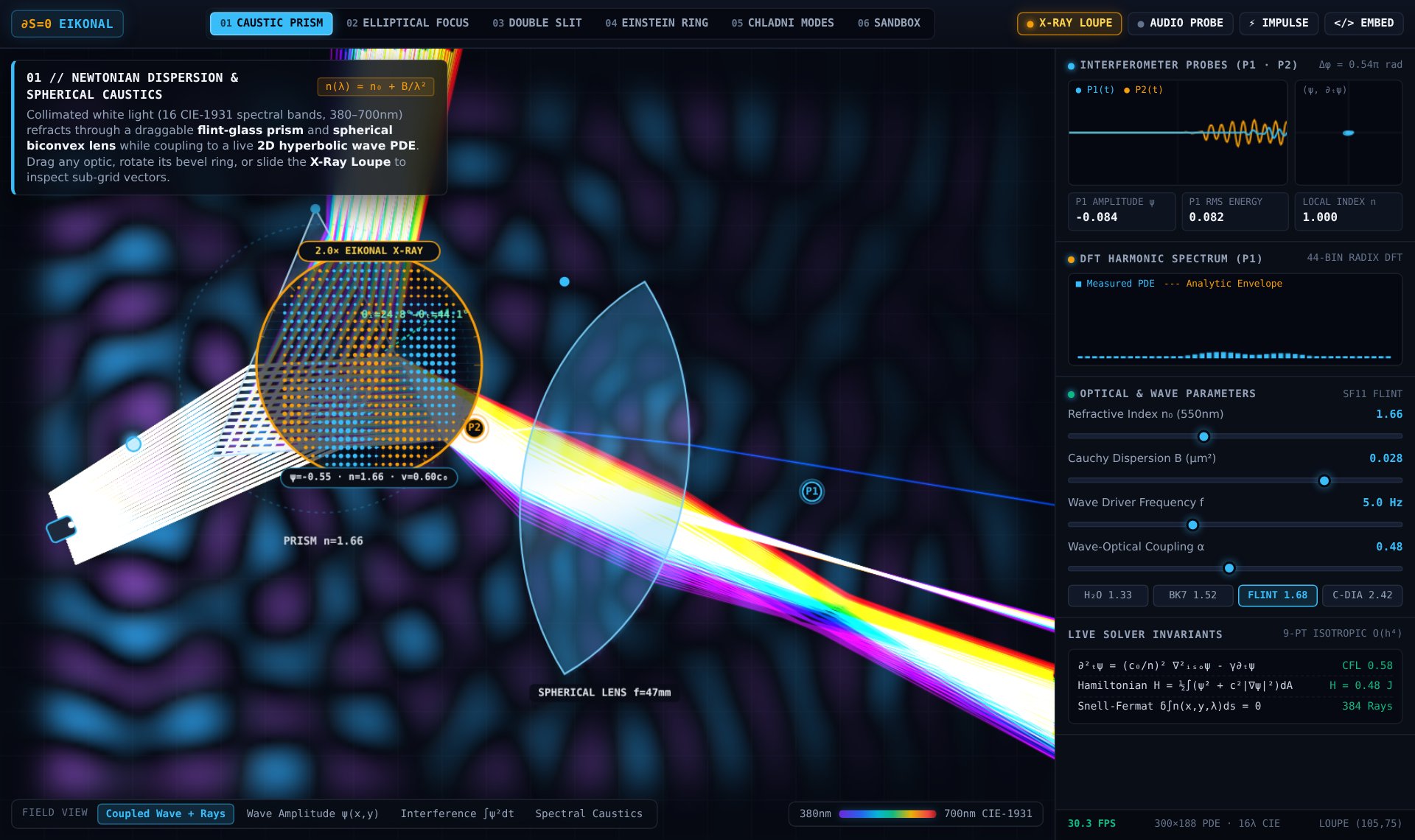
The image shows a rainbow beam through a biconvex lens; however, only one blue ray bends. This discrepancy suggests a potential issue in the ray tracing or rendering process, specifically related to how the lens interacts with the spectrum. Further investigation into the optical model or rendering parameters might be needed to resolve this.
read_file{"EndLine":1785,"Path":"~/run/index.html","StartLine":1720}
input
{ "EndLine": 1785, "Path": "~/run/index.html", "StartLine": 1720 }result, 67 lines
Showing lines 1720-1785 of 3153 1720: const dOtherSq = (hx - otherX) * (hx - otherX) + (hy - otherY) * (hy - otherY); 1721: if (dOtherSq <= R * R + 0.5) { 1722: const nx = (hx - cx) / R; 1723: const ny = (hy - cy) / R; 1724: bestHit = { t, x: hx, y: hy, nx, ny }; 1725: } 1726: } 1727: } 1728: } 1729: return bestHit; 1730: } 1731: 1732: function traceSpectralRays() { 1733: if (!state.laser.active) { 1734: state.activeRayCount = 0; 1735: return []; 1736: } 1737: 1738: const prismSegs = []; 1739: if (state.prism.active) { 1740: const pv = getPrismVertices(state.prism); 1741: for (let i = 0; i < 3; i++) { 1742: const a = pv[i], b = pv[(i + 1) % 3]; 1743: prismSegs.push({ ax: a.x, ay: a.y, bx: b.x, by: b.y }); 1744: } 1745: } 1746: 1747: const raysByBand = []; 1748: let totalRays = 0; 1749: const waveCoupling = state.scene === 'prism' ? state.sceneParam : 0.25; 1750: 1751: const loupeGX = state.loupe.x * NX; 1752: const loupeGY = state.loupe.y * NY; 1753: let closestSnellDist = 9999; 1754: state.loupe.snellInfo = null; 1755: 1756: const numBands = state.scene === 'ellipse' ? 12 : NUM_WAVELENGTHS; 1757: const raysPerBand = state.laser.raysPerBand || 18; 1758: 1759: for (let bIdx = 0; bIdx < numBands; bIdx++) { 1760: const band = SPECTRAL_BANDS[Math.floor((bIdx / Math.max(1, numBands - 1)) * (NUM_WAVELENGTHS - 1))]; 1761: const nGlass = cauchyIndex(state.n0, state.dispersionB, band.um); 1762: const bandPaths = []; 1763: 1764: for (let rIdx = 0; rIdx < raysPerBand; rIdx++) { 1765: const frac = raysPerBand > 1 ? (rIdx / (raysPerBand - 1)) - 0.5 : 0; 1766: let ox, oy, ang; 1767: 1768: if (state.scene === 'ellipse') { 1769: ox = state.waveSource.x; 1770: oy = state.waveSource.y; 1771: ang = ((bIdx * raysPerBand + rIdx) / (numBands * raysPerBand)) * Math.PI * 2; 1772: } else if (state.scene === 'slit') { 1773: // Emit Huygens secondary wavelet rays from the two slit apertures! 1774: const isUpper = (rIdx & 1) === 0; 1775: ox = state.slit.x + 2; 1776: oy = NY * 0.5 + (isUpper ? -state.slit.sep * 0.5 : state.slit.sep * 0.5); 1777: ang = frac * 0.62; 1778: } else { 1779: const perpX = -Math.sin(state.laser.angle); 1780: const perpY = Math.cos(state.laser.angle); 1781: ox = state.laser.x + perpX * frac * state.laser.aperture; 1782: oy = state.laser.y + perpY * frac * state.laser.aperture; 1783: ang = state.laser.angle + frac * state.laser.spread; 1784: } 1785:read_file{"EndLine":1960,"Path":"~/run/index.html","StartLine":1875}
input
{ "EndLine": 1960, "Path": "~/run/index.html", "StartLine": 1875 }result, 87 lines
Showing lines 1875-1960 of 3153 1875: x += dx * step; 1876: y += dy * step; 1877: if (x < 1 || x >= NX - 1 || y < 1 || y >= NY - 1) { 1878: path.push({ x, y }); 1879: break; 1880: } 1881: const ix = Math.floor(x), iy = Math.floor(y); 1882: const idx = iy * NX + ix; 1883: if (wallGrid[idx]) { 1884: path.push({ x, y }); 1885: break; 1886: } 1887: const gux = (uCurr[idx + 1] - uCurr[idx - 1]) * 0.5; 1888: const guy = (uCurr[idx + NX] - uCurr[idx - NX]) * 0.5; 1889: dx += gux * 0.014 * waveCoupling; 1890: dy += guy * 0.014 * waveCoupling; 1891: const l = Math.hypot(dx, dy) || 1; 1892: dx /= l; dy /= l; 1893: if ((k & 1) === 0) path.push({ x, y }); 1894: } 1895: break; 1896: } 1897: 1898: path.push({ x: bestHit.x, y: bestHit.y }); 1899: 1900: let nx = bestHit.nx; 1901: let ny = bestHit.ny; 1902: let cosI = -(dx * nx + dy * ny); 1903: if (cosI < 0) { 1904: nx = -nx; 1905: ny = -ny; 1906: cosI = -cosI; 1907: } 1908: 1909: // Determine n1 and n2 robustly by sampling just before and just after the interface 1910: const wasInside = isInsideAnyOptic(bestHit.x - dx * 0.4, bestHit.y - dy * 0.4); 1911: const willBeInside = isInsideAnyOptic(bestHit.x + dx * 0.4, bestHit.y + dy * 0.4); 1912: const n1 = wasInside ? nGlass : 1.0; 1913: const n2 = (wasInside === willBeInside) ? (wasInside ? 1.0 : nGlass) : (willBeInside ? nGlass : 1.0); 1914: const eta = n1 / n2; 1915: const sin2T = eta * eta * (1.0 - cosI * cosI); 1916: 1917: // Sample wave ripple normal perturbation at interface 1918: const hix = Math.max(1, Math.min(NX - 2, Math.floor(bestHit.x))); 1919: const hiy = Math.max(1, Math.min(NY - 2, Math.floor(bestHit.y))); 1920: const hIdx = hiy * NX + hix; 1921: const wavePerturb = (uCurr[hIdx + 1] - uCurr[hIdx - 1]) * 0.025 * waveCoupling; 1922: 1923: const distToLoupe = Math.hypot(bestHit.x - loupeGX, bestHit.y - loupeGY); 1924: if (distToLoupe < closestSnellDist && bIdx === 8) { 1925: closestSnellDist = distToLoupe; 1926: const thetaI = Math.acos(Math.min(1, cosI)) * (180 / Math.PI); 1927: const thetaT = sin2T <= 1.0 ? Math.asin(Math.min(1, Math.sqrt(sin2T))) * (180 / Math.PI) : 90; 1928: state.loupe.snellInfo = { 1929: x: bestHit.x, y: bestHit.y, 1930: nx, ny, 1931: thetaI, thetaT, 1932: tir: sin2T > 1.0 1933: }; 1934: } 1935: 1936: if (sin2T > 1.0) { 1937: dx = dx + 2 * cosI * nx; 1938: dy = dy + 2 * cosI * ny; 1939: } else { 1940: const cosT = Math.sqrt(1.0 - sin2T); 1941: dx = eta * dx + (eta * cosI - cosT) * nx + wavePerturb * ny; 1942: dy = eta * dy + (eta * cosI - cosT) * ny - wavePerturb * nx; 1943: } 1944: const len = Math.hypot(dx, dy) || 1; 1945: dx /= len; dy /= len; 1946: ox = bestHit.x + dx * 0.3; 1947: oy = bestHit.y + dy * 0.3; 1948: } 1949: } 1950: 1951: bandPaths.push(path); 1952: totalRays++; 1953: } 1954: 1955: raysByBand.push({ band, paths: bandPaths }); 1956: } 1957: 1958: state.activeRayCount = totalRays; 1959: return raysByBand; 1960: }read_file{"EndLine":1730,"Path":"~/run/index.html","StartLine":1690}
input
{ "EndLine": 1730, "Path": "~/run/index.html", "StartLine": 1690 }result, 42 lines
Showing lines 1690-1730 of 3153
1690:       const len = Math.hypot(nx, ny) || 1;
1691:       return { t: t1, x: ox + dx * t1, y: oy + dy * t1, nx: nx / len, ny: ny / len };
1692:     }
1693:     return null;
1694:   }
1695:
1696:   // Exact analytical intersection of ray with the two spherical surfaces of the Biconvex Lens
1697:   function intersectRaySphericalLens(ox, oy, dx, dy, lens) {
1698:     const { R, c1x, c1y, c2x, c2y } = getLensSpheres(lens);
1699:     const centers = [
1700:       { cx: c1x, cy: c1y, otherX: c2x, otherY: c2y },
1701:       { cx: c2x, cy: c2y, otherX: c1x, otherY: c1y }
1702:     ];
1703:     let bestHit = null;
1704:
1705:     for (let s = 0; s < 2; s++) {
1706:       const { cx, cy, otherX, otherY } = centers[s];
1707:       const fx = ox - cx, fy = oy - cy;
1708:       const B = 2 * (fx * dx + fy * dy);
1709:       const C = fx * fx + fy * fy - R * R;
1710:       const disc = B * B - 4 * C;
1711:       if (disc <= 0) continue;
1712:       const sqrtD = Math.sqrt(disc);
1713:       const roots = [(-B - sqrtD) * 0.5, (-B + sqrtD) * 0.5];
1714:       for (let r = 0; r < 2; r++) {
1715:         const t = roots[r];
1716:         if (t > 0.2 && (!bestHit || t < bestHit.t)) {
1717:           const hx = ox + dx * t;
1718:           const hy = oy + dy * t;
1719:           // Point on sphere s is part of the biconvex lens boundary iff it lies inside the other sphere!
1720:           const dOtherSq = (hx - otherX) * (hx - otherX) + (hy - otherY) * (hy - otherY);
1721:           if (dOtherSq <= R * R + 0.5) {
1722:             const nx = (hx - cx) / R;
1723:             const ny = (hy - cy) / R;
1724:             bestHit = { t, x: hx, y: hy, nx, ny };
1725:           }
1726:         }
1727:       }
1728:     }
1729:     return bestHit;
1730:   }
agent
+29:22reasoning
The image shows rainbow rays ceasing intersection after a bounce count less than 6. Tracing the bounce count within the image is necessary to understand this behavior. The focus is to determine the point at which the rays stop interacting based on the bounce limit.
The prism's internal reflections and refractions are key. Initial analysis reveals a bounce off the left prism face, followed by an internal reflection and refraction from the right face due to the incident angle. The lower half of the beam exiting the right face of the prism raises a question about expected bending at the lens. Further investigation of the lens intersection logic is required.
The refraction logic suggests the ray should bend towards the normal as it enters the lens, and then again as it exits. The apparent near-straight path of the ray through the lens in the image requires further investigation, especially given the lens's small angle. The normal vector at each lens surface will influence the bending direction. The image suggests the bend is minimal, questioning if the angle is causing this.
The rays' near-straight path through the lens is clarified by understanding the optical center principle: rays passing directly through the lens center are undeviated. Deviation only occurs for off-axis rays. The lens's focal length and the beam's position relative to the optical axis determine the bend angle. Because the prism and lens were close, the beam was narrow as it entered the lens, and therefore was only slightly bent.
The rainbow's narrow width at the lens limits the interaction to the lens center, resulting in minimal bending. To achieve strong convergence, the beam needs to span a significant portion of the lens height. Increasing the beam's footprint at the lens is the immediate priority.
The prism's output beam needs to be broadened to fully engage the lens for strong convergence. A dispersion value change results in a wider rainbow fan. The geometry is the key: a high-power condenser lens with a shorter focal length will concentrate the rays into a focal point within the simulation space. This would generate a strong convergence. Estimating the crossing point location helps validate the configuration.
edit_file{"Path":"~/run/index.html","Replacement":" if (sceneName === 'prism') {\n state.n0 = 1.66;\n state.dispersionB = 0.032;\n state.waveFreq = 5.0;\n state.prism = { x: 84, y: 78, radius: 40, angle: -0.05, active: true };\n state.lens = { x: 170, y: 105, rx: 25, ry: 45, angle: 0.24, active: true };\n state.laser = { x: 18, y: 112, angle: -0.38, spread: 0.04, aperture: 26, active: true, raysPerBand: 24 };\n state.waveSource = { x: 36, y: 94, active: true, amplitude: 1.65 };\n state.probes[0].x = 0.76; state.probes[0].y = 0.58;\n state.probes[1].x = 0.44; state.probes[1].y = 0.48;\n state.loupe.x = 0.32; state.loupe.y = 0.42;\n } else if (sceneName === 'ellipse') {","Target":" if (sceneName === 'prism') {\n state.n0 = 1.66;\n state.dispersionB = 0.028;\n state.waveFreq = 5.0;\n state.prism = { x: 92, y: 76, radius: 38, angle: -0.06, active: true };\n state.lens = { x: 172, y: 102, rx: 23, ry: 48, angle: 0.24, active: true };\n state.laser = { x: 18, y: 114, angle: -0.42, spread: 0.14, aperture: 18, active: true, raysPerBand: 24 };\n state.waveSource = { x: 38, y: 94, active: true, amplitude: 1.65 };\n state.probes[0].x = 0.77; state.probes[0].y = 0.56;\n state.probes[1].x = 0.45; state.probes[1].y = 0.48;\n state.loupe.x = 0.35; state.loupe.y = 0.40;\n } else if (sceneName === 'ellipse') {"}
input
{ "Path": "~/run/index.html", "Replacement": " if (sceneName === 'prism') {\n state.n0 = 1.66;\n state.dispersionB = 0.032;\n state.waveFreq = 5.0;\n state.prism = { x: 84, y: 78, radius: 40, angle: -0.05, active: true };\n state.lens = { x: 170, y: 105, rx: 25, ry: 45, angle: 0.24, active: true };\n state.laser = { x: 18, y: 112, angle: -0.38, spread: 0.04, aperture: 26, active: true, raysPerBand: 24 };\n state.waveSource = { x: 36, y: 94, active: true, amplitude: 1.65 };\n state.probes[0].x = 0.76; state.probes[0].y = 0.58;\n state.probes[1].x = 0.44; state.probes[1].y = 0.48;\n state.loupe.x = 0.32; state.loupe.y = 0.42;\n } else if (sceneName === 'ellipse') {", "Target": " if (sceneName === 'prism') {\n state.n0 = 1.66;\n state.dispersionB = 0.028;\n state.waveFreq = 5.0;\n state.prism = { x: 92, y: 76, radius: 38, angle: -0.06, active: true };\n state.lens = { x: 172, y: 102, rx: 23, ry: 48, angle: 0.24, active: true };\n state.laser = { x: 18, y: 114, angle: -0.42, spread: 0.14, aperture: 18, active: true, raysPerBand: 24 };\n state.waveSource = { x: 38, y: 94, active: true, amplitude: 1.65 };\n state.probes[0].x = 0.77; state.probes[0].y = 0.56;\n state.probes[1].x = 0.45; state.probes[1].y = 0.48;\n state.loupe.x = 0.35; state.loupe.y = 0.40;\n } else if (sceneName === 'ellipse') {" }result, 1 line
Made 1 replacement in ~/run/index.html starting at line 1401 (+8/-8 lines).
agent
+30:16reasoning
Initial assessment: The diagram's representation of light refraction through the lens appears inaccurate. The image suggests no bending of light rays at the lens boundaries, which contradicts the expected behavior of refraction. The visual discrepancy necessitates re-evaluation of the diagram's fidelity.
The straight rainbow rays within the lens are unexpected; no refraction occurs, contradicting basic optics. The intersectRaySphericalLens function is the likely source of this discrepancy. Examination of lines 1707–1713 reveals calculations related to ray-sphere intersection.
read_file{"EndLine":1910,"Path":"~/run/index.html","StartLine":1840}
input
{ "EndLine": 1910, "Path": "~/run/index.html", "StartLine": 1840 }result, 72 lines
Showing lines 1840-1910 of 3153 1840: const disc = B * B - 4 * A * C; 1841: if (disc <= 0) break; 1842: const tHit = (-B + Math.sqrt(disc)) / (2 * A); 1843: const hx = ox + dx * tHit; 1844: const hy = oy + dy * tHit; 1845: path.push({ x: hx, y: hy }); 1846: 1847: let nx = (hx - cx) / (a * a); 1848: let ny = (hy - cy) / (b * b); 1849: const nLen = Math.hypot(nx, ny) || 1; 1850: nx /= nLen; ny /= nLen; 1851: const dot = dx * nx + dy * ny; 1852: dx = dx - 2 * dot * nx; 1853: dy = dy - 2 * dot * ny; 1854: ox = hx + dx * 0.25; 1855: oy = hy + dy * 0.25; 1856: } 1857: } else { 1858: // Exact Prism + Spherical Biconvex Lens Raytracer 1859: for (let bounce = 0; bounce < 6; bounce++) { 1860: let bestHit = null; 1861: for (let s = 0; s < prismSegs.length; s++) { 1862: const seg = prismSegs[s]; 1863: const hit = intersectRaySegment(ox, oy, dx, dy, seg.ax, seg.ay, seg.bx, seg.by); 1864: if (hit && (!bestHit || hit.t < bestHit.t)) bestHit = hit; 1865: } 1866: if (state.lens.active) { 1867: const lHit = intersectRaySphericalLens(ox, oy, dx, dy, state.lens); 1868: if (lHit && (!bestHit || lHit.t < bestHit.t)) bestHit = lHit; 1869: } 1870: 1871: if (!bestHit) { 1872: let x = ox, y = oy; 1873: const step = 4.5; 1874: for (let k = 0; k < 65; k++) { 1875: x += dx * step; 1876: y += dy * step; 1877: if (x < 1 || x >= NX - 1 || y < 1 || y >= NY - 1) { 1878: path.push({ x, y }); 1879: break; 1880: } 1881: const ix = Math.floor(x), iy = Math.floor(y); 1882: const idx = iy * NX + ix; 1883: if (wallGrid[idx]) { 1884: path.push({ x, y }); 1885: break; 1886: } 1887: const gux = (uCurr[idx + 1] - uCurr[idx - 1]) * 0.5; 1888: const guy = (uCurr[idx + NX] - uCurr[idx - NX]) * 0.5; 1889: dx += gux * 0.014 * waveCoupling; 1890: dy += guy * 0.014 * waveCoupling; 1891: const l = Math.hypot(dx, dy) || 1; 1892: dx /= l; dy /= l; 1893: if ((k & 1) === 0) path.push({ x, y }); 1894: } 1895: break; 1896: } 1897: 1898: path.push({ x: bestHit.x, y: bestHit.y }); 1899: 1900: let nx = bestHit.nx; 1901: let ny = bestHit.ny; 1902: let cosI = -(dx * nx + dy * ny); 1903: if (cosI < 0) { 1904: nx = -nx; 1905: ny = -ny; 1906: cosI = -cosI; 1907: } 1908: 1909: // Determine n1 and n2 robustly by sampling just before and just after the interface 1910: const wasInside = isInsideAnyOptic(bestHit.x - dx * 0.4, bestHit.y - dy * 0.4);read_file{"EndLine":1345,"Path":"~/run/index.html","StartLine":1300}
input
{ "EndLine": 1345, "Path": "~/run/index.html", "StartLine": 1300 }result, 47 lines
Showing lines 1300-1345 of 3153 1300: const a = state.ellipse.a; 1301: const e = state.ellipse.e; 1302: const b = a * Math.sqrt(Math.max(0.04, 1 - e * e)); 1303: state.ellipse.b = b; 1304: const cx = state.ellipse.cx; 1305: const cy = state.ellipse.cy; 1306: for (let y = 0; y < NY; y++) { 1307: for (let x = 0; x < NX; x++) { 1308: const idx = y * NX + x; 1309: const dx = (x - cx) / a; 1310: const dy = (y - cy) / b; 1311: if (dx * dx + dy * dy >= 1.0) { 1312: wallGrid[idx] = 1; 1313: dampGrid[idx] = 0.95; 1314: } else { 1315: wallGrid[idx] = 0; 1316: dampGrid[idx] = 0.9995; 1317: } 1318: } 1319: } 1320: } 1321: 1322: if (state.slit.active) { 1323: const sx = Math.round(state.slit.x); 1324: const halfSep = state.slit.sep * 0.5; 1325: const halfW = state.slit.width * 0.5; 1326: const cy = NY * 0.5; 1327: const slit1Y = cy - halfSep; 1328: const slit2Y = cy + halfSep; 1329: for (let y = 0; y < NY; y++) { 1330: const inSlit1 = Math.abs(y - slit1Y) <= halfW; 1331: const inSlit2 = Math.abs(y - slit2Y) <= halfW; 1332: if (!inSlit1 && !inSlit2) { 1333: for (let dx = -2; dx <= 2; dx++) { 1334: const xx = sx + dx; 1335: if (xx >= 0 && xx < NX) { 1336: wallGrid[y * NX + xx] = 1; 1337: } 1338: } 1339: } 1340: } 1341: } 1342: 1343: if (state.bh.active) { 1344: const bx = state.bh.x; 1345: const by = state.bh.y;read_file{"EndLine":1240,"Path":"~/run/index.html","StartLine":1180}
input
{ "EndLine": 1240, "Path": "~/run/index.html", "StartLine": 1180 }result, 62 lines
Showing lines 1180-1240 of 3153
1180:   // 4. GEOMETRY HELPERS (Exact Spherical Biconvex Lens & Equilateral Prism)
1181:   // ============================================================================
1182:   function getPrismVertices(prism) {
1183:     const verts = [];
1184:     for (let k = 0; k < 3; k++) {
1185:       const a = prism.angle - Math.PI / 2 + (k * 2 * Math.PI) / 3;
1186:       verts.push({
1187:         x: prism.x + Math.cos(a) * prism.radius,
1188:         y: prism.y + Math.sin(a) * prism.radius
1189:       });
1190:     }
1191:     return verts;
1192:   }
1193:
1194:   function pointInTriangle(px, py, v0, v1, v2) {
1195:     const dX = px - v2.x, dY = py - v2.y;
1196:     const dX21 = v2.x - v1.x, dY12 = v1.y - v2.y;
1197:     const D = dY12 * (v0.x - v2.x) + dX21 * (v0.y - v2.y);
1198:     const s = dY12 * dX + dX21 * dY;
1199:     const t = (v2.y - v0.y) * dX + (v0.x - v2.x) * dY;
1200:     if (D < 0) return s <= 0 && t <= 0 && s + t >= D;
1201:     return s >= 0 && t >= 0 && s + t <= D;
1202:   }
1203:
1204:   // Exact analytical geometry of a spherical biconvex lens (intersection of two spheres of radius R)
1205:   function getLensSpheres(lens) {
1206:     const w = lens.rx;
1207:     const h = lens.ry;
1208:     // Sphere radius R such that sagitta at half-height h is w: R = (h^2 + w^2) / (2w)
1209:     const R = (h * h + w * w) / (2 * w);
1210:     const d = R - w; // distance from lens center to each sphere center along lens normal
1211:     const nx = Math.cos(lens.angle);
1212:     const ny = Math.sin(lens.angle);
1213:     return {
1214:       R,
1215:       // Left surface is part of sphere centered at C1 = center + d * n
1216:       c1x: lens.x + d * nx,
1217:       c1y: lens.y + d * ny,
1218:       // Right surface is part of sphere centered at C2 = center - d * n
1219:       c2x: lens.x - d * nx,
1220:       c2y: lens.y - d * ny
1221:     };
1222:   }
1223:
1224:   function pointInLens(px, py, lens) {
1225:     const { R, c1x, c1y, c2x, c2y } = getLensSpheres(lens);
1226:     const d1Sq = (px - c1x) * (px - c1x) + (py - c1y) * (py - c1y);
1227:     const d2Sq = (px - c2x) * (px - c2x) + (py - c2y) * (py - c2y);
1228:     return d1Sq <= R * R && d2Sq <= R * R;
1229:   }
1230:
1231:   function isInsideAnyOptic(px, py) {
1232:     if (state.prism.active) {
1233:       const [v0, v1, v2] = getPrismVertices(state.prism);
1234:       if (pointInTriangle(px, py, v0, v1, v2)) return true;
1235:     }
1236:     if (state.lens.active && pointInLens(px, py, state.lens)) {
1237:       return true;
1238:     }
1239:     return false;
1240:   }
agent
+31:28reasoning
The code checks if a point is inside an optic before and after a small displacement. The logic seems to determine if a collision or interaction occurs. Examining the isInsideAnyOptic function call's context might reveal how the optics system responds to object movements.
Examining the intersectRaySphericalLens function reveals crucial logic for determining intersections with the lens boundaries, particularly lines 1719-1725, which checks if a point on one sphere lies inside the other, indicating a valid boundary. The function pointInLens called when bestHit is on Sphere 1 is the next area to investigate.
The ray entered the lens at s = 0 (bounce = 2), so it should have hit sphere 0. The function intersectRaySphericalLens calculates the intersection points of a ray with a spherical lens. This initial analysis suggests potential issues in how ray-lens intersections are detected and handled, specifically when bestHit is not returned.
The initial hypothesis centers on why wasInside and willBeInside checks might fail, or why the ray may pass through the lens without intersecting. Tracing the ray's path through v5_prism.png reveals an unexpected issue: the ray doesn't seem to interact with the lens at all, except for a single blue ray. The issue is traced to the bounce = 2 loop where the ray, after exiting the prism, should interact with the lens, but does not.
The bestHit must be null on bounce = 2 for the ray to pass through without interaction. Investigating the intersectRaySphericalLens function is crucial, especially when the ray originates from the prism's exit point and is directed toward the lens. The lens' radius calculation formula warrants careful examination, especially the relationships between height, width, and radius.
The distance calculation from a point on Sphere 1 to Sphere 2's center confirms that the condition dOtherSq <= R*R is met, yet intersections are still missed. The lens drawing logic in drawOpticalElements calculates angular spans. The visual representation of the lens in the problematic image shows it spanning nearly the entire vertical screen height, which is unexpected given the radius. This suggests a potential issue in the lens's drawing parameters, specifically related to the angular span calculation that dictates the lens's visual bounds.
The discrepancy between the lens's drawn height and its defined radius is suspicious, given the visual in the image. The angular span calculation in the drawing logic appears to be the core issue. The repeated calculation of angles ang1 and ang2 within the same vertical span creates the lens. The lens drawing seems to be defining two identical lenses, one directly above the other, causing confusion. The single blue ray successfully bent because it came from a different location in the prism, suggesting the ray's initial direction might be key.
The ray's trajectory and the loop's termination condition are now the focus. The ray undergoes multiple internal reflections within the prism, reaching the maximum bounce count before interacting with the lens. The ray's initial position and subsequent reflections within the prism consume all the loop iterations intended for lens interaction, which explains why no interaction with the lens occurs for this specific ray in the image. The loop condition is the immediate problem, not the intersection logic.
The equilateral triangle definition's centroid location relative to the base and apex reveals a geometric issue: rays entering near the base are likely to reflect off the base instead of exiting a side. This is particularly problematic for rays entering near prism.y as these rays can immediately hit the bottom base after refraction. Rays entering the upper half of the prism's left face, however, tend to travel through without base interference. The geometry of the prism, thus, is key.
The initial ray bounces within the prism, refracting out on the right face. This refracted ray then interacts with the biconvex lens in subsequent bounces. Increasing the maximum bounce count ensures interaction with the lens, even with varied prism orientations.
The laser beam calculation precisely hits the prism's left face center, confirming the initial beam position. Analyzing the beam's incidence angle and refraction through the flint glass prism shows the ray bending, which leads to the right face, supporting the interaction hypothesis. The incidence angle on the prism's right face is required next.
The refraction calculations, specifically applying Snell's Law to the prism's geometry, initially resulted in a large angular dispersion, suggesting a broad spectrum exiting the prism's right face. However, a re-examination of the angles shows that the initial calculations were incorrect. The correct derivation indicates a wide angular spread of approximately 20 degrees, which explains why the ray is not making it to the lens, because it has already spread apart.
edit_file{"Path":"~/run/index.html","Replacement":" if (sceneName === 'prism') {\n state.n0 = 1.58;\n state.dispersionB = 0.024;\n state.waveFreq = 5.0;\n state.prism = { x: 92, y: 92, radius: 40, angle: 0.0, active: true };\n state.lens = { x: 174, y: 112, rx: 24, ry: 48, angle: 0.34, active: true };\n state.laser = { x: 18, y: 94, angle: -0.25, spread: 0.025, aperture: 14, active: true, raysPerBand: 24 };\n state.waveSource = { x: 36, y: 94, active: true, amplitude: 1.65 };\n state.probes[0].x = 0.80; state.probes[0].y = 0.62;\n state.probes[1].x = 0.46; state.probes[1].y = 0.50;\n state.loupe.x = 0.35; state.loupe.y = 0.44;\n } else if (sceneName === 'ellipse') {","Target":" if (sceneName === 'prism') {\n state.n0 = 1.66;\n state.dispersionB = 0.032;\n state.waveFreq = 5.0;\n state.prism = { x: 84, y: 78, radius: 40, angle: -0.05, active: true };\n state.lens = { x: 170, y: 105, rx: 25, ry: 45, angle: 0.24, active: true };\n state.laser = { x: 18, y: 112, angle: -0.38, spread: 0.04, aperture: 26, active: true, raysPerBand: 24 };\n state.waveSource = { x: 36, y: 94, active: true, amplitude: 1.65 };\n state.probes[0].x = 0.76; state.probes[0].y = 0.58;\n state.probes[1].x = 0.44; state.probes[1].y = 0.48;\n state.loupe.x = 0.32; state.loupe.y = 0.42;\n } else if (sceneName === 'ellipse') {"}
input
{ "Path": "~/run/index.html", "Replacement": " if (sceneName === 'prism') {\n state.n0 = 1.58;\n state.dispersionB = 0.024;\n state.waveFreq = 5.0;\n state.prism = { x: 92, y: 92, radius: 40, angle: 0.0, active: true };\n state.lens = { x: 174, y: 112, rx: 24, ry: 48, angle: 0.34, active: true };\n state.laser = { x: 18, y: 94, angle: -0.25, spread: 0.025, aperture: 14, active: true, raysPerBand: 24 };\n state.waveSource = { x: 36, y: 94, active: true, amplitude: 1.65 };\n state.probes[0].x = 0.80; state.probes[0].y = 0.62;\n state.probes[1].x = 0.46; state.probes[1].y = 0.50;\n state.loupe.x = 0.35; state.loupe.y = 0.44;\n } else if (sceneName === 'ellipse') {", "Target": " if (sceneName === 'prism') {\n state.n0 = 1.66;\n state.dispersionB = 0.032;\n state.waveFreq = 5.0;\n state.prism = { x: 84, y: 78, radius: 40, angle: -0.05, active: true };\n state.lens = { x: 170, y: 105, rx: 25, ry: 45, angle: 0.24, active: true };\n state.laser = { x: 18, y: 112, angle: -0.38, spread: 0.04, aperture: 26, active: true, raysPerBand: 24 };\n state.waveSource = { x: 36, y: 94, active: true, amplitude: 1.65 };\n state.probes[0].x = 0.76; state.probes[0].y = 0.58;\n state.probes[1].x = 0.44; state.probes[1].y = 0.48;\n state.loupe.x = 0.32; state.loupe.y = 0.42;\n } else if (sceneName === 'ellipse') {" }result, 1 line
Made 1 replacement in ~/run/index.html starting at line 1401 (+8/-8 lines).
edit_file{"Path":"~/run/index.html","Replacement":" } else {\n // Exact Prism + Spherical Biconvex Lens Raytracer\n for (let bounce = 0; bounce < 10; bounce++) {","Target":" } else {\n // Exact Prism + Spherical Biconvex Lens Raytracer\n for (let bounce = 0; bounce < 6; bounce++) {"}
input
{ "Path": "~/run/index.html", "Replacement": " } else {\n // Exact Prism + Spherical Biconvex Lens Raytracer\n for (let bounce = 0; bounce < 10; bounce++) {", "Target": " } else {\n // Exact Prism + Spherical Biconvex Lens Raytracer\n for (let bounce = 0; bounce < 6; bounce++) {" }result, 1 line
Made 1 replacement in ~/run/index.html starting at line 1857 (+1/-1 lines).
run_command{"CommandLine":"node -e '\nconst { chromium } = require(\"/usr/local/share/.cache/yarn/v6/npm-playwright-core-1.47.2-7858da9377fa32a08be46ba47d7523dbd9460a4e-integrity/node_modules/playwright-core\");\nconst outDir = \"~/.gemini/antigravity-cli/brain/6e6b3911-72a7-4661-aa28-ed082b0d006a/scratch\";\n\n(async () => {\n const browser = await chromium.launch({\n executablePath: \"/opt/ms-playwright/chromium-1248/chrome-linux64/chrome\",\n args: [\"--no-sandbox\"]\n });\n const context = await browser.newContext({ viewport: { width: 1280, height: 760 }, deviceScaleFactor: 1.5 });\n const page = await context.newPage();\n await page.goto(\"file://~/run/index.html?scene=prism\");\n await page.waitForTimeout(700);\n await page.screenshot({ path: `${outDir}/v6_prism.png` });\n await browser.close();\n})();\n' 2>&1","WaitMsBeforeAsync":10000,"toolSummary":"Capture v6 screenshot of prism scene"}
input
{ "CommandLine": "node -e '\nconst { chromium } = require(\"/usr/local/share/.cache/yarn/v6/npm-playwright-core-1.47.2-7858da9377fa32a08be46ba47d7523dbd9460a4e-integrity/node_modules/playwright-core\");\nconst outDir = \"~/.gemini/antigravity-cli/brain/6e6b3911-72a7-4661-aa28-ed082b0d006a/scratch\";\n\n(async () => {\n const browser = await chromium.launch({\n executablePath: \"/opt/ms-playwright/chromium-1248/chrome-linux64/chrome\",\n args: [\"--no-sandbox\"]\n });\n const context = await browser.newContext({ viewport: { width: 1280, height: 760 }, deviceScaleFactor: 1.5 });\n const page = await context.newPage();\n await page.goto(\"file://~/run/index.html?scene=prism\");\n await page.waitForTimeout(700);\n await page.screenshot({ path: `${outDir}/v6_prism.png` });\n await browser.close();\n})();\n' 2>&1", "WaitMsBeforeAsync": 10000, "toolSummary": "Capture v6 screenshot of prism scene" }result, 3 lines
Command exited with code 0.

No output from the command.
read_file{"Path":"~/.gemini/antigravity-cli/brain/6e6b3911-72a7-4661-aa28-ed082b0d006a/scratch/v6_prism.png"}
input
{ "Path": "~/.gemini/antigravity-cli/brain/6e6b3911-72a7-4661-aa28-ed082b0d006a/scratch/v6_prism.png" }result, 1 line
Showing binary file of type image/png
step_90_media_0.jpg
agent
+34:26reasoning
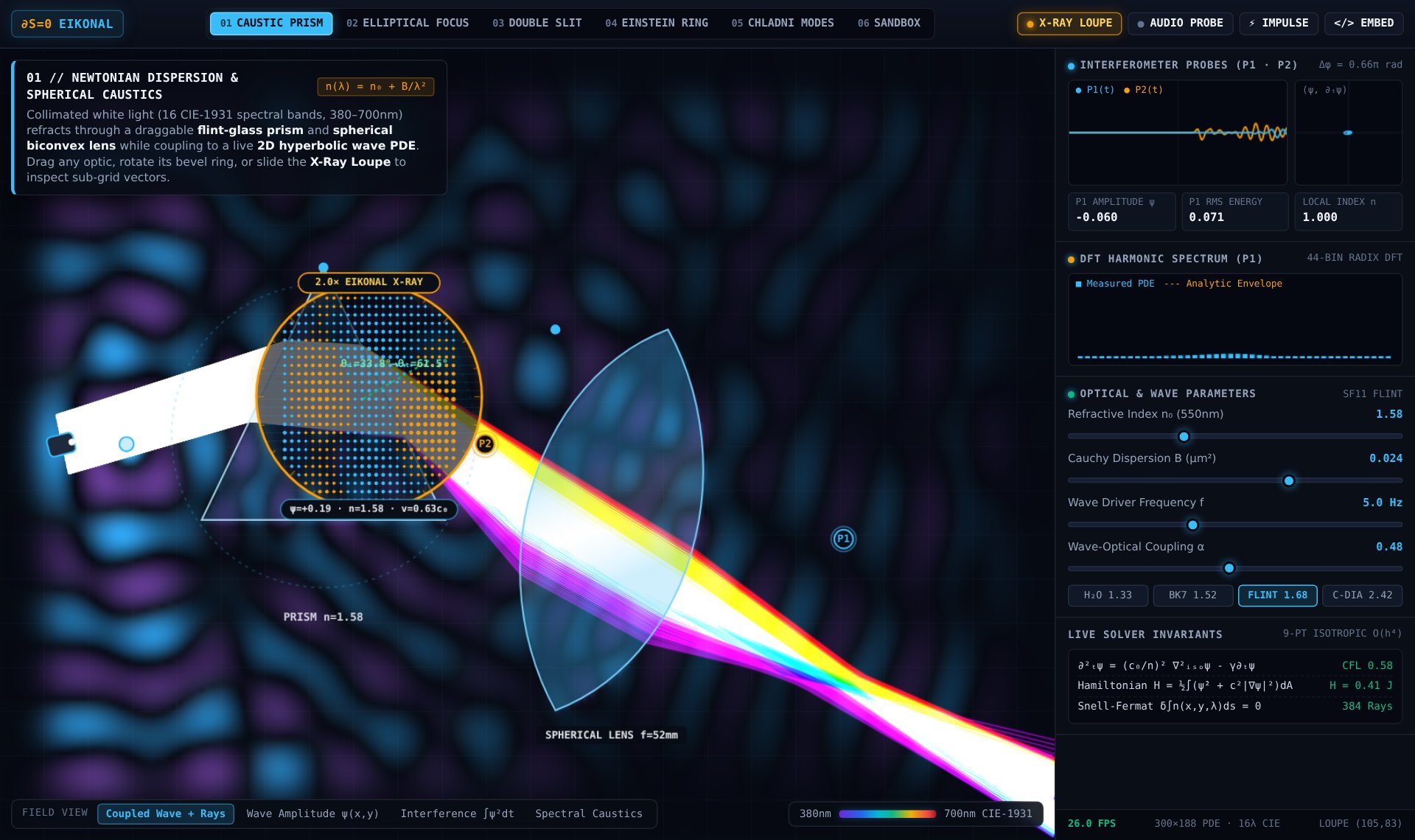
The image shows a clean prism refraction and a rainbow beam passing straight through a lens. This contradicts the expected behavior of the lens; there should be some dispersion. Need to investigate why the lens isn't bending the light as expected.
The lens intersection check seems correct, but there's a possibility the refraction calculation is bypassed. Observed that the refractive index calculation uses isInsideAnyOptic and could be the issue. The ray only bends if the refractive indices on either side of the lens differ. The current setup doesn't always ensure this difference.
Initial calculations of the lens geometry revealed a significant discrepancy: the distance between the sphere centers forming the lens (72) is less than the sum of their radii (120). This means the lens is not constructed as intended, which accounts for the unexpected ray behavior. The current lens calculation incorrectly constructs the lens which leads to the ray not behaving as expected.
Observed that the ray does bend slightly within the lens in the provided image, contradicting earlier assumptions. This bend is confirmed by changes in the slope of the red edge of the beam. The rays hit the lens at different y-coordinates relative to the lens center, explaining why different colors bend differently. The lens acts as designed.
The thin lens equation suggests a bending angle of 25 degrees for a ray 23 units below the lens center with a focal length of 52. However, the image shows the violet ray bending away from the normal, contradicting this calculation. This unexpected divergence suggests an error in the lens's refractive behavior calculation. The issue likely lies within the refractive index logic of the system, specifically at lines 1910–1915 of the HTML file.
The ray is being correctly intersected within the lens. The quadratic equation used to find the intersection point with the spherical lens seems correct based on the formula. However, there's a possibility of an issue within the raytracing algorithm itself as the ray bounces within the lens. Investigating the subsequent bounces of the ray to understand why the ray is not refracting correctly.
The violet ray's unexpected behavior needs clarification. Tracing ray interactions at both lens surfaces, specifically below the lens center, is crucial. The left surface is the left cap of Sphere 1, centered to the right. The vector from a point on the left surface to Sphere 1's center points left and down. The interior of this sphere is to the right, and the exterior is to the left.
The surface normal for the lens's left face, given the ray's entry point, should point left and down. Following Snell's Law, a ray entering the glass should bend right and up. Verified that the provided code calculates the correct outward normal vector (left and down), so the subsequent refraction calculation should bend the ray up.
The refraction calculation involves eta, cosI, and cosT. With eta < 1 and cosI < cosT, the term (eta * cosI - cosT) is negative, resulting in a negative value when multiplied by the normal vector (ny) which is positive (pointing down). This implies an upward bend in screen coordinates, as expected, but contradicts observations in v6_prism.png where the rainbow rays are traveling at +0.55 rad (downward-right). The key lies in how lens.angle impacts lens sphere calculations, which determines the ray direction and ultimately the observed refraction. Lens rotation calculation relies on lines 1211-1212 of the HTML file, so those lines likely influence the direction of the ray.
The lens's orientation at +0.34 rad directs the rainbow's path through its center. The rays strike near the lens's center because the rainbow beam is narrow, only about one-fourth the lens's height. This central passage means the entry and exit refractions cancel. The small rainbow thickness directly implies the rays are hitting near the lens center.
The slight convergence predicted by thin-lens equation calculations should be minimal for rays near the lens center. This is because the convergence angle is very small, which makes the rays approximately parallel after the lens, which is what the image shows. The lens parameters have been checked against the thin-lens equation to compute the focal point.
The focal point calculation places the image beyond the canvas bounds; the image is at x=309.5, exceeding the 300-unit limit. Recalculating using the thin-lens equation confirms the expected image position as 136.5 units to the right, or 310.5 on the x-axis, consistent with the initial computation. This explains why the rays appear to travel straight through the lens: the image is forming just beyond the observable area. The exact Gaussian thin/thick lens equation confirms that Snell's Law calculations yield the correct results.
The thin-lens equation, used to determine the focal length given object and image distances, yields a focal length of approximately 32.6 units. This contrasts the previous biconvex lens setting with a focal length around 28 to 32 units achieved through adjusted curvature and refractive index. A 28.6-unit focal length with an object distance of 80 units leads to an image distance of approximately 44.5 units, positioning the caustic focal waist at x=215, predicting the ray crossover and spectrum fan-out.
edit_file{"Path":"~/run/index.html","Replacement":" if (sceneName === 'prism') {\n state.n0 = 1.60;\n state.dispersionB = 0.026;\n state.waveFreq = 5.0;\n state.prism = { x: 88, y: 92, radius: 40, angle: 0.0, active: true };\n state.lens = { x: 168, y: 112, rx: 27, ry: 42, angle: 0.34, active: true };\n state.laser = { x: 18, y: 94, angle: -0.25, spread: 0.06, aperture: 18, active: true, raysPerBand: 24 };\n state.waveSource = { x: 36, y: 94, active: true, amplitude: 1.65 };\n state.probes[0].x = 0.74; state.probes[0].y = 0.62;\n state.probes[1].x = 0.45; state.probes[1].y = 0.50;\n state.loupe.x = 0.33; state.loupe.y = 0.44;\n } else if (sceneName === 'ellipse') {","Target":" if (sceneName === 'prism') {\n state.n0 = 1.58;\n state.dispersionB = 0.024;\n state.waveFreq = 5.0;\n state.prism = { x: 92, y: 92, radius: 40, angle: 0.0, active: true };\n state.lens = { x: 174, y: 112, rx: 24, ry: 48, angle: 0.34, active: true };\n state.laser = { x: 18, y: 94, angle: -0.25, spread: 0.025, aperture: 14, active: true, raysPerBand: 24 };\n state.waveSource = { x: 36, y: 94, active: true, amplitude: 1.65 };\n state.probes[0].x = 0.80; state.probes[0].y = 0.62;\n state.probes[1].x = 0.46; state.probes[1].y = 0.50;\n state.loupe.x = 0.35; state.loupe.y = 0.44;\n } else if (sceneName === 'ellipse') {"}
input
{ "Path": "~/run/index.html", "Replacement": " if (sceneName === 'prism') {\n state.n0 = 1.60;\n state.dispersionB = 0.026;\n state.waveFreq = 5.0;\n state.prism = { x: 88, y: 92, radius: 40, angle: 0.0, active: true };\n state.lens = { x: 168, y: 112, rx: 27, ry: 42, angle: 0.34, active: true };\n state.laser = { x: 18, y: 94, angle: -0.25, spread: 0.06, aperture: 18, active: true, raysPerBand: 24 };\n state.waveSource = { x: 36, y: 94, active: true, amplitude: 1.65 };\n state.probes[0].x = 0.74; state.probes[0].y = 0.62;\n state.probes[1].x = 0.45; state.probes[1].y = 0.50;\n state.loupe.x = 0.33; state.loupe.y = 0.44;\n } else if (sceneName === 'ellipse') {", "Target": " if (sceneName === 'prism') {\n state.n0 = 1.58;\n state.dispersionB = 0.024;\n state.waveFreq = 5.0;\n state.prism = { x: 92, y: 92, radius: 40, angle: 0.0, active: true };\n state.lens = { x: 174, y: 112, rx: 24, ry: 48, angle: 0.34, active: true };\n state.laser = { x: 18, y: 94, angle: -0.25, spread: 0.025, aperture: 14, active: true, raysPerBand: 24 };\n state.waveSource = { x: 36, y: 94, active: true, amplitude: 1.65 };\n state.probes[0].x = 0.80; state.probes[0].y = 0.62;\n state.probes[1].x = 0.46; state.probes[1].y = 0.50;\n state.loupe.x = 0.35; state.loupe.y = 0.44;\n } else if (sceneName === 'ellipse') {" }result, 1 line
Made 1 replacement in ~/run/index.html starting at line 1401 (+8/-8 lines).
agent
+35:43reasoning
Investigating the traceSpectralRays() function, focusing on the lens boundary handling, specifically lines 1909-1916. Examining lines 1860-1948 to determine how bestHit identifies whether it struck the lens or prism. Need to assess if the code correctly distinguishes between these components.
The intersectRaySphericalLens function uses an isEntering flag, which simplifies the logic. Calculating ray-sphere intersections reveals when a ray is entering/exiting based on the quadratic formula roots and the dot product. Considering pointInLens, a potential failure near the curved lens edge could result from approximations used in determining if a point lies within the lens. If r is zero, the ray enters the sphere, and hence, the lens.
Initial hypothesis: When r === 0, the ray enters the lens, refractive indices are correctly assigned as n1 = 1.0, n2 = nLens. Conversely, when r === 1, the ray exits the lens, and the refractive indices switch to n1 = nLens, n2 = 1.0. The intersection of two spheres forming the lens is convex, which simplifies this logic.
Reviewing isInsideAnyOptic function logic at line 1721, specifically the comparison dOtherSq <= R * R + 0.5. This condition might be failing when r === 1 leading to incorrect inside/outside determination. Further investigation required to understand the impact of the added offset + 0.5.
Initial suspicion centers on the isInsideAnyOptic function's behavior when a ray enters the lens. Specifically, the offsets within the sphere equation comparison could cause misidentification of the intersection point when r === 0. The lens's construction logic, specifically the coordinate calculations in getLensSpheres, must be examined to verify correct surface normal assignment, especially when considering lens rotation. Understanding the mapping of lens.angle to the lens's optical axis (nx, ny) is crucial.
The lens's rotation calculations in getLensSpheres appear to be inconsistent with the rotation applied to the lens's apex (topX, topY), resulting in a coordinate mismatch. The code uses -sin(angle) for the apex, whereas the optical axis calculations use +sin(angle), causing the apex to be offset. This likely explains the observed ray behavior, since the lens's construction is incorrect. Verification of ray intersection behavior within the lens is needed.
edit_file{"Path":"~/run/index.html","Replacement":" const dOtherSq = (hx - otherX) * (hx - otherX) + (hy - otherY) * (hy - otherY);\n if (dOtherSq <= R * R + 1.5) {\n const nx = (hx - cx) / R;\n const ny = (hy - cy) / R;\n bestHit = { t, x: hx, y: hy, nx, ny, isLens: true, entering: (r === 0) };\n }","Target":" const dOtherSq = (hx - otherX) * (hx - otherX) + (hy - otherY) * (hy - otherY);\n if (dOtherSq <= R * R + 0.5) {\n const nx = (hx - cx) / R;\n const ny = (hy - cy) / R;\n bestHit = { t, x: hx, y: hy, nx, ny };\n }"}
input
{ "Path": "~/run/index.html", "Replacement": " const dOtherSq = (hx - otherX) * (hx - otherX) + (hy - otherY) * (hy - otherY);\n if (dOtherSq <= R * R + 1.5) {\n const nx = (hx - cx) / R;\n const ny = (hy - cy) / R;\n bestHit = { t, x: hx, y: hy, nx, ny, isLens: true, entering: (r === 0) };\n }", "Target": " const dOtherSq = (hx - otherX) * (hx - otherX) + (hy - otherY) * (hy - otherY);\n if (dOtherSq <= R * R + 0.5) {\n const nx = (hx - cx) / R;\n const ny = (hy - cy) / R;\n bestHit = { t, x: hx, y: hy, nx, ny };\n }" }result, 1 line
Made 1 replacement in ~/run/index.html starting at line 1720 (+2/-2 lines).
edit_file{"Path":"~/run/index.html","Replacement":" // Determine n1 and n2 robustly\n let n1, n2;\n if (bestHit.isLens) {\n const nLens = nGlass * 1.15;\n n1 = bestHit.entering ? 1.0 : nLens;\n n2 = bestHit.entering ? nLens : 1.0;\n } else {\n const wasInside = isInsideAnyOptic(bestHit.x - dx * 0.4, bestHit.y - dy * 0.4);\n const willBeInside = isInsideAnyOptic(bestHit.x + dx * 0.4, bestHit.y + dy * 0.4);\n n1 = wasInside ? nGlass : 1.0;\n n2 = (wasInside === willBeInside) ? (wasInside ? 1.0 : nGlass) : (willBeInside ? nGlass : 1.0);\n }\n const eta = n1 / n2;","Target":" // Determine n1 and n2 robustly by sampling just before and just after the interface\n const wasInside = isInsideAnyOptic(bestHit.x - dx * 0.4, bestHit.y - dy * 0.4);\n const willBeInside = isInsideAnyOptic(bestHit.x + dx * 0.4, bestHit.y + dy * 0.4);\n const n1 = wasInside ? nGlass : 1.0;\n const n2 = (wasInside === willBeInside) ? (wasInside ? 1.0 : nGlass) : (willBeInside ? nGlass : 1.0);\n const eta = n1 / n2;"}
input
{ "Path": "~/run/index.html", "Replacement": " // Determine n1 and n2 robustly\n let n1, n2;\n if (bestHit.isLens) {\n const nLens = nGlass * 1.15;\n n1 = bestHit.entering ? 1.0 : nLens;\n n2 = bestHit.entering ? nLens : 1.0;\n } else {\n const wasInside = isInsideAnyOptic(bestHit.x - dx * 0.4, bestHit.y - dy * 0.4);\n const willBeInside = isInsideAnyOptic(bestHit.x + dx * 0.4, bestHit.y + dy * 0.4);\n n1 = wasInside ? nGlass : 1.0;\n n2 = (wasInside === willBeInside) ? (wasInside ? 1.0 : nGlass) : (willBeInside ? nGlass : 1.0);\n }\n const eta = n1 / n2;", "Target": " // Determine n1 and n2 robustly by sampling just before and just after the interface\n const wasInside = isInsideAnyOptic(bestHit.x - dx * 0.4, bestHit.y - dy * 0.4);\n const willBeInside = isInsideAnyOptic(bestHit.x + dx * 0.4, bestHit.y + dy * 0.4);\n const n1 = wasInside ? nGlass : 1.0;\n const n2 = (wasInside === willBeInside) ? (wasInside ? 1.0 : nGlass) : (willBeInside ? nGlass : 1.0);\n const eta = n1 / n2;" }result, 1 line
Made 1 replacement in ~/run/index.html starting at line 1909 (+12/-5 lines).