A design kit, reviewed by Fable 5.2
- agent
- Claude Code 2.1.322
- model
- claude-fable-5-2
- harness
- Claude Code
- started
- 2026-11-10 04:17 UTC
- took
- 4 min · 48 turns
user
+0:00Write a walkthrough review of this design kit for a reader who hasn't seen it. Go page by page: for each still, write a short paragraph on what works and what doesn't, with specifics. Then give your verdict on each settled decision (keep, revisit, or cut) with the argument for it. Finish with what's missing. Write it as an essay, in plain prose.
The design kit is in this folder: settled.md lists the decisions settled so far, with the owner's words, and the stills are 01-bench-light.png to 16-marks-in-use.png, in that order (the long ones are split into parts). Open each with the Read tool.
agent
+0:03Bashls -la [redacted: private path]
command
ls -la [redacted: private path]result, 25 lines
total 5844
drwx------  2 severian severian   4096 Nov 10 12:16 .
drwx------ 19 severian severian  12288 Nov 10 12:17 ..
-rw-------  1 severian severian 193201 Nov 10 12:16 01-bench-light.png
-rw-------  1 severian severian 193537 Nov 10 12:16 02-bench-dark.png
-rw-------  1 severian severian 343652 Nov 10 12:16 03-bench-3440.png
-rw-------  1 severian severian 289716 Nov 10 12:16 04-bench-phone.png
-rw-------  1 severian severian 603229 Nov 10 12:16 05-bench-landing-sheet.png
-rw-------  1 severian severian 424782 Nov 10 12:16 06-bench-runlist-sheet.png
-rw-------  1 severian severian 252795 Nov 10 12:16 07-tracker-claviger.png
-rw-------  1 severian severian 252196 Nov 10 12:16 08-tracker-claviger-dark.png
-rw-------  1 severian severian 369593 Nov 10 12:16 09-tracker-lowmarch.png
-rw-------  1 severian severian 174969 Nov 10 12:16 10-severian-light.png
-rw-------  1 severian severian 172092 Nov 10 12:16 11-severian-dark.png
-rw-------  1 severian severian 275051 Nov 10 12:16 12-severian-phone.png
-rw-------  1 severian severian 160181 Nov 10 12:16 13-sceneconvert.png
-rw-------  1 severian severian 159161 Nov 10 12:16 14-sceneconvert-dark.png
-rw-------  1 severian severian 342942 Nov 10 12:16 15a-kit.png
-rw-------  1 severian severian 388118 Nov 10 12:16 15b-kit.png
-rw-------  1 severian severian 322362 Nov 10 12:16 15c-kit.png
-rw-------  1 severian severian 313364 Nov 10 12:16 15d-kit.png
-rw-------  1 severian severian 379874 Nov 10 12:16 15e-kit.png
-rw-------  1 severian severian 225401 Nov 10 12:16 15f-kit.png
-rw-------  1 severian severian  79693 Nov 10 12:16 16-marks-in-use.png
-rw-------  1 severian severian   6345 Nov 10 12:16 settled.md
Read[redacted: private path]settled.md
input
{ "file_path": "[redacted: private path]settled.md" }result, 66 lines
1 # What is settled, and how it got settled 2 3 The owner's words are in quotes. Everything here was decided by the owner's marks, round by round. The surfaces are: 4 - the Bench, a dashboard for ML training runs; 5 - severian.dev, the owner's personal site; 6 - Scene Convert, a file-converter tool page; 7 - project trackers, public pages that follow a project's stages. 8 9 The kit is meant to be "repeatedly applicable to other projects". 10 11 ## Direction 12 1. **Signature vs spectacle.** These are separate jobs. Big set-pieces read as impressive but not personal ("it sure isn't making me go yep, that's me"). 13 2. **The register.** The owner named Arknights, Limbus Company, XCOM and Gundam: being in command of a roster of named specialists, with dossiers, designations, sorties, results, stamped orders, hit-stop and hard cuts. Inspiration only; nothing from any game is reproduced. 14 3. **What gives it away.** "Shapes and how it moves. Numbers, type, colour, those are all adjustable to me." It must work flat and small. 15 4. **Rejected directions.** 16 - Pure instrument screens "leaned too hard on the instrument side". 17 - 3D metallic objects with readings: rein it in. 18 - Book-edge ornament was "unwieldy… too finicky and gimmicky". 19 - Dramatising the page's own plumbing was "overobsessed with the whole page updates". 20 5. **The bar.** One strong gesture, big and legible at a glance. No fine-line detail. 21 22 ## Type and colour 23 6. **Type.** Headings are Space Grotesk 600; small text and ids are Geist. Seven-segment digits are for live readings only. The unicase display face is out of all UI markings. No stencil on anything read under pressure. 24 7. **Surfaces.** A seven-level surface ladder (sunken, page, raised, panel, plane, plane-raised, plane-high). Depth comes from the ladder, not shadows. This answered "the tracker looks horrendous… the lack of colors for backgrounds". 25 8. **Signal red** has three jobs: the commit and what it lands on; the warning edge (a striped zone on what needs attention soon); and the moving arc inside the waiting ring (added round six at the owner's request: "a color in it that moves inside it"). Red never marks done. 26 27 ## Shape and motion 28 9. **The cut.** One big 16 degree cut per page: the plane, the dark area on the Bench. Text never crosses a cut, and every slant is 16 degrees. 29 10. **The element is "C, the key"**: a 16 degree slanted plate used for actions, red only on hover or press. Of three candidates (A plate, B tab, C key) the owner said "C is all we need". B and C together "will look overwhelming". 30 11. **The commit gesture.** The owner's yeses on a contrast sheet were Cut-in and Tactical readout. Clash, Cel-cut, Ritual and "the cut opens" were no; corner brackets were out. The gesture: 31 - the small plate is the preview; 32 - the same plate grown out of its subject is the commit; 33 - the result lands on the plate; 34 - the commit leaves a stamp (red-filled framed number and a red sliver). 35 36 Plates stay fully inside the screen with both cut ends showing: deliberate crops "read weirdly… is this intentional?". The plate "works now". 37 12. **Scan.** On landing only, pieces arriving one at a time ("more of the elements coming into place one at a time"). The owner kept it; round six made it 20% faster (0.72 s) with nothing visible before the sweep reaches it. 38 13. **Lock-on.** Only where you can act, on the Bench's run list ("means little if the item is not clickable or has no useful info"). No arrow pointers. Hovering a run lifts its row onto a plate and shows a preview card under the list. 39 14. **One sequence.** "Scan, commit, preview, lock-in… merged into one". Round six kept the three beats of the landing: reveal, commit, settle. 40 15. **Nothing moves at idle** except the waiting ring. Round seven is testing an hourglass with falling sand in its place. 41 16. **Effects follow information.** Effects are scaled to the information they reveal. A preview that repeats visible text, or a hero element that flips on hover, reads as bolted on. 42 43 ## Decals (marks) 44 17. **Decals must be earned.** The owner rejected whole kanji, arrows with no use, and sheet-lifted compositions: "we're still wholesale using straight up kanji and the rescue arrow that we don't have any use for". They said "the decals feel earned this time" once each mark had a job and was checked at real size. Rules: 45 - one mark, one meaning, on every page; 46 - a tag and its value form one lockup; 47 - a mark is sized and pointed for what it serves; 48 - no mark sits on text. 49 18. **Exclusions:** 50 - pack lettering, kanji and numerals; 51 - corner brackets; 52 - square frames as step markers; 53 - hexes and chevrons as new meanings; 54 - arrows; 55 - no new rings. 56 19. **Round one, yes:** activity rail, warning edge, waiting ring ("should probably be spinning"), closed, stopped by hand, milestone, forked from, depends on, layered sheets (ornament). Maybe: the hover edge and the budget dial (large sizes only). No: score to beat. 57 20. **Round two, yes:** section caps, quiet gap, phase span, changed, queued (a ring with an hourglass), failing, archived, partial result, overlaid runs, budget dial at large sizes. Meh: restart tally and the reworked hover edge. 58 21. **Round three, yes:** panel tab, count lockup ("21 of 28"), budget row (width is cost), plates on a track, locked slot, group rule, and progress to the cap (ticks). Meh: the readout wedge ("the space above… has very little information"). The cost chips have too much space inside. 59 60 ## Surfaces 61 22. **The Bench.** The run list is locked: dark plate on the selected row, its own column of run numbers ("we are getting real good at this"). A negative sign hangs outside the digits so it never pushes a reading right. 62 23. **severian.dev.** Locked: no big name, the feed breathes, contact at the bottom, and link hovers don't repeat the link text. 63 24. **Scene Convert.** Tool-first with a big uploader; it takes severian.dev's colours and type, with the reference below the tool. 64 25. **Trackers.** The kit goes onto the tracker, never the other way. Stage markers are a numeral on a slanted plate: done quiet, current the loudest, upcoming outlined. The tracker uses the full width on wide screens. 65 26. **The whole kit** is meant to be "repeatedly applicable to other projects". The owner wants more rounds to expand it. 66Read[redacted: private path]01-bench-light.png
input
{
  "file_path": "[redacted: private path]01-bench-light.png"
}
result
no output
01-bench-light.png Read[redacted: private path]02-bench-dark.png
input
{
  "file_path": "[redacted: private path]02-bench-dark.png"
}
result
no output
02-bench-dark.png Read[redacted: private path]03-bench-3440.png
input
{
  "file_path": "[redacted: private path]03-bench-3440.png"
}
result
no output
03-bench-3440.png Read[redacted: private path]04-bench-phone.png
input
{
  "file_path": "[redacted: private path]04-bench-phone.png"
}
result
no output
04-bench-phone.png Read[redacted: private path]05-bench-landing-sheet.png
input
{
  "file_path": "[redacted: private path]05-bench-landing-sheet.png"
}
result
no output
05-bench-landing-sheet.jpg Read[redacted: private path]06-bench-runlist-sheet.png
input
{
  "file_path": "[redacted: private path]06-bench-runlist-sheet.png"
}
result
no output
06-bench-runlist-sheet.png Read[redacted: private path]07-tracker-claviger.png
input
{
  "file_path": "[redacted: private path]07-tracker-claviger.png"
}
result
no output
07-tracker-claviger.png Read[redacted: private path]08-tracker-claviger-dark.png
input
{
  "file_path": "[redacted: private path]08-tracker-claviger-dark.png"
}
result
no output
08-tracker-claviger-dark.png Read[redacted: private path]09-tracker-lowmarch.png
input
{
  "file_path": "[redacted: private path]09-tracker-lowmarch.png"
}
result
no output
09-tracker-lowmarch.png Read[redacted: private path]10-severian-light.png
input
{
  "file_path": "[redacted: private path]10-severian-light.png"
}
result
no output
10-severian-light.png Read[redacted: private path]11-severian-dark.png
input
{
  "file_path": "[redacted: private path]11-severian-dark.png"
}
result
no output
11-severian-dark.png Read[redacted: private path]12-severian-phone.png
input
{
  "file_path": "[redacted: private path]12-severian-phone.png"
}
result
no output
12-severian-phone.png Read[redacted: private path]13-sceneconvert.png
input
{
  "file_path": "[redacted: private path]13-sceneconvert.png"
}
result
no output
13-sceneconvert.png Read[redacted: private path]14-sceneconvert-dark.png
input
{
  "file_path": "[redacted: private path]14-sceneconvert-dark.png"
}
result
no output
14-sceneconvert-dark.png Read[redacted: private path]15a-kit.png
input
{
  "file_path": "[redacted: private path]15a-kit.png"
}
result
no output
15a-kit.jpg Read[redacted: private path]15b-kit.png
input
{
  "file_path": "[redacted: private path]15b-kit.png"
}
result
no output
15b-kit.jpg Read[redacted: private path]15c-kit.png
input
{
  "file_path": "[redacted: private path]15c-kit.png"
}
result
no output
15c-kit.jpg Read[redacted: private path]15d-kit.png
input
{
  "file_path": "[redacted: private path]15d-kit.png"
}
result
no output
15d-kit.jpg Read[redacted: private path]15e-kit.png
input
{
  "file_path": "[redacted: private path]15e-kit.png"
}
result
no output
15e-kit.jpg Read[redacted: private path]15f-kit.png
input
{
  "file_path": "[redacted: private path]15f-kit.png"
}
result
no output
15f-kit.png Read[redacted: private path]16-marks-in-use.pngno result
input
{
  "file_path": "[redacted: private path]16-marks-in-use.png"
}
agent
+0:22[redacted: pack files]
The decal kit, v2.2: a walkthrough review
The decal kit is a shared visual system for four of one owner's surfaces: the Bench (a dashboard for ML training runs), severian.dev (a personal site), Scene Convert (a file-converter page) and public project trackers. It has four ingredients:
- The cut: one big 16 degree diagonal per page, where a dark "plane" meets cream "paper" along a red edge.
- The key: slanted plates used as buttons.
- The commit: a hit-stop takeover that lands a result on a plate.
- The marks: about twenty-six small marks, each with one fixed meaning.
My overall verdict is that the shapes and the rulebook are good, and that the kit's best rules are better than its compliance with them. The trackers and the run list are the strongest work. The dark tone, the landing sequence and the unused marks are the weakest.
I reviewed stills only. Motion is judged from two contact sheets of small frames, so those judgments are about timing and content, not feel.
The stills
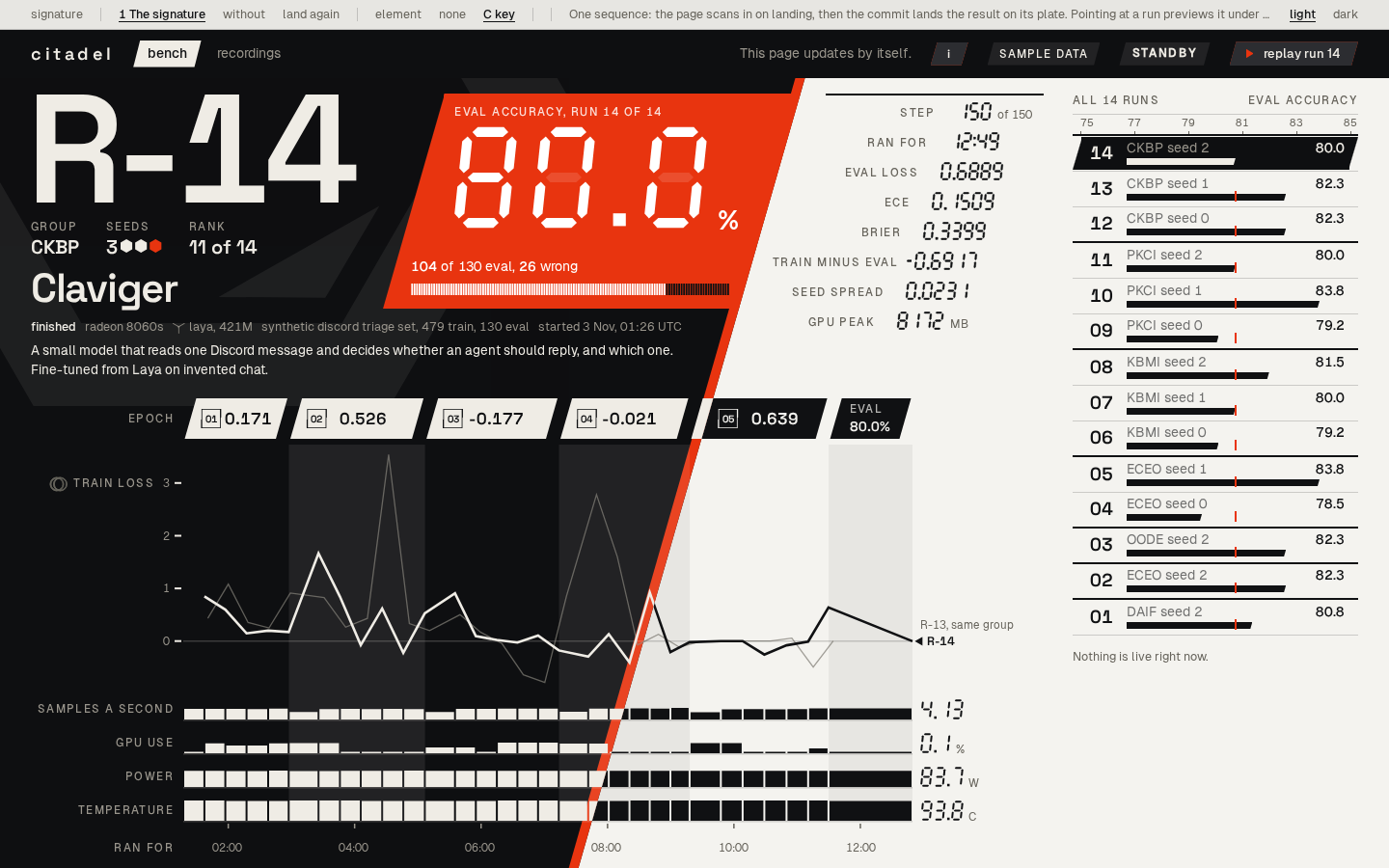
01, Bench, light. The page reads in the right order: a huge "R-14", then a red plate with 80.0% in seven-segment digits, then a column of readings, then the run list. The cut does real work, splitting identity from evidence, and the loss chart inverting as it crosses the cut is the best single detail in the kit. Three things don't work:
- The run is finished and the page says "Nothing is live right now", yet every reading is in the seven-segment face that is reserved for live values.
- That face sets a narrow 1, so numbers break apart: "0.69 17", "0.023 1", "8 172".
- Red has unexplained uses: a tick on every list row (apparently the selected run's score), and one red hex among the seeds.
"STANDBY" and "SAMPLE DATA" also wear the key shape, though they look like statuses, not actions.
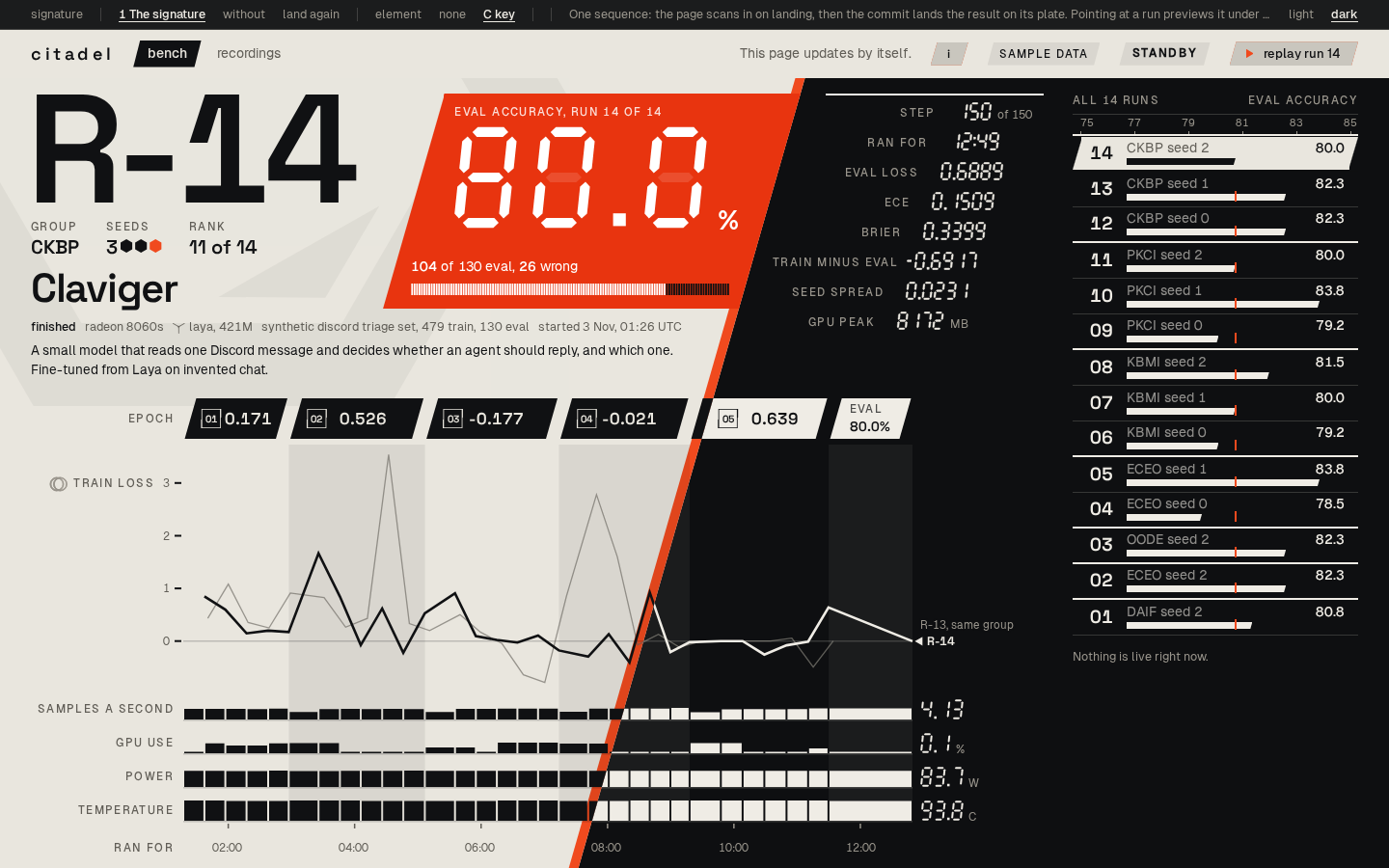
02, Bench, dark. The tones swap exactly, which is tidy and wrong. Because the plane is always the page's opposite, dark mode turns the left half of the screen cream. Someone who picks dark for a dim room gets a brighter page where they look most.
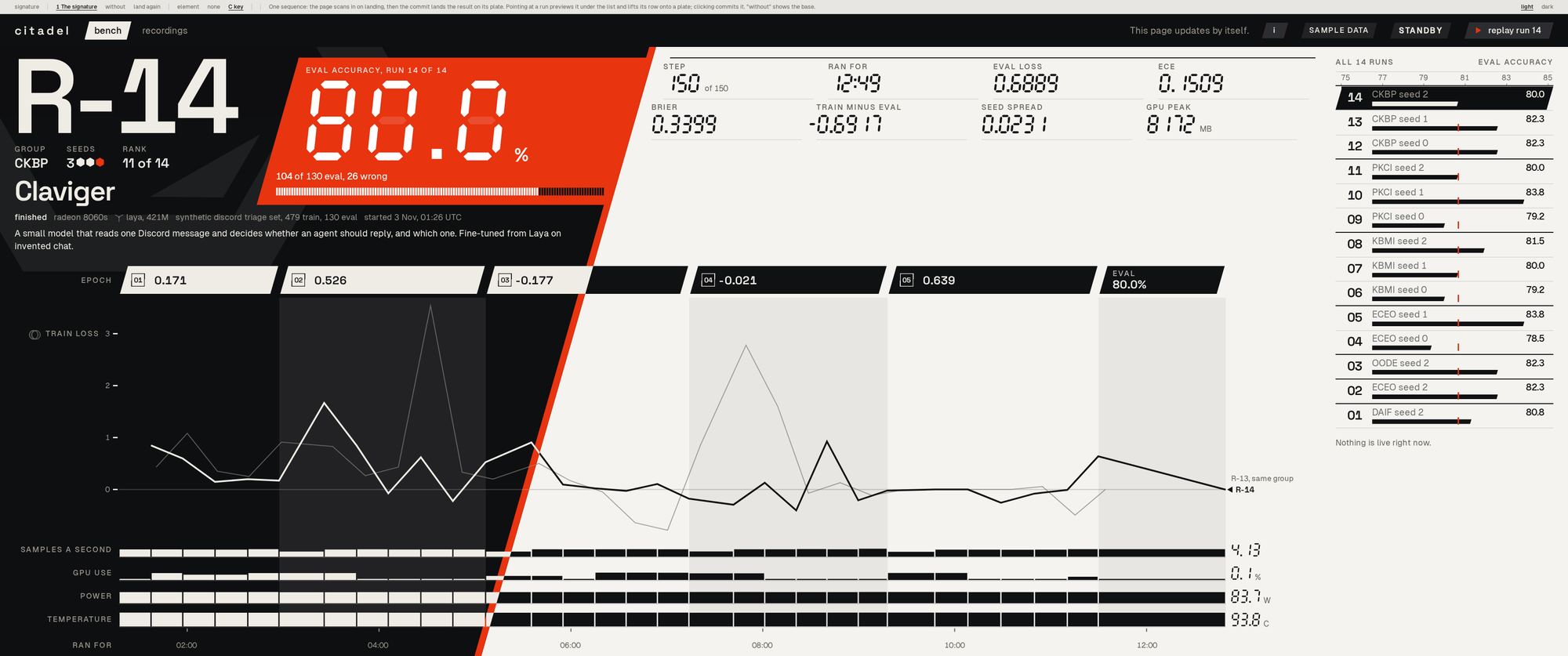
03, Bench at 3440. The layout survives. The readings regroup into a four-by-two grid and the chart stretches honestly. But the cut now slices through the plate of epoch tab 03, which is half light and half black. A wide blank band of paper sits between the readings and the tabs, and the run list stays a narrow strip at the far right.
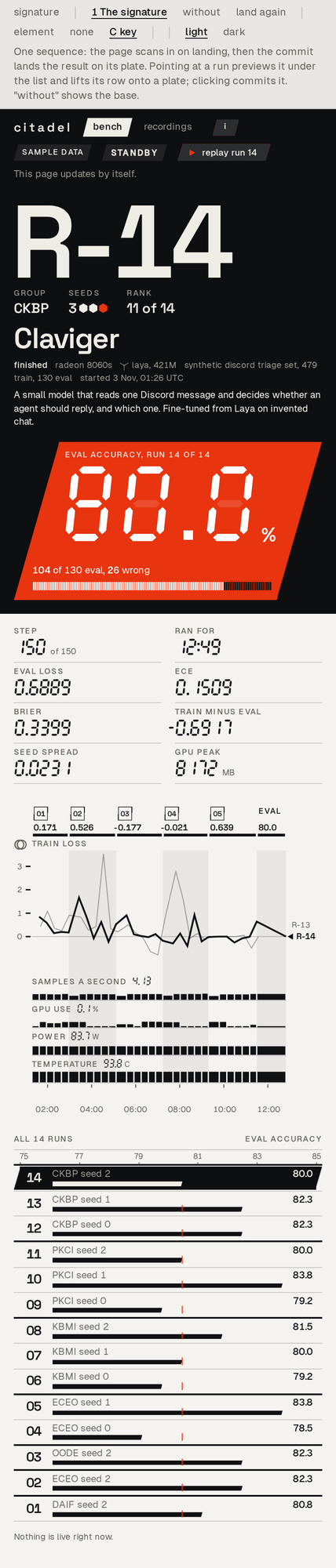
04, Bench, phone. The stacking order is right, and the red plate keeps its slant, so the page is still recognisable. The cut is gone, replaced by a straight band. The run list, the only place you can act, is at the very bottom of a long page. The hover preview has no touch equivalent shown.
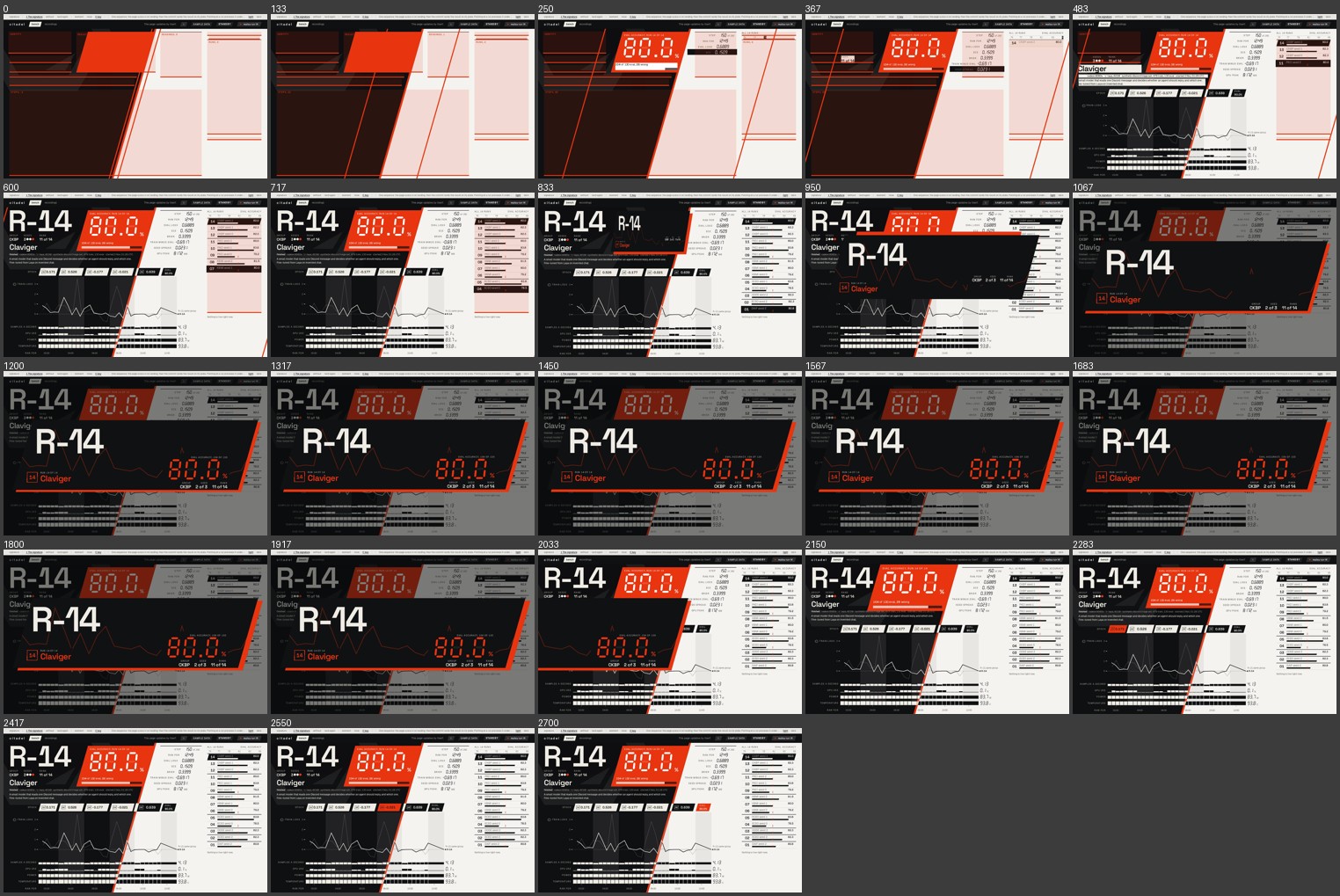
05, landing sequence. A red wireframe scan fills in the page by about 0.7 seconds. Then a plate grows across the screen and holds until about 1.9 seconds, and a red stamp steps along the epoch tabs until 2.7 seconds. The plate obeys its rule, with both cut ends inside the screen. The problem is content: the plate shows R-14, Claviger, 80.0 and the rank, all of which were already readable behind it from 0.6 seconds. By the kit's own rule, that is an effect bolted on.
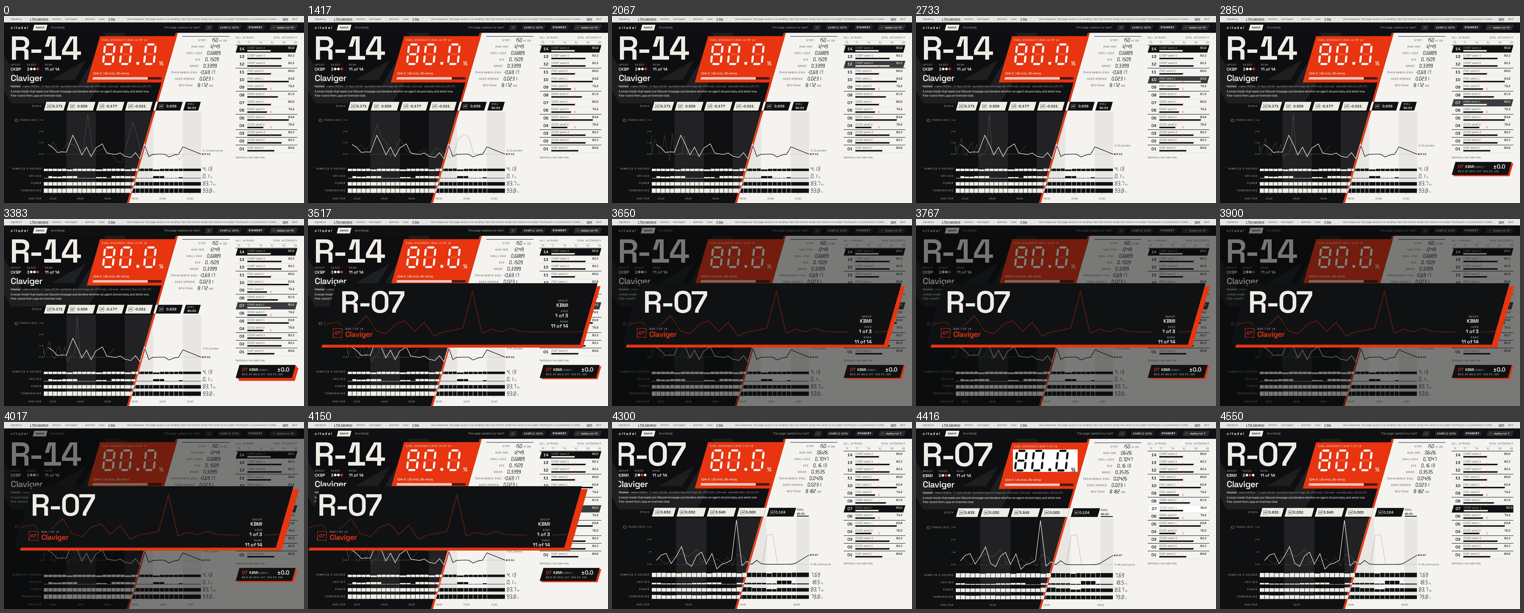
06, run-list sequence. This is the commit earning its place. Pointing at a run puts a small plate in a fixed slot under the list, showing the gap against the current run, which the row doesn't show. Clicking grows the big plate, the page swaps to R-07, and the result flashes. The takeover costs about 0.8 seconds per click, which will grate on the tenth run of a browsing session unless repeats are shortened.
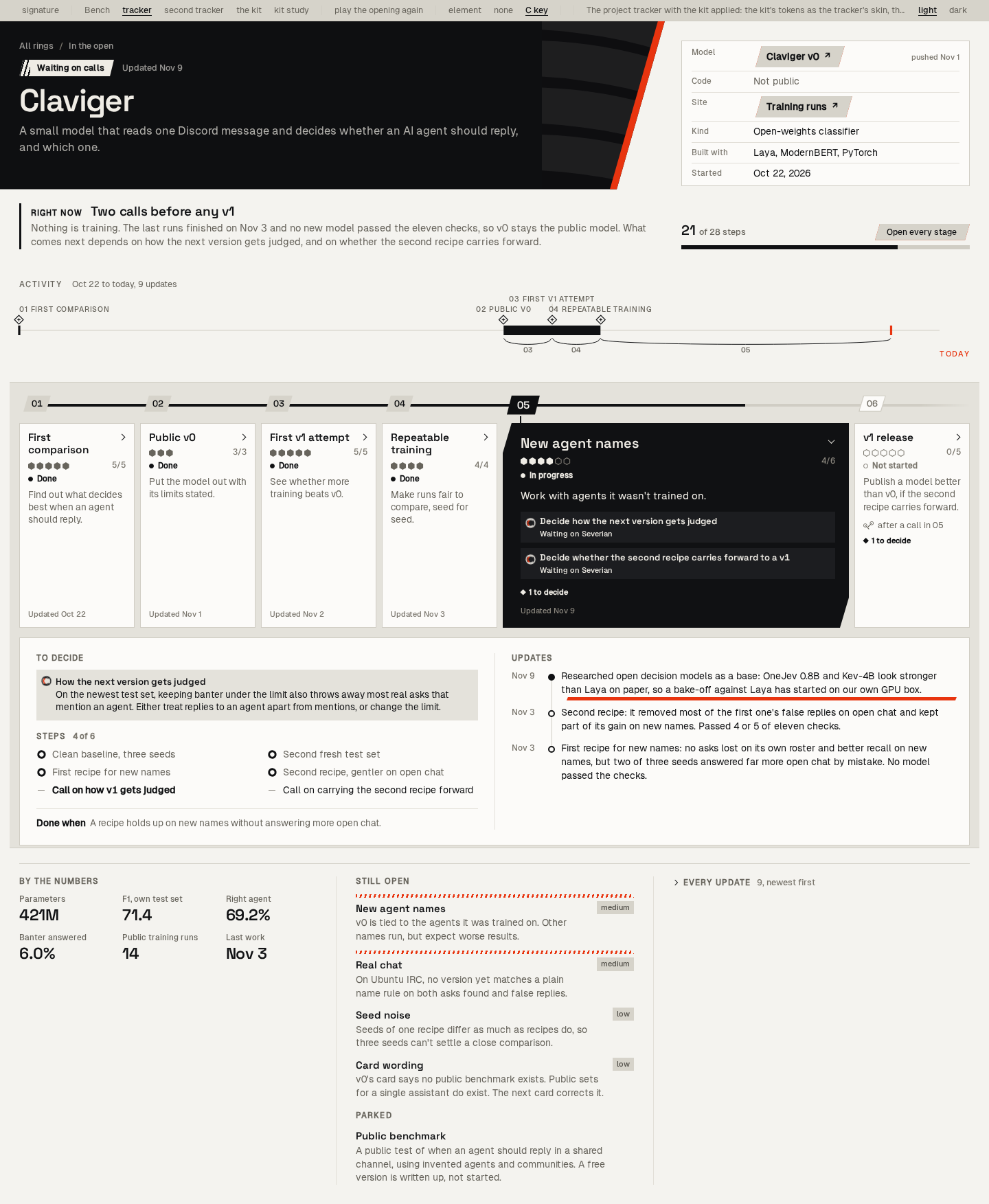
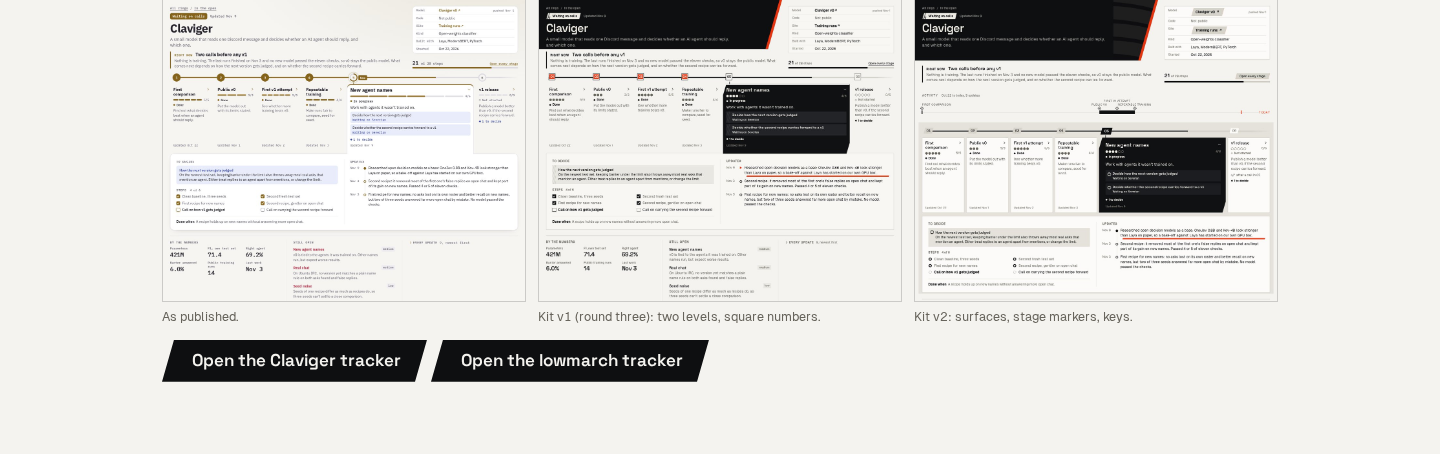
07, Claviger tracker, light. This is the kit at its best. A header band ends in the cut, a sunken road holds raised cards, and the open stage sits on the dark plane. Red is limited to a few small places. Weaknesses:
- The four finished cards are as tall as the open one and mostly empty.
- Progress is said three ways on each card (hexes, "5/5", "Done").
- The pending decision appears in four places on one screen.
- The activity rail spends a full-width row on nine updates clustered in two clumps, with stacked labels and thin bowls.
- The bottom-right column is blank.
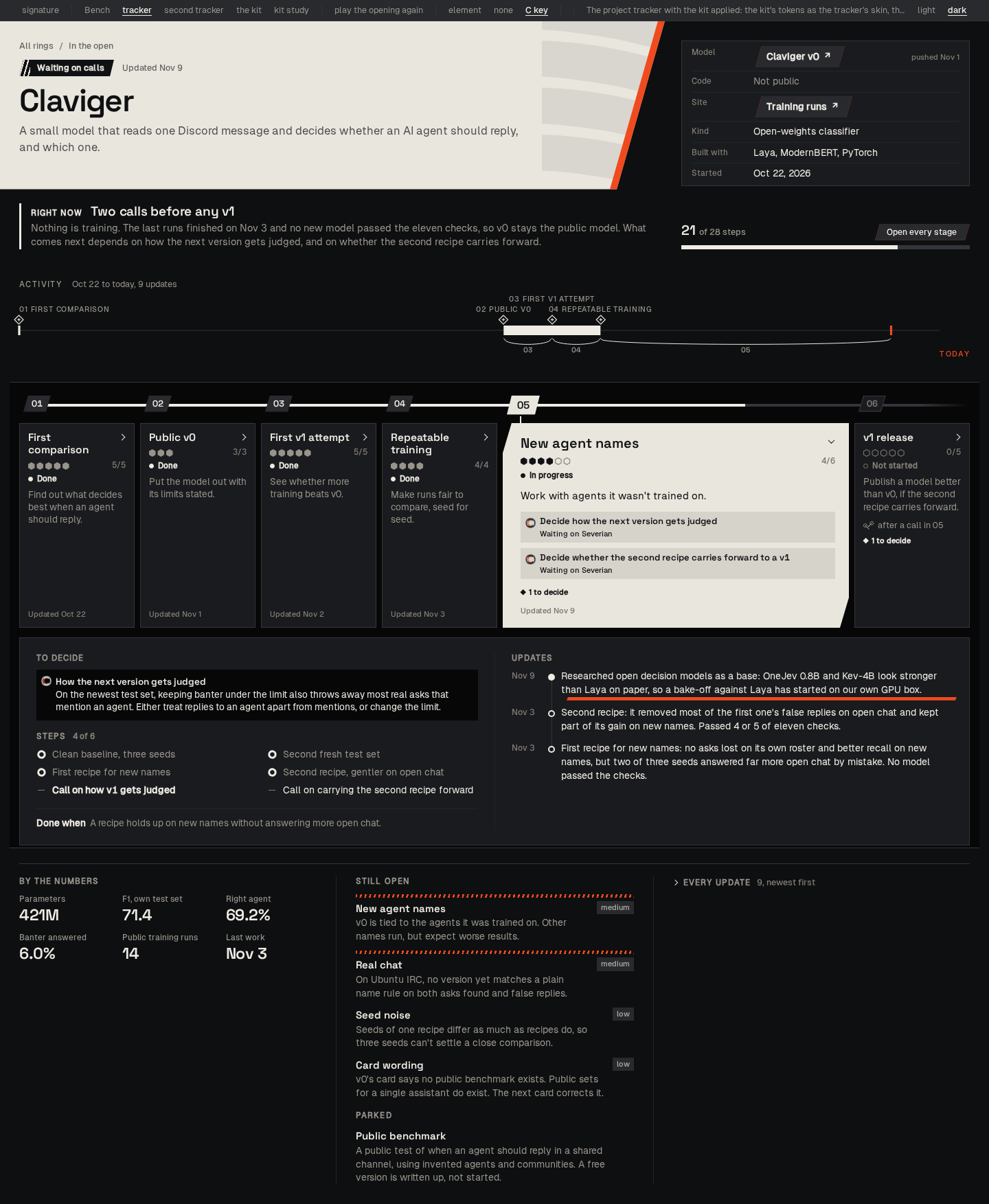
08, Claviger tracker, dark. Dark works here because the plane is small. The page is mostly dark, and the cream header and open stage are the loudest things, as they should be. This is the evidence that the dark problem is about plane area, not the flip itself.
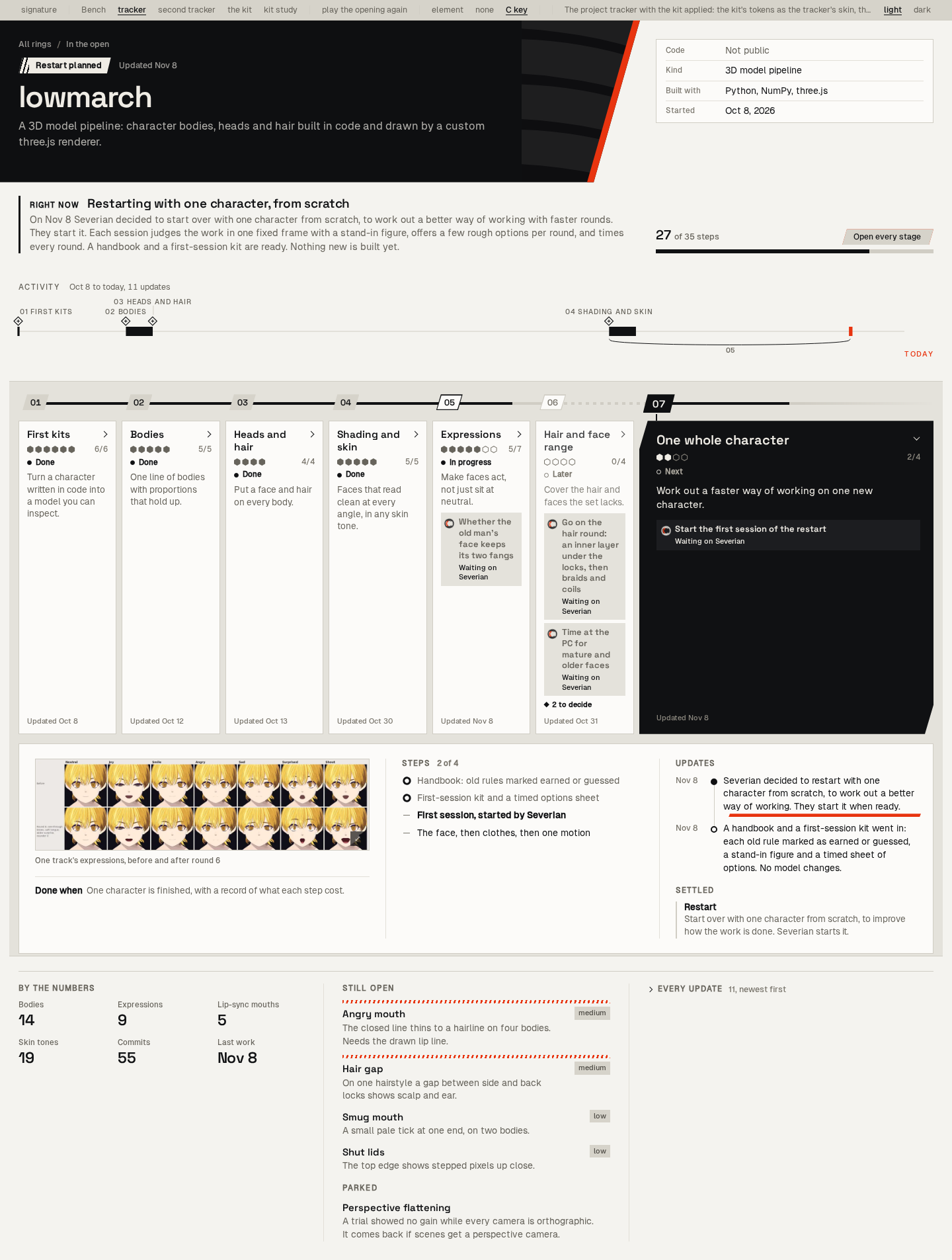
09, lowmarch tracker. This is a useful stress test: seven stages, and the open stage (07, "Next") is not the one in progress (05). The surfaces cope, but stage 05 gets a heavy outlined marker that the kit's three states don't define. The track goes solid, dotted, then solid again. Card height is set by the longest card, so the done cards are two-thirds empty, and waiting items in narrow columns wrap to about eight lines. A colour image sheet appears with no kit rule for images.
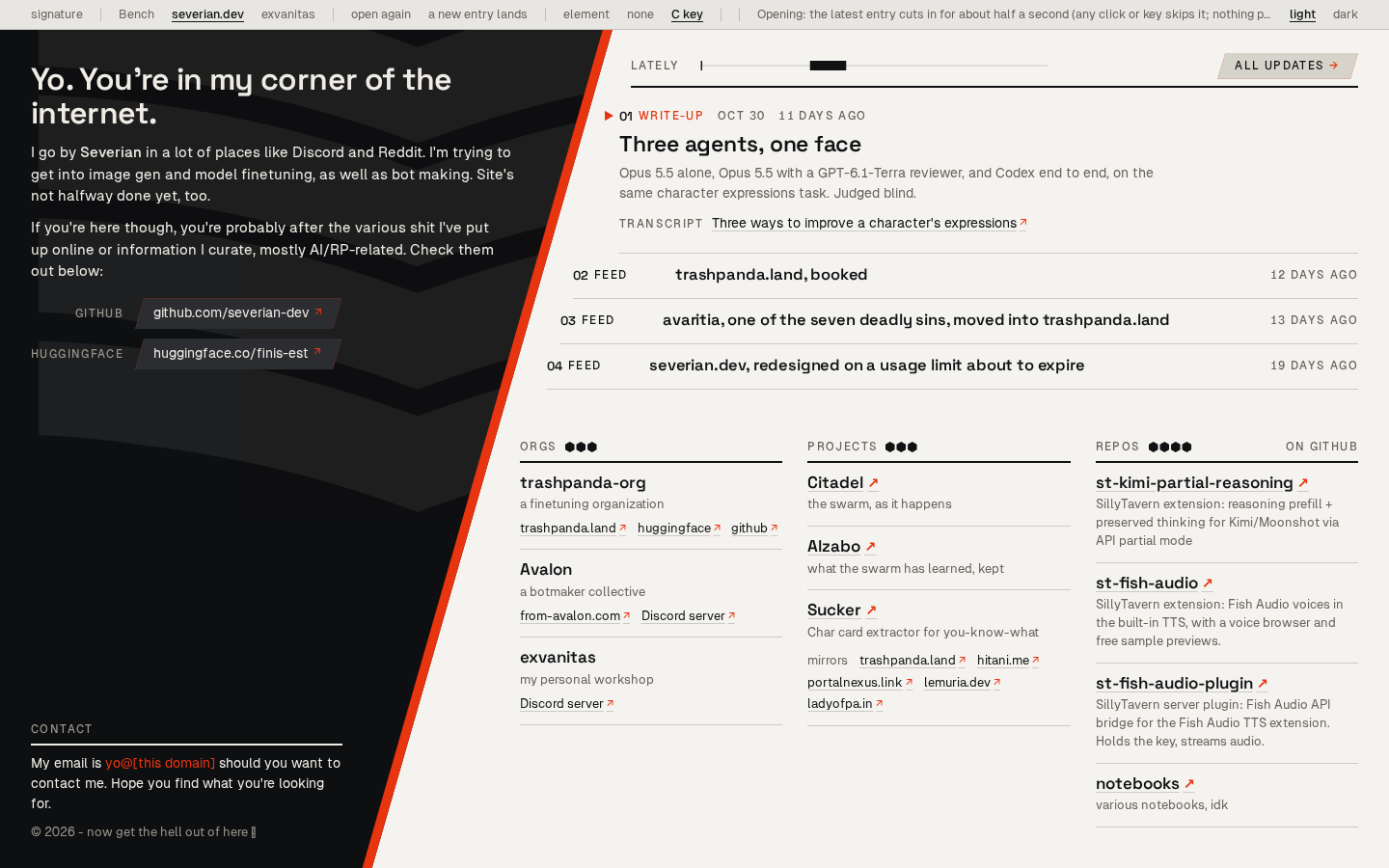
10, severian.dev, light. A full-height cut puts the introduction on the plane and the feed on paper. The feed rows step back along the diagonal at exactly the cut's slope, which is lovely. The casual copy is left alone, and that's right. Less good:
- The left panel is empty for about 370 pixels between the links and the contact block.
- The "Lately" rail is a tick and a block with no scale, so it's decoration.
- The hexes after "Orgs" and "Projects" are a tally of items you can already count, not "k of N".
- About twenty red outbound arrows dilute the red.
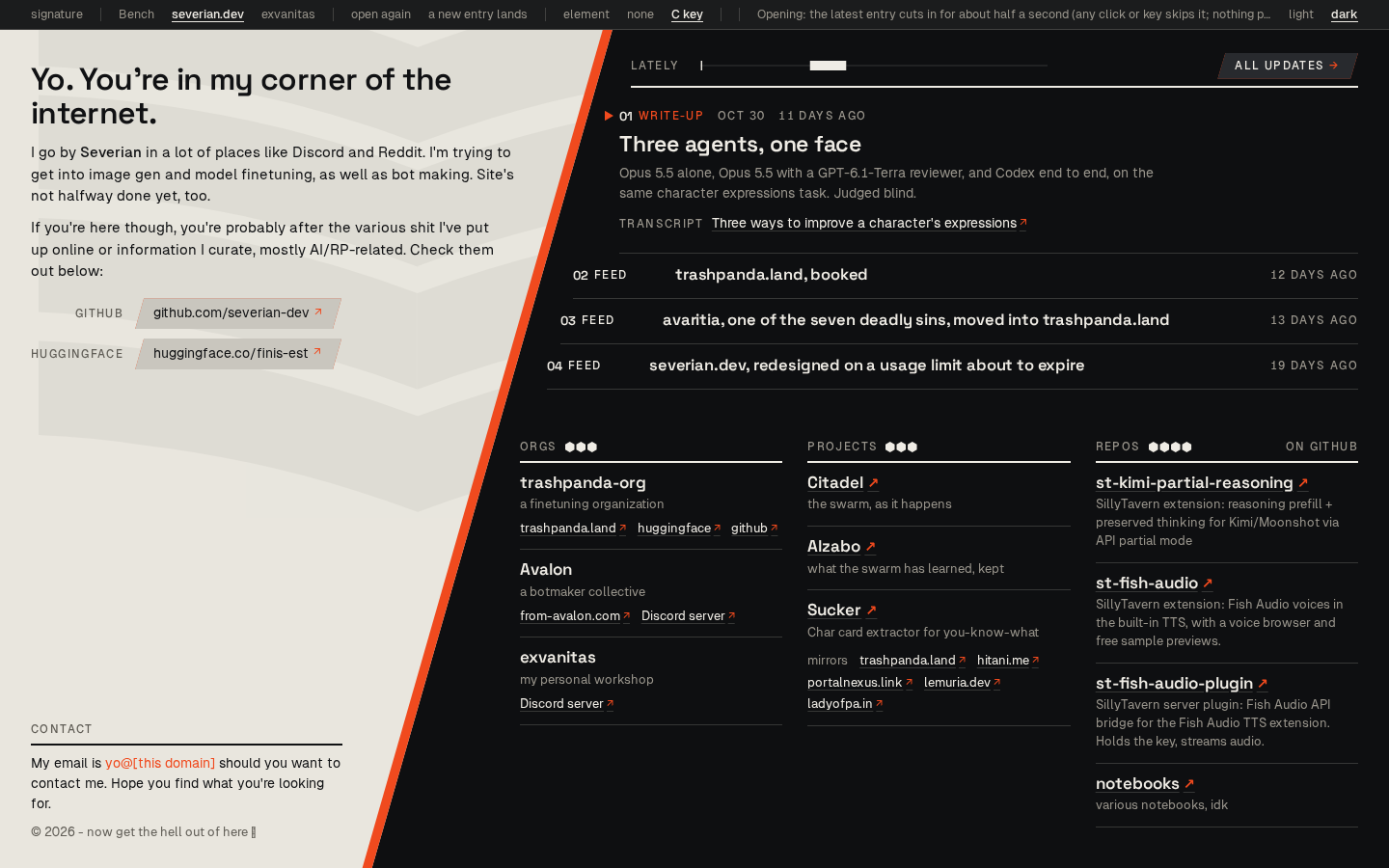
11, severian.dev, dark. The introduction becomes a cream slab on a dark page. That's tolerable at a third of the width. The two link keys are beige on cream and barely read as buttons.
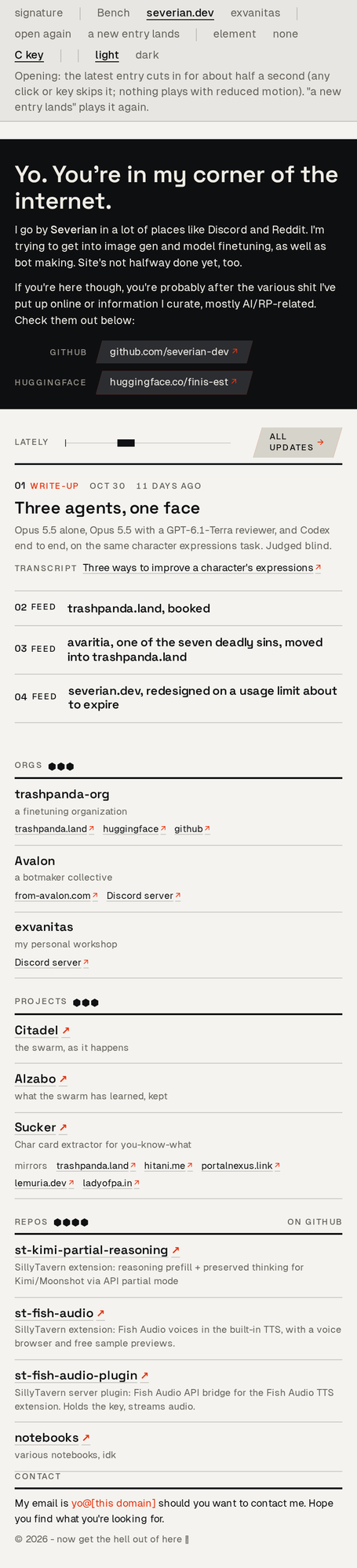
12, severian.dev, phone. It's clean and ordered, but with the cut gone only the key ends and hexes identify it. The "All updates" key wraps to two lines, and "Contact" sits tight against the last repo with no section gap.
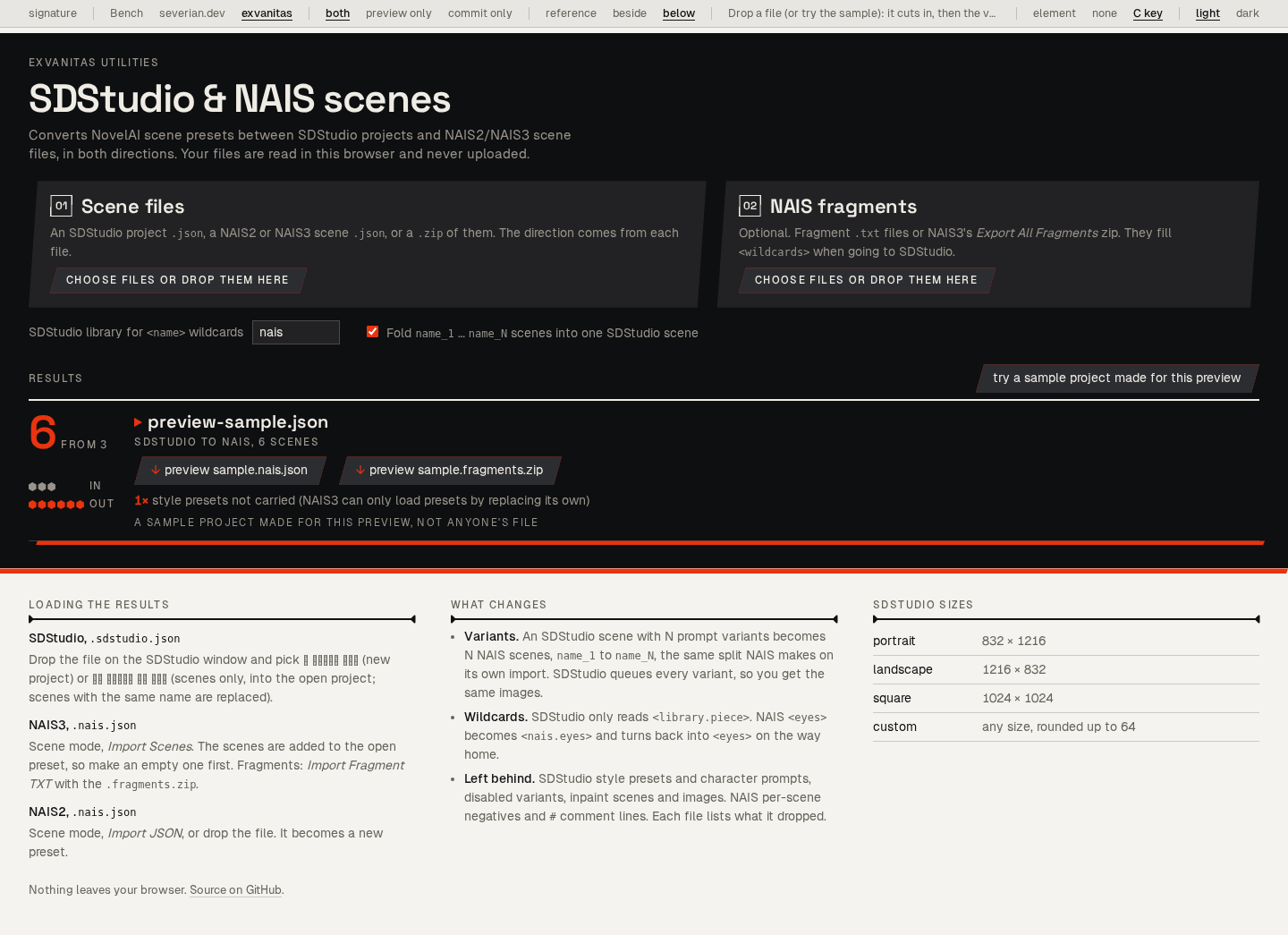
13, Scene Convert. It's tool-first as intended. The two slanted drop panels are clear, and the big red "6 from 3" is a true result. The sample is honestly labelled as made for the preview, not anyone's file. Problems:
- There is no diagonal cut. The band ends in a straight red edge, about 30 pixels below the red sliver under the result, so two red rules stack.
- The panels are numbered with framed "01" and "02", the square-frame step marker the kit excludes.
- The reference text shows missing-glyph boxes where non-Latin menu labels should be.
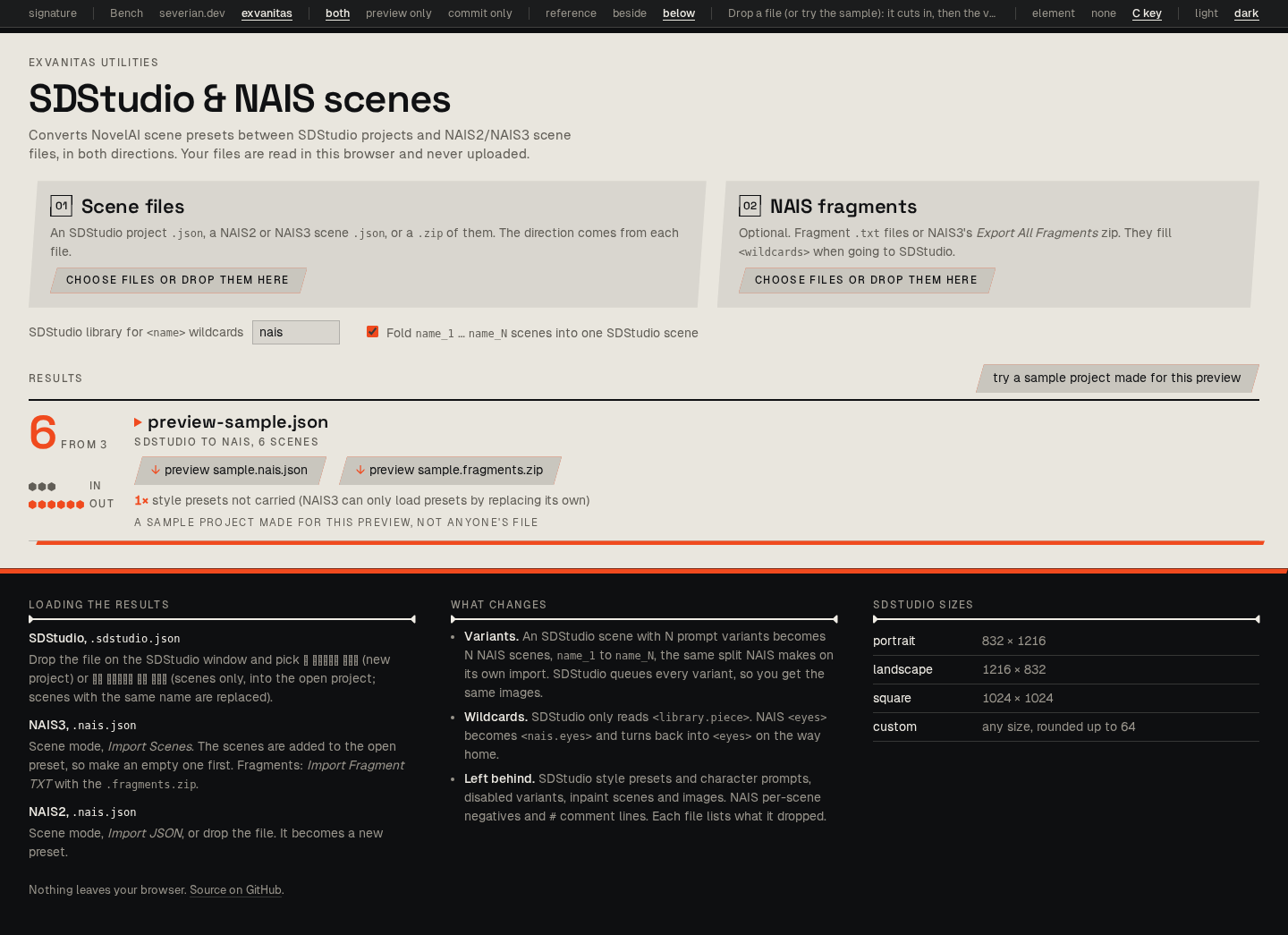
14, Scene Convert, dark. It's the same page inverted, with the same low-contrast keys on the light plane.
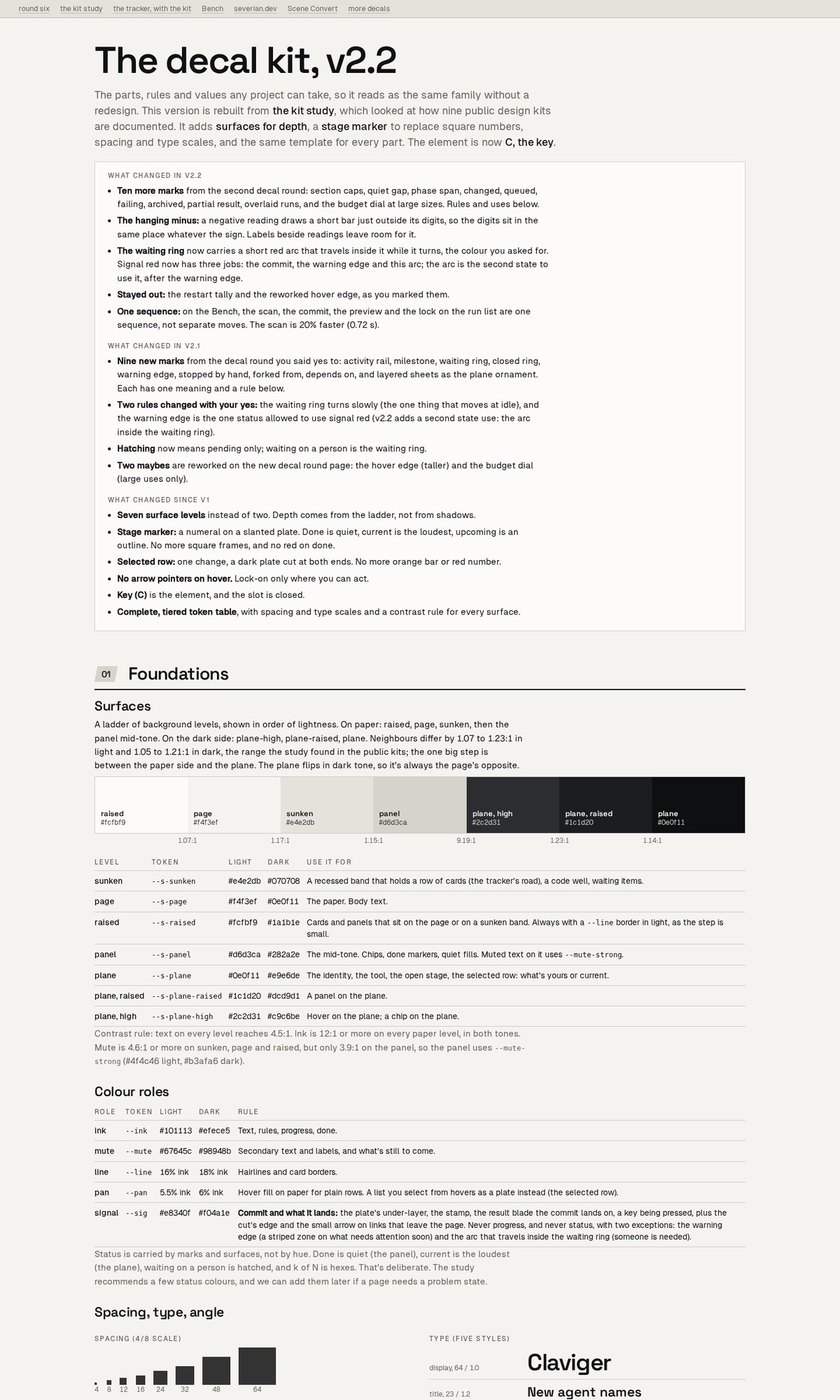
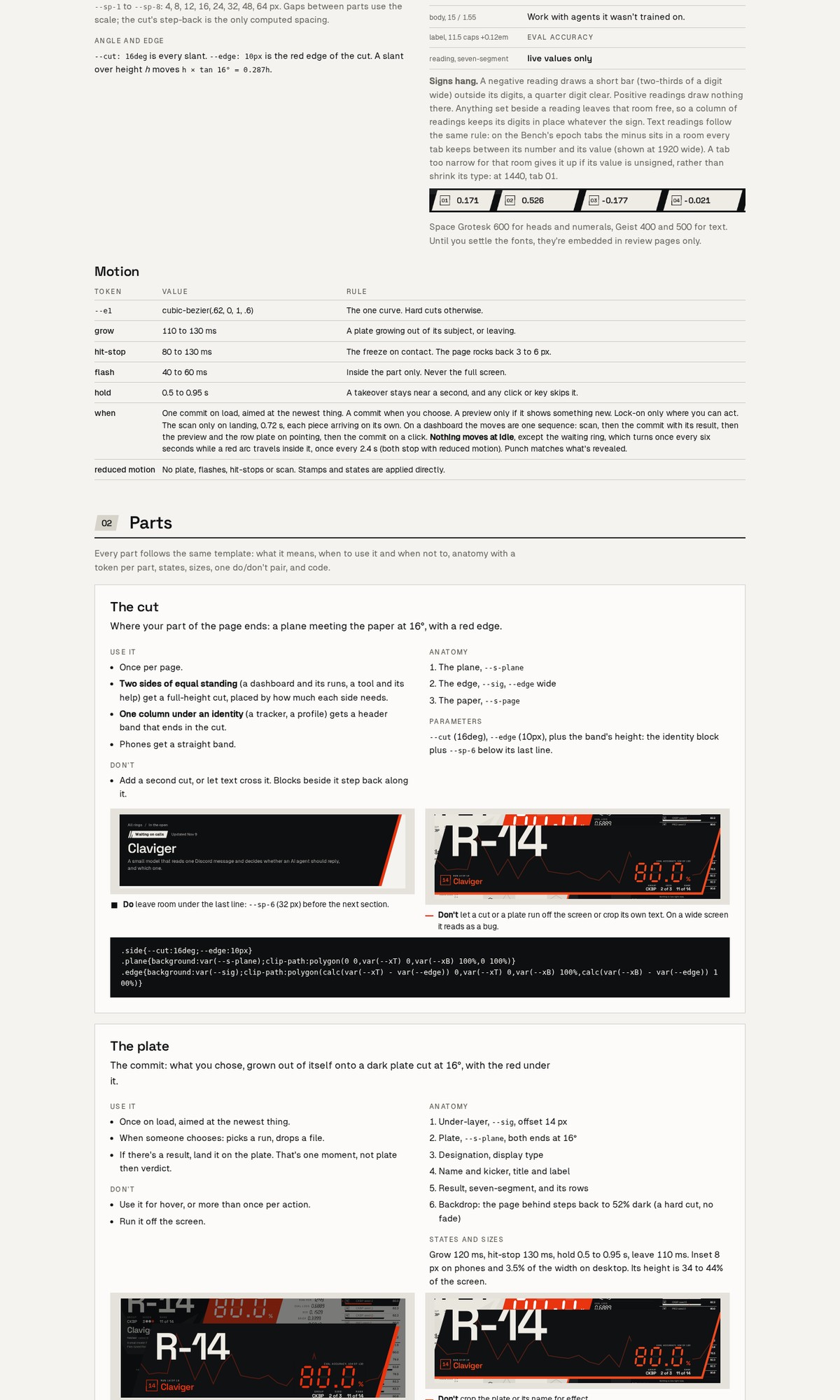
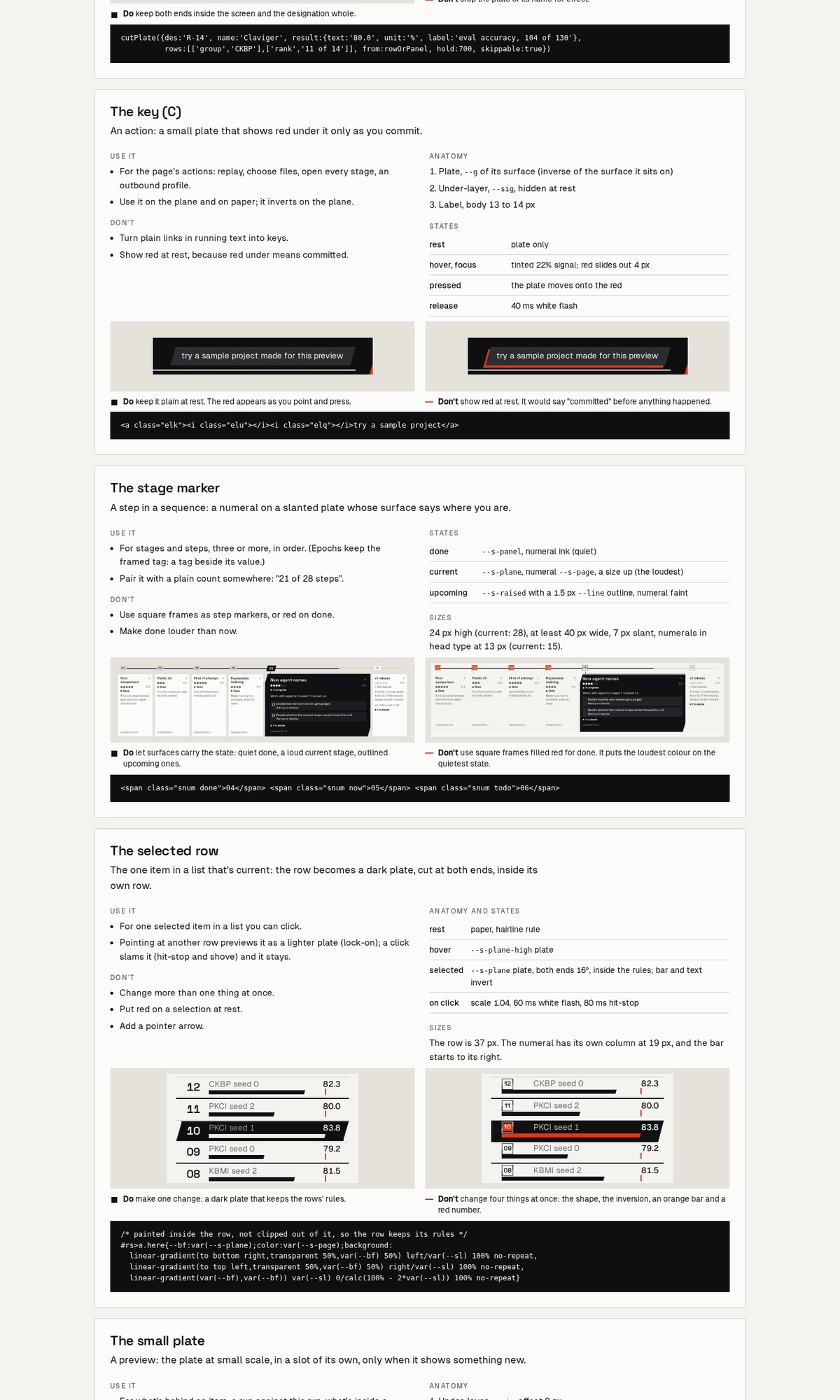
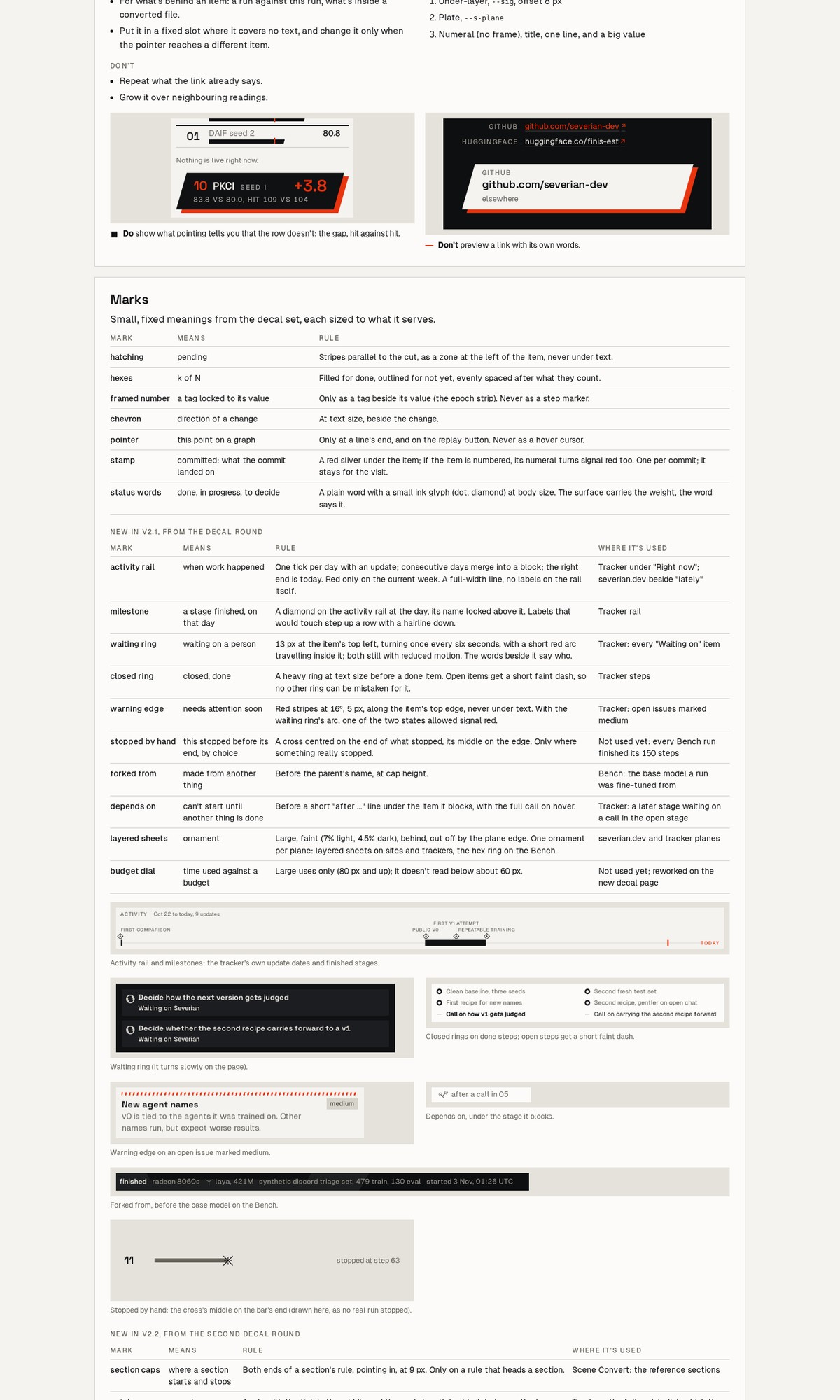
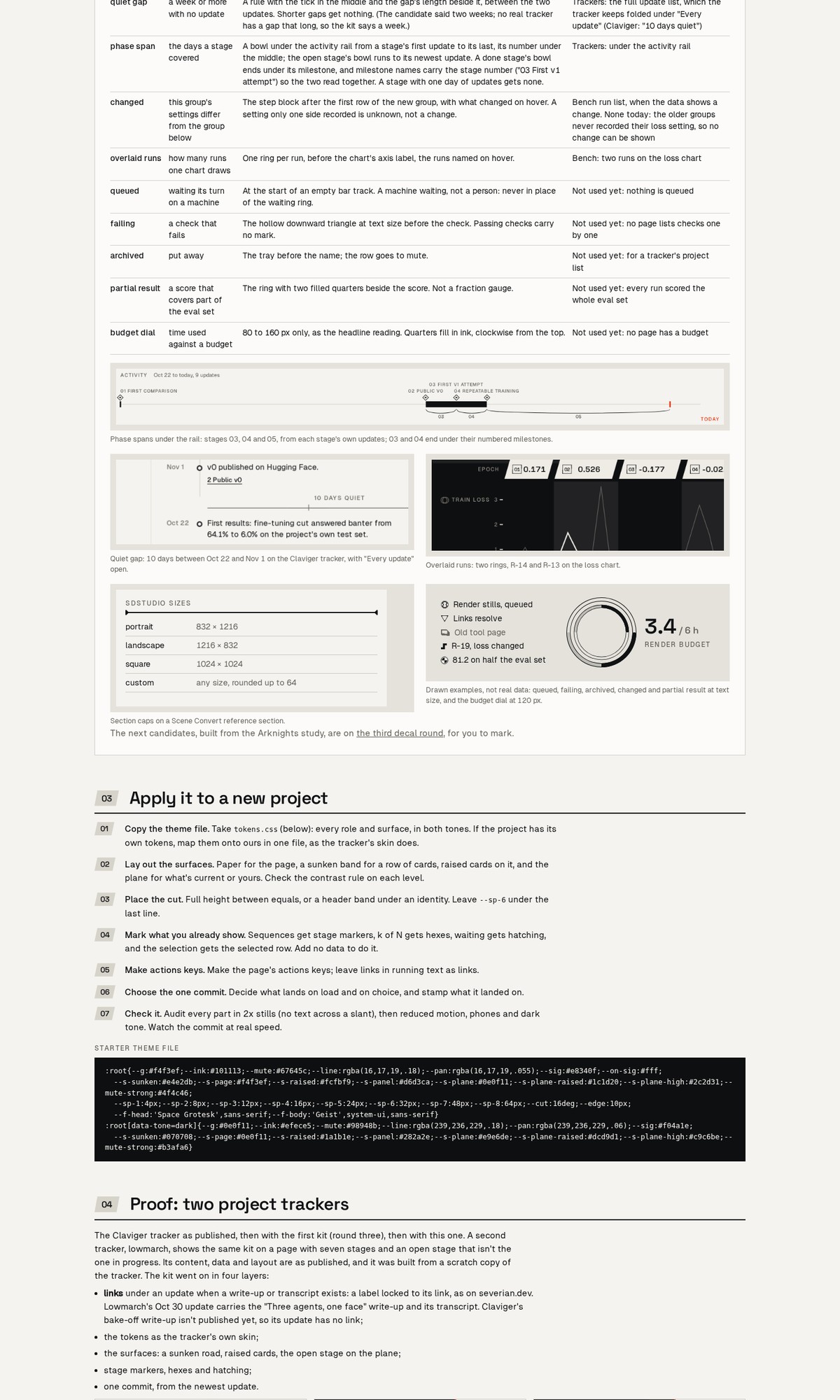
15, the kit document. The parts section is excellent. Every part has use, don't, anatomy, states and a do/don't pair made from real screenshots, and the contrast rule admits its own failure case. As a reference it has four problems:
- It opens with three changelogs addressed to the owner.
- It contradicts itself on hatching. The changelog says hatching means pending and the ring means waiting on a person. The colour note and step 04 of "Apply it" still say waiting is hatched.
- It says the fonts aren't settled.
- It lags the settled list: round three is still described as candidates.
Seven of the marks are listed as "not used yet" and shown as drawn examples.
16, marks in use. Twenty-six marks sit on one sheet, labelled by source-pack ids such as "ornament-10" that mean nothing to a reader. Eight are rings or ring-like. At working size the waiting, queued and partial-result rings are near-identical dots.
The settled decisions
Direction
- Signature versus spectacle: keep. The quiet pages are the most personal ones, and the landing takeover is the last piece of spectacle.
- The command-roster register: keep. It fits the Bench, where runs really are a roster, and it sensibly thins out elsewhere.
- Shapes and motion give it away: revisit. On both phones the main shape disappears, so "works flat and small" is not yet met.
- Rejected directions: keep, and enforce. The Bench still has thirteen instrument readouts and a line announcing that the page updates itself.
- One strong gesture, no fine-line detail: keep. The activity rail's diamonds and bowls break it.
Type and colour
- Type: keep the faces, revisit the seven-segment rule. Either finished runs don't get that face, or the rule should say "measured readings". Fix the narrow 1 either way.
- Surface ladder: keep the ladder, revisit two things. Steps of 1.05 to 1.07 need a hairline to show, so depth is not from the ladder alone. The plane flip should also be capped by area in dark tone.
- Signal red's three jobs: revisit. The kit's own table lists more: the cut edge, outbound arrows, the today tick, the stamp. The pages add red hexes, a red checkbox and a red loss warning. Take red off arrows and tallies, then rewrite the rule.
Shape and motion
- The cut: keep it and the angle, revisit "one per page". Phones and Scene Convert have none, and at 3440 it splits a tab. Write the exceptions down.
- The key: keep. One element is enough. Fix the spec, which says "inverse of its surface" where the pages show tonal keys, and keep statuses out of the shape.
- The commit gesture: keep on choice, cut on load. Choosing a run or dropping a file reveals something. The landing commit reveals nothing new.
- Scan: keep. It is the reveal, and it should be the whole landing.
- Lock-on: keep. It needs a touch and keyboard form.
- One sequence: keep the merge, revisit the three beats. Scan and settle are enough on landing.
- Nothing moves at idle: keep, and cut the hourglass test. "Queued" is already a ring with an hourglass, so a second hourglass breaks one mark, one meaning. Falling sand at 13 pixels is also fine-line detail.
- Effects follow information: keep. It's the best rule in the kit. Apply it to the landing and to the triple-encoded progress.
Decals
- Decals must be earned: keep, and enforce. Seven marks have a meaning and no job. Shelve them until a page needs them.
- Exclusions: keep, revisit the wording. Say whether link and download arrows count as arrows, and remove the framed numbers from Scene Convert.
- Round one: keep most. Keep the warning edge, closed ring, milestone, forked-from, depends-on and layered sheets. Revisit the activity rail. Shelve stopped-by-hand and the budget dial.
- Round two: revisit. Section caps, quiet gap and overlaid runs are in use and fine. Queued, failing, archived, partial result and changed are unearned so far.
- Round three: keep what is visible, no verdict on the rest. The count lockup, plates on a track and the group rule all work. The panel tab, budget row, locked slot and progress ticks appear in no still.
Surfaces
- Bench run list: keep. It's the best component, and the hanging minus is a real refinement. Label the red tick.
- severian.dev: keep. Fill or shorten the empty left panel.
- Scene Convert: keep tool-first and the borrowed skin, revisit the page. It currently breaks the cut rule and doubles its red line.
- Trackers: keep the direction and the stage markers, revisit two details. Define the in-progress-but-not-open state, and stop done cards inheriting the tallest card's height.
- Reusable kit, more rounds: keep the aim, revisit the plan. The next round should subtract and stress-test, not add marks.
What's missing
States the pages will need. There is no error state and no problem colour, and Scene Convert will reject a file sooner or later. There is no still of a live run, which is what the seven-segment face and the waiting ring exist for. There is no failed or stopped run, and no empty or loading state.
Input and motion coverage. Focus is lumped in with hover. Nothing shows touch. Reduced motion is described but not shown, and the motion itself can't be reviewed without video.
Sizes and stress cases. Missing are a wide tracker (which decision 25 claims), a tracker and a Scene Convert on a phone, and anything between 780 and 1440 pixels, where the cut will be tightest. Nothing tests long content: a three-digit run number in the 19 pixel column, two hundred runs, or twelve stages.
Parts with no entry. Charts, form controls and images have none, though charts fill the largest area of the Bench.
The document itself. It needs to lead with the rules, not their history, and to define plate, small plate, key and stage marker against each other. It also needs one trial on a project built by someone other than the owner, which is the only real test of "repeatedly applicable".
end of the transcript