A 3D model pipeline, pushed by Fable 5.2
user
+40:16just providing more steering information here. you're here as an adversarial agent intending to prove that you can do much, much better than the prior model who was working on this project. pull all the stops out and do whatever's necessary to break free of what plagues the current project, show me your best work. not just using the tools and following that project's footsteps, the point is a radical improvement that only you could do, compared to where this project has already tread.
agent
+41:40reasoning
I'm going past the kit with two approaches: her own design, whose first build is running now, and my own perspective cel renderer built for the exported model's light, hair and face.
Bashcd ~/Projects/lowmarch-fable52 && date +%H:%M:%S && python3 - <<'E'
command
cd ~/Projects/lowmarch-fable52 && date +%H:%M:%S && python3 - <<'E' p="tools/whole/build.py"; s=open(p).read() old='''# her stance:''' new='''# her design: "kit" is Elaine's dress as the old kit builds it (the first frame); "wren" is tools/whole/wren.py DESIGN = os.environ.get("WHOLE_DESIGN", "kit") if DESIGN == "wren": import wren outfit.COSTUMES["whole_knight"] = wren.build CAST[NAME].update(shape=dict(src["shape"], **wren.SHAPE), paint=dict(CAST[NAME]["paint"], **wren.PAINT)) # her stance:''' assert old in s; s=s.replace(old,new,1); open(p,"w").write(s) E cp -r review/out/whole review/out/whole2 && (time LOWMARCH_SITE=whole2 WHOLE_DESIGN=wren OMP_NUM_THREADS=1 OPENBLAS_NUM_THREADS=1 python3 tools/whole/build.py arm_f_slender wren) 2>&1 | tail -25result, 17 lines
19:14:36 Traceback (most recent call last): File "~/Projects/lowmarch-fable52/tools/whole/build.py", line 127, in <module> r = build.character((n, None)) File "~/Projects/lowmarch-fable52/review/vroid-02/build.py", line 192, in character p, c = portrait(name, "bust") File "~/Projects/lowmarch-fable52/review/vroid-02/build.py", line 159, in portrait return vp.Portrait(model_path(name, c), shape=c["shape"], File "~/Projects/lowmarch-fable52/tools/vroid_portrait.py", line 996, in __init__ for pc in costume(fit): File "~/Projects/lowmarch-fable52/tools/whole/wren.py", line 193, in build legs_side = merge_surfaces((thigh[0], thigh[1]), (shin[0], shin[1])) TypeError: 'Surface' object is not subscriptable real 0m17.202s user 0m16.397s sys 0m0.502sBashcd ~/Projects/lowmarch-fable52 && grep -n "^def merge_surfaces" -A8 tools/fitting.py | head -12; sed -n 579,594p tools/outfit.py; python3 - <<'E'
command
cd ~/Projects/lowmarch-fable52 && grep -n "^def merge_surfaces" -A8 tools/fitting.py | head -12; sed -n 579,594p tools/outfit.py; python3 - <<'E' p="tools/whole/wren.py"; s=open(p).read() R=[("legs_side = merge_surfaces((thigh[0], thigh[1]), (shin[0], shin[1]))","legs_side = merge_surfaces(_pt(thigh), _pt(shin))"), ("merge_surfaces(fore, sleeve), la, hd,","merge_surfaces(_pt(fore), _pt(sleeve)), la, hd,"), ("arm_s = merge_surfaces(O.limb_surface(fit, (f\"{side}_LowerArm\", f\"{side}_UpperArm\"), side), sleeve)", "arm_s = merge_surfaces(_pt(O.limb_surface(fit, (f\"{side}_LowerArm\", f\"{side}_UpperArm\"), side)), _pt(sleeve))"), ("waist = merge_surfaces(plate, (hose[\"pos\"], hose[\"tri\"]))","waist = merge_surfaces(_pt(plate), (hose[\"pos\"], hose[\"tri\"]))"), ("hang = merge_surfaces((belt[\"pos\"], belt[\"tri\"]), plate, (hose[\"pos\"], hose[\"tri\"]))","hang = merge_surfaces((belt[\"pos\"], belt[\"tri\"]), _pt(plate), (hose[\"pos\"], hose[\"tri\"]))"), ("def _landmarks(fit):","def _pt(surf):\n return surf.pos, surf.tri\n\n\ndef _landmarks(fit):")] for a,b in R: assert a in s, a[:50]; s=s.replace(a,b) open(p,"w").write(s) E (time LOWMARCH_SITE=whole2 WHOLE_DESIGN=wren OMP_NUM_THREADS=1 OPENBLAS_NUM_THREADS=1 python3 tools/whole/build.py arm_f_slender wren) 2>&1 | tail -12result, 34 lines
86:def merge_surfaces(*meshes):
87-    pos, tri, off = [], [], 0
88-    for p, t in meshes:
89-        pos.append(p)
90-        tri.append(np.asarray(t) + off)
91-        off += len(p)
92-    return Surface(np.concatenate(pos), np.concatenate(tri))
93-
94-
def limb_surface(fit, bones, side=None):
    """The skin of one limb (bones matched by name), optionally only one side of the body, so ray
    casts out of a bone can't reach the torso or the other limb."""
    T = fit.tris_for(bones, min_w=0.35)
    if side:
        cx = fit.pos[T][:, :, 0].mean(1)
        T = T[cx < 0.01] if side == "L" else T[cx > -0.01]
    return Surface(fit.pos, T)


def side_of(pc, side):
    """A piece's triangles on one side of the body (the character's left is -x)."""
    cx = pc["pos"][pc["tri"]][:, :, 0].mean(1)
    return Surface(pc["pos"], pc["tri"][cx < 0.0] if side == "L" else pc["tri"][cx > 0.0])


wren.glb 6.8 MB, 58s
  wren: 10 keyframes checked; 2 with an arm through the body, 7 with an arm resting on it
    ! wren, attack at 0.68 s: right upper arm 2.7 cm inside the body
    ! wren, attack at 1.05 s: right upper arm 2.7 cm inside the body
-> ~/Projects/lowmarch-fable52/review/out/whole2/site  97s

real	1m37.544s
user	1m25.953s
sys	0m4.531s
agent
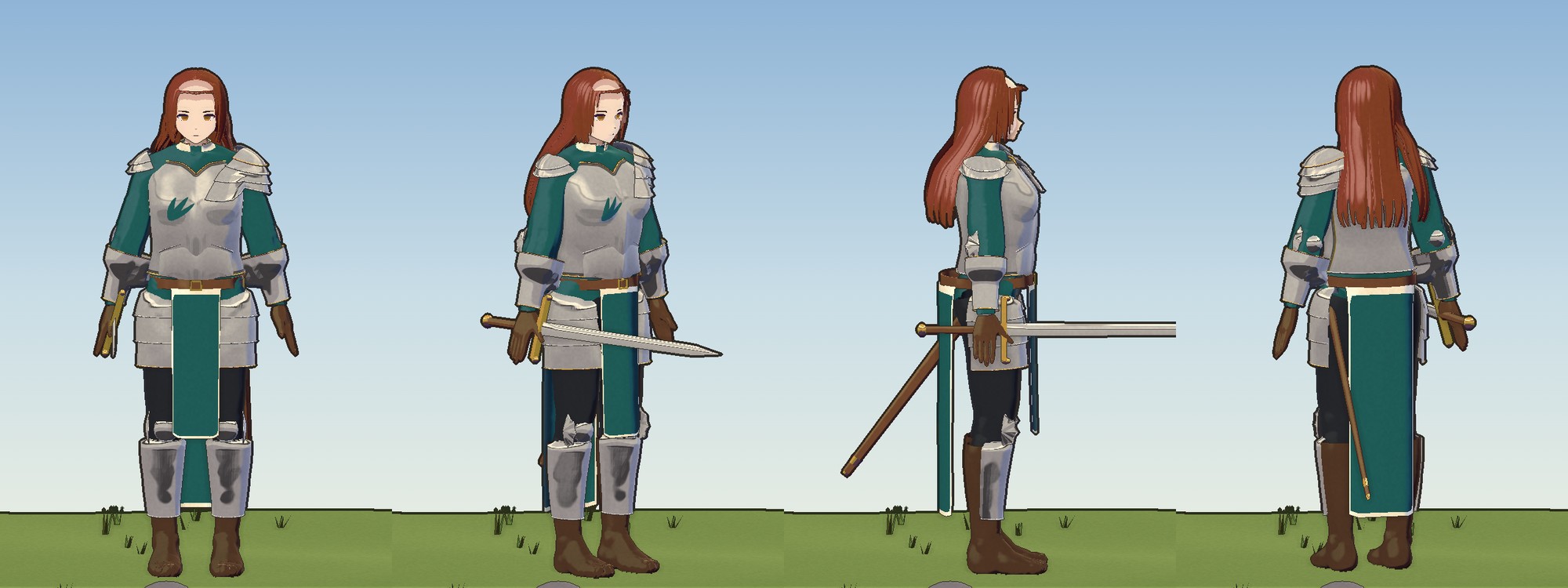
+43:51Her new design built on the first full run (97 s). Shooting it now to see the costume, the haircut and the armour.
Bashcd ~/Projects/lowmarch-fable52 && mkdir -p review/out/whole2/shots && cd review/out/whole2/shots && python3 - <<'E'
command
cd ~/Projects/lowmarch-fable52 && mkdir -p review/out/whole2/shots && cd review/out/whole2/shots && python3 - <<'E' import json base=json.load(open("~/Projects/lowmarch-fable52/tools/whole/frame.json")) def sp(name, **kw): s=dict(base, w=960, h=540, scale=1); s.pop("key",None); s.update(kw); json.dump(s, open(name+".json","w")) pl=lambda y:{"wren":{"pos":[0,0,0],"yaw":y},"mob_soldier":{"pos":[6,0,0],"yaw":-70}} sp("ref_front", place=pl(0), clips={"wren":["ref",0]}, size=1.95, centre=[0,0.92,0], w=640, h=960) sp("ref_q", place=pl(40), clips={"wren":["ref",0]}, size=1.95, centre=[0,0.92,0], w=640, h=960) sp("ref_side", place=pl(90), clips={"wren":["ref",0]}, size=1.95, centre=[0,0.92,0], w=640, h=960) sp("ref_back", place=pl(200), clips={"wren":["ref",0]}, size=1.95, centre=[0,0.92,0], w=640, h=960) sp("head_f", place=pl(0), clips={"wren":["ref",0]}, size=0.5, centre=[0,1.50,0], w=640, h=640) sp("head_q", place=pl(40), clips={"wren":["ref",0]}, size=0.5, centre=[0,1.50,0], w=640, h=640) E for n in ref_front ref_q ref_side ref_back head_f head_q; do WHOLE_SITE=../site python3 ../../../../tools/whole/shoot.py $n.json $n.png >/dev/null & done; wait python3 -c " from PIL import Image a=[Image.open(n+'.png') for n in ('ref_front','ref_q','ref_side','ref_back')] W=Image.new('RGB',(640*4,960)); [W.paste(im,(640*i,0)) for i,im in enumerate(a)]; W.save('turn.png') b=[Image.open(n+'.png') for n in ('head_f','head_q')] W=Image.new('RGB',(1280,640)); [W.paste(im,(640*i,0)) for i,im in enumerate(b)]; W.save('heads.png')"; lsresult, 24 lines
FAILED [1] Exit 1 WHOLE_SITE=../site python3 ../../../../tools/whole/shoot.py $n.json $n.png > /dev/null FAILED FAILED FAILED [2] Exit 1 WHOLE_SITE=../site python3 ../../../../tools/whole/shoot.py $n.json $n.png > /dev/null [5]- Exit 1 WHOLE_SITE=../site python3 ../../../../tools/whole/shoot.py $n.json $n.png > /dev/null [6]+ Exit 1 WHOLE_SITE=../site python3 ../../../../tools/whole/shoot.py $n.json $n.png > /dev/null FAILED [3]- Exit 1 WHOLE_SITE=../site python3 ../../../../tools/whole/shoot.py $n.json $n.png > /dev/null FAILED [4]+ Exit 1 WHOLE_SITE=../site python3 ../../../../tools/whole/shoot.py $n.json $n.png > /dev/null Traceback (most recent call last): File "<string>", line 3, in <module> File "<string>", line 3, in <listcomp> File "[redacted: private path]/PIL/Image.py", line 3465, in open fp = builtins.open(filename, "rb") FileNotFoundError: [Errno 2] No such file or directory: 'ref_front.png' head_f.json head_q.json ref_back.json ref_front.json ref_q.json ref_side.jsonBashcd ~/Projects/lowmarch-fable52/review/out/whole2/shots && R=~/Projects/lowmarch-fable52 && for n in ref_front ref_q ref_side ref_back head_f head_q; do WHOLE_SITE=$R/review/out/whole2/site python3 $R/tools/whole/shoot.py $n.json $n.png >/dev/null & done; wait
command
cd ~/Projects/lowmarch-fable52/review/out/whole2/shots && R=~/Projects/lowmarch-fable52 && for n in ref_front ref_q ref_side ref_back head_f head_q; do WHOLE_SITE=$R/review/out/whole2/site python3 $R/tools/whole/shoot.py $n.json $n.png >/dev/null & done; wait python3 -c " from PIL import Image a=[Image.open(n+'.png') for n in ('ref_front','ref_q','ref_side','ref_back')] W=Image.new('RGB',(640*4,960)); [W.paste(im,(640*i,0)) for i,im in enumerate(a)]; W.save('turn.png') b=[Image.open(n+'.png') for n in ('head_f','head_q')] W=Image.new('RGB',(1280,640)); [W.paste(im,(640*i,0)) for i,im in enumerate(b)]; W.save('heads.png')"; ls *.pngresult, 14 lines
[1]   Done                    WHOLE_SITE=$R/review/out/whole2/site python3 $R/tools/whole/shoot.py $n.json $n.png > /dev/null
[5]-  Done                    WHOLE_SITE=$R/review/out/whole2/site python3 $R/tools/whole/shoot.py $n.json $n.png > /dev/null
[6]+  Done                    WHOLE_SITE=$R/review/out/whole2/site python3 $R/tools/whole/shoot.py $n.json $n.png > /dev/null
[2]   Done                    WHOLE_SITE=$R/review/out/whole2/site python3 $R/tools/whole/shoot.py $n.json $n.png > /dev/null
[3]-  Done                    WHOLE_SITE=$R/review/out/whole2/site python3 $R/tools/whole/shoot.py $n.json $n.png > /dev/null
[4]+  Done                    WHOLE_SITE=$R/review/out/whole2/site python3 $R/tools/whole/shoot.py $n.json $n.png > /dev/null
head_f.png
head_q.png
heads.png
ref_back.png
ref_front.png
ref_q.png
ref_side.png
turn.png
Read~/Projects/lowmarch-fable52/review/out/whole2/shots/turn.png
input
{
  "file_path": "~/Projects/lowmarch-fable52/review/out/whole2/shots/turn.png"
}
result
no output
turn.jpg Read~/Projects/lowmarch-fable52/review/out/whole2/shots/heads.png
input
{
  "file_path": "~/Projects/lowmarch-fable52/review/out/whole2/shots/heads.png"
}
result
no output
heads.png Bashcd ~/Projects/lowmarch-fable52 && sed -n 900,941p tools/outfit.py; sed -n 661,679p tools/outfit.py; grep -n "def pleated_skirt" -A12 tools/gear.py; grep -n "def skirt_cone" -A14 tools/gear.py | head -40
command
cd ~/Projects/lowmarch-fable52 && sed -n 900,941p tools/outfit.py; sed -n 661,679p tools/outfit.py; grep -n "def pleated_skirt" -A12 tools/gear.py; grep -n "def skirt_cone" -A14 tools/gear.py | head -40
result, 89 lines
def sabaton(fit, name, side, role="metal", pad=0.010, ridges=3, seg=26, rows=14):
    """A steel shoe over the whole foot (hides the base model's toes), built as a shoe last from
    the foot's measurements: sole outline rounded at heel and toe and widest at the ball, top
    rising from a rounded toe over the instep to the ankle at the heel. Lame ridges follow its
    cross-section over the instep. Rides the foot bone.
    (A squashed ellipsoid read as a triangular hoof; a shell projected onto the foot's convex
    hull creased on the hull's facets.)"""
    w = fit.weight((f"{side}_Foot", f"{side}_ToeBase"))
    P = fit.pos[w > 0.5]
    P = P[(P[:, 0] < 0.01) if side == "L" else (P[:, 0] > -0.01)]
    lo, hi = P.min(0), P.max(0)
    sole = lo[1] - 0.003
    ankle = fit.bone[f"J_Bip_{side}_Foot"][1]
    z_heel, z_toe = hi[2] + pad, lo[2] - pad                  # the foot points -z
    width = (hi[0] - lo[0]) + 2 * pad
    S = np.linspace(0, 1, seg)
    # centreline: the foot's middle at each station, smoothed
    cx = np.array([np.median(P[np.abs(P[:, 2] - (z_heel + t * (z_toe - z_heel))) < 0.02, 0])
                   if (np.abs(P[:, 2] - (z_heel + t * (z_toe - z_heel))) < 0.02).any() else (lo[0] + hi[0]) / 2 for t in S])
    cx = np.convolve(np.pad(cx, 3, mode="edge"), np.ones(7) / 7, "valid")
    ends = np.sin(np.pi * np.clip(S, 0, 1)) ** 0.42                 # rounds the heel and the toe
    half_w = width / 2 * ends * (0.80 + 0.20 * np.sin(np.pi * np.clip(S * 1.2, 0, 1)))   # widest at the ball
    tall = (ankle + 0.02 - sole) * (1 - 0.62 * np.clip((S - 0.25) / 0.6, 0, 1) ** 0.8)   # ankle at the heel, low toe
    tall = np.maximum(tall * np.sin(np.pi * np.clip(S, 0, 1)) ** 0.22, 0.004)
    phi = np.linspace(0, np.pi, rows)
    G = np.zeros((seg, rows, 3))
    for i, t in enumerate(S):
        z = z_heel + t * (z_toe - z_heel)
        G[i] = np.stack([cx[i] + half_w[i] * np.cos(phi), sole + tall[i] * np.sin(phi), np.full(rows, z)], 1)
    pos, tri = grid_mesh(G)
    c = np.array([(lo[0] + hi[0]) / 2, sole, (z_heel + z_toe) / 2])
    pc = piece(name, role, pos, tri, outward_from=c - [0, 0.05, 0])
    out = [pc]
    for k, t in enumerate(np.linspace(0.50, 0.74, ridges)):            # lames over the instep
        i = int(round(t * (seg - 1)))
        ring = G[i, 1:-1] + np.stack([np.cos(phi[1:-1]), np.sin(phi[1:-1]) * 1.0, np.zeros(rows - 2)], 1) * 0.0018
        out.append(pipe(f"{name}_ridge{k}", role, ring, r=0.0024))
    for q_ in out:
        fit.bind(q_, rigid=f"J_Bip_{side}_Foot")
    return out


def joint_guard(fit, name, joint, child, toward, side, over, r=0.034, wing=0.062, depth=0.020):
    """Couter or poleyn: a domed cap over the point of the joint plus a fan wing on its outer
    side (study: about 1.5x the joint's width). Rides the lower bone."""
    J, C = fit.bone[joint], fit.bone[child]
    ax = (C - J) / np.linalg.norm(C - J)
    tw = np.asarray(toward, float) - ax * (np.asarray(toward, float) @ ax)
    tw /= np.linalg.norm(tw)
    lat = np.array([-1.0 if side == "L" else 1.0, 0, 0])
    lat -= ax * (lat @ ax) + tw * (lat @ tw)
    lat /= np.linalg.norm(lat)
    reach = over.cast(J, tw, rmax=0.15, far=True)
    reach = 0.045 if np.isnan(reach) else reach
    side_r = over.cast(J, lat, rmax=0.15, far=True)
    side_r = 0.045 if np.isnan(side_r) else side_r
    cap, cap_rim = dome(f"{name}_cap", "steel", J + tw * (reach - depth * 0.35), tw, -ax, r, depth)
    wg, wing_rim = fan(f"{name}_wing", "steel", J + lat * (side_r + 0.010) + tw * reach * 0.35, tw, ax, lat, wing)
    return [cap, wg], [cap_rim, wing_rim]


913:def pleated_skirt(fit, under, y_top, y_hem, role="signature", name="skirt_pleats", flare=0.09, pleats=26, depth=0.012,
914-                  split=0.0):
915-    cone = skirt_cone(fit, under, y_top, y_hem, flare)
916-    u0, u1 = (split, 360 - split) if split else (-179, 179)
917-    tri = lambda u: abs(((u * pleats / 360.0) % 1.0) * 2 - 1)               # a triangle wave: knife pleats
918-    fl = lambda u, v, s, t: depth * (1 - t) ** 0.6 * (tri(u) - 0.5)
919-    pc, _ = outline_plate(name, role, cone, u0, u1, lambda u: y_hem, lambda u: y_top, offset=0.002, flare=fl,
920-                          thickness=0.004, nu=pleats * 8, nv=14, roll=0, trim=0.0)
921-    fit.bind(pc, allow=("Hips", "UpperLeg"), fallback="J_Bip_C_Hips")
922-    stiffen(pc, fit, share=0.5)
923-    return _group([pc], "dress")
924-
925-
847:def skirt_cone(fit, under, y_top, y_hem, flare, cz=None, clear=None, gap=0.012, side=0.0):
848-    """A skirt's cone: the waist's radius at y_top, flaring by `flare` down to y_hem. clear: a Surface
849-    it must also stand outside of below its top (the seat and thighs: sized from the waist alone, a
850-    seat that sits further out than the waist showed through the back), never narrowing going down,
851-    by `gap`, plus `side` more at the hips' sides (where a wide stance swings the thighs out)."""
852-    B = fit.bone
853-    cz = float(B["J_Bip_C_Hips"][2]) if cz is None else cz
854-    tc = TorsoChart(under, y_top - 0.05, y_top + 0.03, cz=cz, du=3.0, dv=0.01)
855-    r0 = lambda u: float(tc.radius(u, y_top)) + 0.012
856-    cone = lambda u, v: np.vectorize(r0)(u) + flare * np.clip((y_top - v) / (y_top - y_hem), 0, 1.3) ** 1.2
857-    if clear is None:
858-        return ConeChart(cone, cz=cz)
859-    lc = TorsoChart(clear, y_hem - 0.03, y_top, cz=cz, du=3.0, dv=0.01)
860-    us = np.arange(-180.0, 180.0, 3.0)
861-    vs = np.arange(y_top, y_hem - 0.031, -0.01)                  # top down
agent
+45:40reasoning
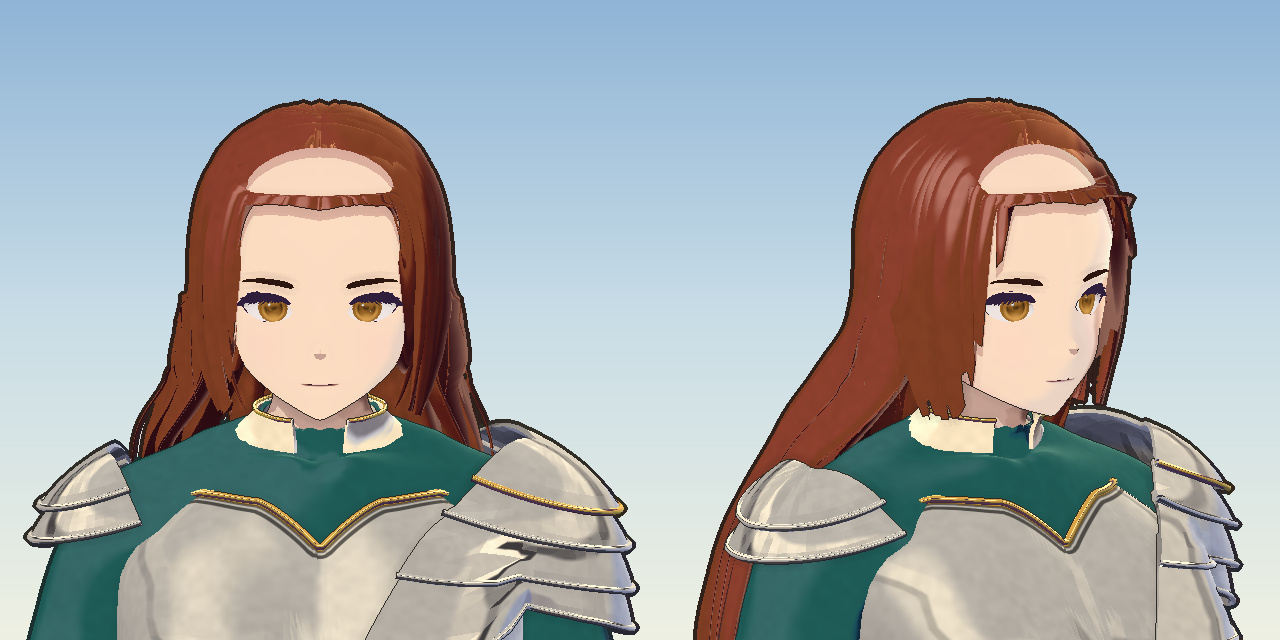
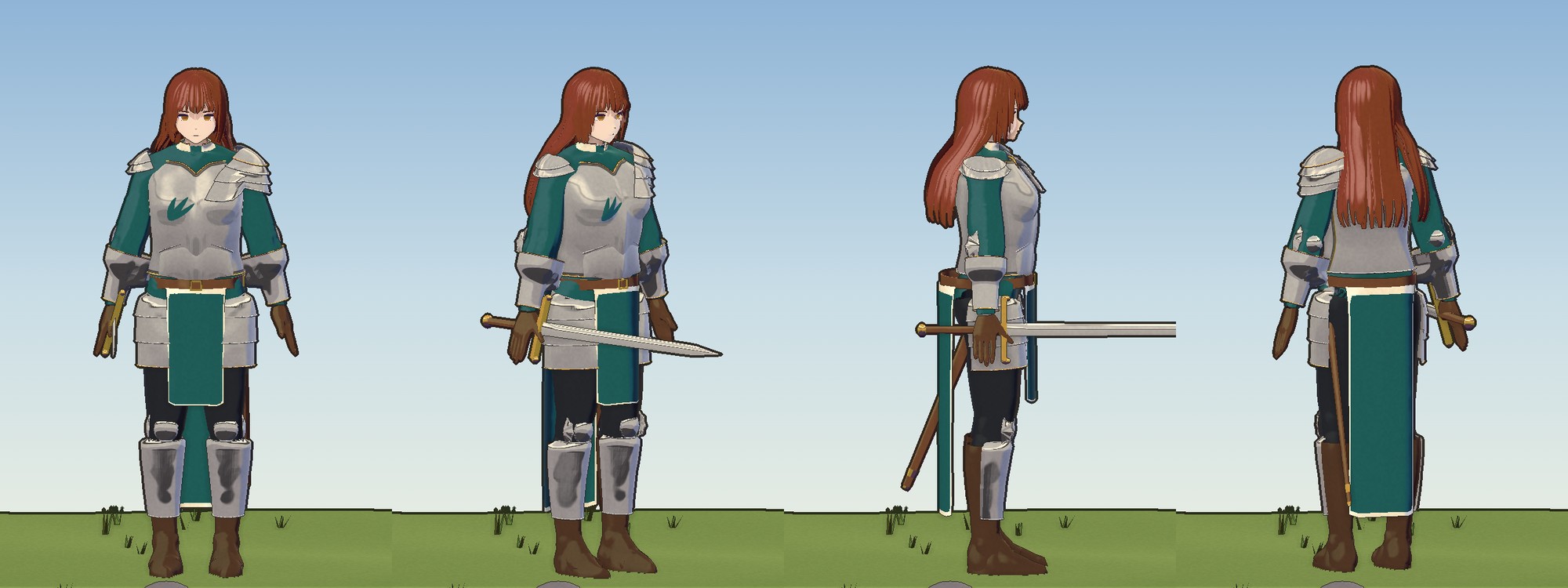
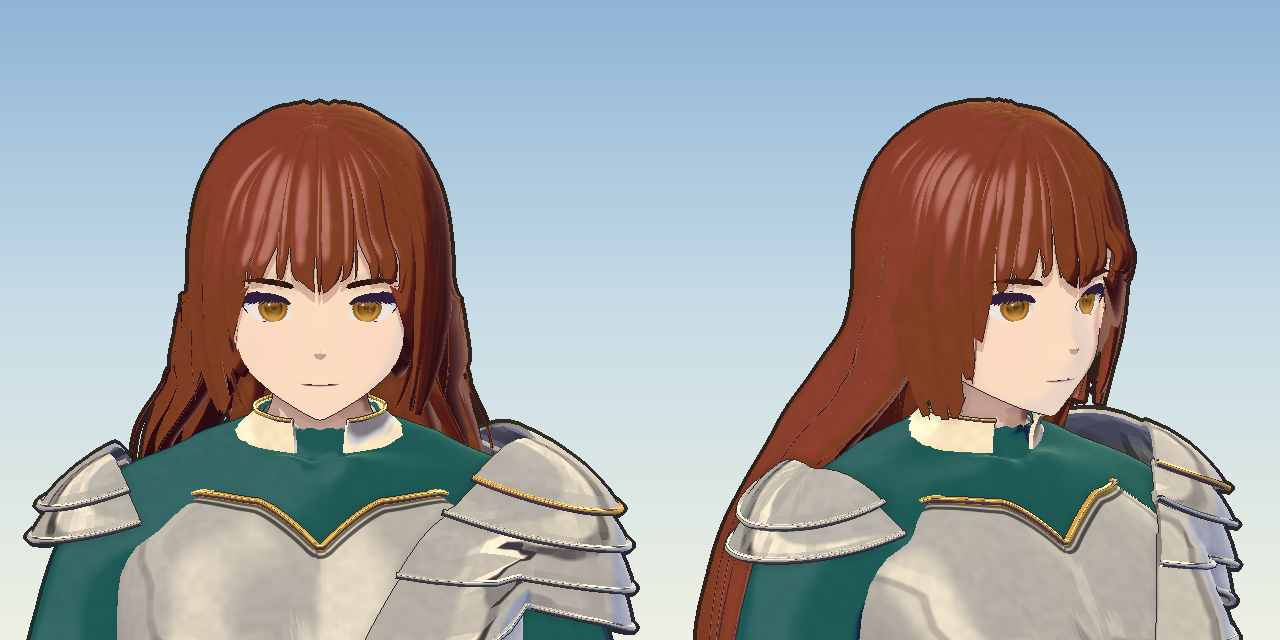
The costume now reads as a finished design. Next I'll fix the too-high fringe, the toes showing through the boots, the crumpling knee guards, and the overlong scabbard.
Bashcd ~/Projects/lowmarch-fable52 && python3 - <<'E'
command
cd ~/Projects/lowmarch-fable52 && python3 - <<'E' p="tools/whole/wren.py"; s=open(p).read() a=s.index("def haircut("); b=s.index("def _pt(surf):") s=s[:a]+'''def haircut(fit, root=1.0, over_eye=0.25, centre=0.08, temple=0.13, sharp=70.0): """Cut the fringe above the eyes. The sample's fringe ends at the middle of the eye, so at game size the face reads as a pale shape with no eyes. Each fringe vertex's depth below the fringe's root line is held to the depth of the cut at its x (a soft minimum, so the hair above the cut is untouched and the ends come out blunt, as scissors leave them). The cut is highest over each eye, drops to a lock between the eyes and again at the temples, and the side locks beyond the temples are left alone. Heights are in spans of this face (eye line to chin) above the eye line, so another face gets the same cut.""" lm = _landmarks(fit) span, eye_y = lm["span"], lm["eye_y"] ex = abs(lm["eyeR"][0]) z_face = lm["eyeL"][2] y_root = eye_y + root * span # above this the hair is untouched for p, r in zip(fit._prims, fit._roles): if r != "hair": continue P = p["pos"] ax = np.abs(P[:, 0]) h = (over_eye + (centre - over_eye) * np.exp(-(ax / (0.28 * ex)) ** 2) + (temple - over_eye) * np.clip((ax - 1.05 * ex) / (0.6 * ex), 0, 1) ** 2) T = y_root - (eye_y + h * span) # how deep the fringe may hang at this x d = np.maximum(y_root - P[:, 1], 0.0) d2 = -np.logaddexp(-d * sharp, -T * sharp) / sharp wx = 1 - np.clip((ax - 1.60 * ex) / (0.35 * ex), 0, 1) # fades out before the side locks wz = np.clip((z_face + 0.035 - P[:, 2]) / 0.02, 0, 1) # only hair in front of the face w = (wx * wx * (3 - 2 * wx)) * (wz * wz * (3 - 2 * wz)) * (d > 0) P[:, 1] = P[:, 1] + ((y_root - d2) - P[:, 1]) * w '''+s[b:] # own base layers, shoes old=s[s.index(" boot_top = knee - 0.045\n"):s.index(" under = mobs._under(shirt)")] new=''' boot_top = knee - 0.045 def cuff(side): a, h = B[f"J_Bip_{side}_LowerArm"], B[f"J_Bip_{side}_Hand"] n = (h - a) / np.linalg.norm(h - a) return n, n @ (h - n * 0.02) torso = ("Spine", "Chest", "UpperChest", "Bust", "Shoulder", "UpperArm", "LowerArm", "Neck", "Hips") nh = np.array([0.0, 1.0, -0.3]) / np.linalg.norm([0.0, 1.0, -0.3]) neckline = (nh, float(nh @ (nk + np.array([0.0, 0.012, 0.0])))) shirt = O.wrap(fit, "shirt", "signature", torso, offset=0.006, exclude=("UpperLeg",), y_min=hips[1] - 0.04, y_max=nk[1] + 0.05, cut=neckline, hems=[cuff("L"), cuff("R"), neckline], subdiv=1) hose = O.wrap(fit, "trousers", "doublet", ("Hips", "UpperLeg", "LowerLeg"), offset=0.006, y_max=hips[1] + 0.02, subdiv=1) # the boots stop at the ankle's foot: the base has toes, so the shoe is a last built over them (outfit.sabaton) boots = O.wrap(fit, "boots", "boot", ("LowerLeg", "Foot"), offset=0.014, y_max=boot_top, exclude=("ToeBase",), subdiv=1, hems=[((0, 1, 0), boot_top - 0.005)]) gloves = O.wrap(fit, "gloves", "glove", ("Hand", "Thumb", "Index", "Middle", "Ring", "Little"), offset=0.003, min_w=0.3, smooth=4) out = _grouped([shirt], "doublet") + _grouped([hose], "trousers") + _grouped([boots], "boots") + _grouped([gloves], "gloves") out += _grouped(O.sabaton(fit, "shoe_L", "L", role="boot", pad=0.013, ridges=0) + O.sabaton(fit, "shoe_R", "R", role="boot", pad=0.013, ridges=0), "boots") G.loose_sleeves(fit, shirt, ease=0.022, cuff=0.60) G.flare_boots(fit, boots, boot_top - 0.005, ease=0.009) ''' s=s.replace(old,new) R=[(''' legs_side, r=0.040, wing=0.058)''',''' thigh, r=0.040, wing=0.046)'''), (''' legs_side = merge_surfaces(_pt(thigh), _pt(shin))\n''',''), (''' sdir = np.array([-0.06, -0.80, 0.60])''',''' sdir = np.array([-0.05, -0.92, 0.38])'''), (''' scab = [O.tube("scabbard", "leather", s0, sdir, 0.86, 0.024, 0.014),''',''' scab = [O.tube("scabbard", "leather", s0, sdir, 0.80, 0.024, 0.014),'''), (''' O.tube("scabbard_chape", "gold", s0 + sdir * 0.80, sdir, 0.07, 0.0165, 0.011)]''',''' O.tube("scabbard_chape", "gold", s0 + sdir * 0.74, sdir, 0.07, 0.0165, 0.011)]'''), ('''(("tabard", 0, 0.085, ytop - (knee + 0.10)), ("tabard_back", 180, 0.135, ytop - (knee - 0.17)))''','''(("tabard", 0, 0.105, ytop - (knee + 0.21)), ("tabard_back", 180, 0.135, ytop - (knee - 0.17)))'''), ] for a_,b_ in R: assert a_ in s, a_[:60]; s=s.replace(a_,b_) open(p,"w").write(s) p="tools/whole/build.py"; s=open(p).read() old=''' build.scenery(NAME)\n''' new=''' if not os.path.exists(f"{build.OUT}/plains.glb.json") or os.environ.get("WHOLE_GROUND"): build.scenery(NAME) # dresses her again (the kit builds terrain with a character) ''' assert old in s; open(p,"w").write(s.replace(old,new)) E grep -n "import mobs" tools/whole/wren.py; (time LOWMARCH_SITE=whole2 WHOLE_DESIGN=wren OMP_NUM_THREADS=1 OPENBLAS_NUM_THREADS=1 python3 tools/whole/build.py arm_f_slender wren) 2>&1 | grep -E "Error|error|real|wren.glb|line" | head; cd review/out/whole2/shots && R=~/Projects/lowmarch-fable52 && for n in ref_front ref_q ref_side ref_back head_f head_q; do WHOLE_SITE=$R/review/out/whole2/site python3 $R/tools/whole/shoot.py $n.json $n.png >/dev/null 2>&1 & done; wait python3 -c " from PIL import Image a=[Image.open(n+'.png') for n in ('ref_front','ref_q','ref_side','ref_back')] W=Image.new('RGB',(640*4,960)); [W.paste(im,(640*i,0)) for i,im in enumerate(a)]; W.save('turn.png') b=[Image.open(n+'.png') for n in ('head_f','head_q')] W=Image.new('RGB',(1280,640)); [W.paste(im,(640*i,0)) for i,im in enumerate(b)]; W.save('heads.png')"result, 9 lines
23:import mobs
wren.glb 6.6 MB, 48s
real	0m48.598s
[1]   Done                    WHOLE_SITE=$R/review/out/whole2/site python3 $R/tools/whole/shoot.py $n.json $n.png > /dev/null 2>&1
[2]   Done                    WHOLE_SITE=$R/review/out/whole2/site python3 $R/tools/whole/shoot.py $n.json $n.png > /dev/null 2>&1
[3]   Done                    WHOLE_SITE=$R/review/out/whole2/site python3 $R/tools/whole/shoot.py $n.json $n.png > /dev/null 2>&1
[4]   Done                    WHOLE_SITE=$R/review/out/whole2/site python3 $R/tools/whole/shoot.py $n.json $n.png > /dev/null 2>&1
[5]-  Done                    WHOLE_SITE=$R/review/out/whole2/site python3 $R/tools/whole/shoot.py $n.json $n.png > /dev/null 2>&1
[6]+  Done                    WHOLE_SITE=$R/review/out/whole2/site python3 $R/tools/whole/shoot.py $n.json $n.png > /dev/null 2>&1
user
+47:15mind telling me how you're deviating now? just so I can tell early if you're just going by the usual route
agent
+47:40reasoning
For the last 25 minutes I've kept to the project's route, but the next step is a deviation: my own cel renderer with authored lighting and a real background, while keeping the VRoid body and fitted armour plates. If you'd rather I swap VRoid hair for hair I build myself or move modelling into Blender, say so now; otherwise I'm continuing with the plan.
Read~/Projects/lowmarch-fable52/review/out/whole2/shots/turn.png
input
{
  "file_path": "~/Projects/lowmarch-fable52/review/out/whole2/shots/turn.png"
}
result
no output
turn_2.jpg Read~/Projects/lowmarch-fable52/review/out/whole2/shots/heads.png
input
{
  "file_path": "~/Projects/lowmarch-fable52/review/out/whole2/shots/heads.png"
}
result
no output
heads_2.png Bashcd ~/Projects/lowmarch-fable52 && date +%H:%M:%S && sed -n 856,900p review/vroid-02/index.html && sed -n 912,990p review/vroid-02/index.html
command
cd ~/Projects/lowmarch-fable52 && date +%H:%M:%S && sed -n 856,900p review/vroid-02/index.html && sed -n 912,990p review/vroid-02/index.html
result, 124 lines
19:20:42 // forehead and much less than the head is deep, so a brow still hides behind the skull when the head turns away. const BROW_LIFT = 0.04; const KIND = { cloth: 0, skin: 1, hair: 2, steel: 3, gold: 4, leather: 5, world: 6 }; function paintMaterial(V, role, map, index, infoRole = role, decal = false) { const Rl = V.roles[role] || { mode: "flat", color: "#ff00ff" }, P = (V.paint || {})[role]; const u = { uKind: { value: 9 }, uBase: { value: new THREE.Color(0.8, 0.8, 0.8) }, uKey: { value: KEY.clone() }, uMap: { value: map || white }, uAlpha: { value: 0 }, uPass: { value: 0 }, uInfo: { value: new THREE.Vector4(roleId(infoRole) / 255, (index % 256) / 255, Math.floor(index / 256) / 255, 1) }, uEye: { value: V.roles.iris.colors.map(hex) }, uFlat: { value: new THREE.Color() }, uSkinRef: { value: new THREE.Vector3(0.965, 0.878, 0.80) }, uGold: { value: hex((V.paint && V.paint.gold && V.paint.gold.base) || "#b08b3f") }, uAmbient: { value: new THREE.Vector3(1, 1, 1) }, uKeyCol: { value: new THREE.Vector3(1, 1, 1) }, uRimCol: { value: new THREE.Vector3() }, uGrain: { value: 0.05 }, uFaceTex: { value: 0 }, uDecal: { value: decal ? 1 : 0 }, uBand: { value: null }, uSkinTone: { value: new THREE.Vector3(1, 1, 1) }, uShadeOnly: { value: 0 }, uSkinRamp: { value: 0 }, uSkinL: { value: new THREE.Color() }, uSkinS: { value: new THREE.Color() }, uSkinC: { value: new THREE.Color() }, tCastInfo: { value: null }, tCastDepth: { value: null }, uCastRes: { value: new THREE.Vector2(1, 1) }, uCastOn: { value: 0 }, uCastNear: { value: 0.1 }, uCastFar: { value: 40 }, uCastPpm: { value: 1 }, uMotif: { value: hex((V.paint && V.paint.motif && V.paint.motif.base) || "#3a44a0") }, uLift: { value: 0 } }; if (P) { u.uKind.value = KIND[P.kind] ?? 0; if (P.base) u.uBase.value = hex(P.base); if (P.grain != null) u.uGrain.value = P.grain; } else if (Rl.bands) { u.uKind.value = Rl.world ? 6 : 0; u.uBase.value = hex(Rl.bands[Math.min(1, Rl.bands.length - 1)][1]); } if (P && P.kind === "world") { u.uKey.value = new THREE.Vector3(...V.sun); u.uGrain.value = 0.12; } if (P && P.shade) u.uShadeOnly.value = 1; // shadow cards: skin, always in its shade tone if (P && P.kind === "skin" && P.ramp) { // a designed ramp: lit, shade, deep shade u.uSkinRamp.value = 1; u.uSkinL.value = hex(P.ramp[0]); u.uSkinS.value = hex(P.ramp[1]); u.uSkinC.value = hex(P.ramp[2]); } if (P && P.kind === "skin" && P.base) { // skin tone: the base colour against the default light skin const c = hex(P.base); u.uSkinTone.value.set(c.r / 0.973, c.g / 0.882, c.b / 0.835); } if (role === "face" && map) u.uFaceTex.value = 1; if (role === "hair" && map) u.uAlpha.value = 1; if (role === "iris") { u.uKind.value = 7; u.uAlpha.value = 1; } else if (role === "white" || role === "highlight") { u.uKind.value = map ? 8 : 9; if (map) u.uAlpha.value = 1; u.uFlat.value = hex(Rl.color || "#ffffff"); } else if (!P && Rl.mode === "flat") { u.uKind.value = 9; u.uFlat.value = hex(Rl.color); if (map) u.uAlpha.value = role === "line" ? 2 : 1; } if (role === "brow") u.uLift.value = BROW_LIFT; if (role === "mouth" && map) u.uKind.value = 10; u.uBand.value = u.uGold.value.clone(); const m = new THREE.ShaderMaterial({ uniforms: u, vertexShader: PAINT_VS, fragmentShader: PAINT_FS, side: THREE.DoubleSide, extensions: { derivatives: true } }); // meshes without plate data or a cloth edge read zeros, not whatever another program left in that slot m.defaultAttributeValues = { ...m.defaultAttributeValues, _plate: [0, 0, 0, 0], edge: [0] }; return m; } // ---- models ------------------------------------------------------------------------------------------------------ const loader = new GLTFLoader(); const chars = new Map(); // name -> loaded character async function parseGlb(file) { const j = await (await fetch(file)).json(); const bin = Uint8Array.from(atob(j.glb), c => c.charCodeAt(0)); return await new Promise((ok, bad) => loader.parse(bin.buffer, "", ok, bad)); } let meshIndex = 1; function prepMesh(o, V, opts = {}) { const m0 = o.material, role = o.userData.role || "body", raw = rawTex(m0.map); const infoRole = role === "hair" && opts.hairB ? "hair_b" : role === "shadow" ? "body" : role; const decal = !!(m0.userData && m0.userData.decal); // the map is a design mask, not a colour const base = { map: decal ? null : (m0.map || null), color: m0.color.clone(), side: THREE.DoubleSide, alphaTest: m0.alphaTest || 0 }; const clay = new THREE.MeshStandardMaterial({ ...base, roughness: 0.85, metalness: m0.metalness || 0 }); const toon = new THREE.MeshToonMaterial({ ...base, gradientMap: gradient }); if (role === "hair" && m0.map && V.paint && V.paint.hair) { // the VRoid sample's hair texture carries its own colour (dark on some samples): in 3D use the // character's hair colour, with the texture's light and dark only for strand detail for (const m of [clay, toon]) { m.color = hex(V.paint.hair.base); m.onBeforeCompile = sh => { sh.fragmentShader = sh.fragmentShader.replace("#include <map_fragment>", `#ifdef USE_MAP vec4 texel_ = texture2D(map, vMapUv); diffuseColor.rgb *= mix(1.0, clamp(dot(texel_.rgb, vec3(0.3333)) / 0.5, 0.45, 1.35), 0.6); diffuseColor.a *= texel_.a; #endif`); }; m.customProgramCacheKey = () => "hairlum"; } } o.userData.mats = { clay, toon, painted: paintMaterial(V, role, raw, meshIndex, infoRole, decal) }; meshIndex++; o.userData.group = o.userData.group || "body"; o.userData.role = role; o.frustumCulled = false; } async function loadCharacter(name) { if (chars.has(name)) return chars.get(name); const def = charDef(name), V = def.info, ci = CAM.characters.indexOf(def); const gltf = await parseGlb(`${name}.glb.json`); const turn = new THREE.Group(), holder = new THREE.Group(); turn.add(holder); holder.add(gltf.scene); const meshes = []; gltf.scene.traverse(o => { if (o.isMesh) { prepMesh(o, V, { hairB: ci > 0 }); meshes.push(o); } }); gltf.scene.updateMatrixWorld(true); const bone = n => gltf.scene.getObjectByName(n); const cloths = [], world = new THREE.Group(); for (const [cname, info] of Object.entries(V.cloth || {})) { const skinned = meshes.find(m => m.userData.material === cname); if (!skinned) continue; const trims = meshes.filter(m => info.trims.includes(m.userData.material)); const caps = V.capsules.filter(c => !info.collide || info.collide.some(k => c.bones[0].includes(k))); const cl = info.closed ? new SkirtRig(skinned, info.u, info.v, trims, caps, bone, info.edges === "hem") : new Cloth(skinned, info.u, info.v, trims, caps, bone, false, info.edges === "hem"); const band = info.band || "gold", BR = V.roles[band] || V.roles.gold; const gold = hex(BR.bands ? BR.bands[Math.min(1, BR.bands.length - 1)][1] : BR.color); const PB = (V.paint || {})[band]; if (PB && PB.base) skinned.userData.mats.painted.uniforms.uBand.value = hex(PB.base); // gold stays gold for decals cl.lines3d = new THREE.LineSegments(cl.lines.geometry, new THREE.LineBasicMaterial({ color: gold })); cl.lines3d.frustumCulled = false; world.add(cl.display, cl.lines3d); cloths.push(cl); } const mixer = new THREE.AnimationMixer(gltf.scene); const actions = Object.fromEntries(gltf.animations.map(c => [c.name, mixer.clipAction(c)])); const skeleton = meshes.find(m => m.isSkinnedMesh)?.skeleton; const c = { name, info: V, turn, holder, root: gltf.scene, meshes, cloths, world, mixer, actions, skeleton, clip: "idle", t: 0, groups: [...new Set(meshes.map(m => m.userData.group))] }; c.springs = makeSprings(c, V.springs); chars.set(name, c); return c; } async function loadGround() { if (ground) return ground; const V = CAM.characters[0].info, gltf = await parseGlb("plains.glb.json"), meshes = []; gltf.scene.traverse(o => { if (o.isMesh) { prepMesh(o, V); meshes.push(o); } }); ground = { root: gltf.scene, meshes }; return ground; }Bashcd ~/Projects/lowmarch-fable52 && sed -n 318,346p review/vroid-02/index.html && sed -n 372,412p review/vroid-02/index.html && sed -n 425,440p review/vroid-02/index.html && sed -n 476,530p review/vroid-02/index.html
command
cd ~/Projects/lowmarch-fable52 && sed -n 318,346p review/vroid-02/index.html && sed -n 372,412p review/vroid-02/index.html && sed -n 425,440p review/vroid-02/index.html && sed -n 476,530p review/vroid-02/index.html
result, 141 lines
varying vec3 vN; varying vec2 vUv; varying vec3 vView; varying vec3 vObj; varying float vEdge; varying vec4 vPlate; void main() { ${SKIN_BODY} vN = normalize(normalMatrix * objectNormal); vUv = uv; vObj = position; vEdge = edge; vPlate = _plate; vec4 mv = modelViewMatrix * vec4(transformed, 1.0); vView = -mv.xyz; mv.z += uLift; // brows: drawn over the bangs (depth lift toward the camera) gl_Position = projectionMatrix * mv; }`; const HSV = ` vec3 rgb2hsv(vec3 c) { vec4 K = vec4(0.0, -1.0 / 3.0, 2.0 / 3.0, -1.0); vec4 p = mix(vec4(c.bg, K.wz), vec4(c.gb, K.xy), step(c.b, c.g)); vec4 q = mix(vec4(p.xyw, c.r), vec4(c.r, p.yzx), step(p.x, c.r)); float d = q.x - min(q.w, q.y); return vec3(abs(q.z + (q.w - q.y) / (6.0 * d + 1e-10)), d / (q.x + 1e-10), q.x); } vec3 hsv2rgb(vec3 c) { vec4 K = vec4(1.0, 2.0 / 3.0, 1.0 / 3.0, 3.0); vec3 p = abs(fract(c.xxx + K.xyz) * 6.0 - K.www); return c.z * mix(K.xxx, clamp(p - K.xxx, 0.0, 1.0), c.y); }`; // painted renderer, after the Unicorn Overlord study: tight terminators, hue-shifted ramps built from // one base colour per material, hard reflection bands on steel, strand highlights on hair, a stage // grade and a back rim const PAINT_FS = ` uniform int uKind; uniform vec3 uBase; uniform vec3 uKey; uniform sampler2D uMap; uniform int uAlpha; uniform int uPass; uniform vec4 uInfo; uniform vec3 uEye[3]; uniform vec3 uFlat; uniform vec3 uSkinRef; uniform vec3 uGold; uniform vec3 uAmbient; uniform vec3 uKeyCol; uniform vec3 uRimCol; uniform float uGrain; uniform int uFaceTex; uniform int uDecal; uniform vec3 uMotif; uniform vec3 uBand; uniform vec3 uSkinTone; uniform int uShadeOnly; } varying vec3 vN; varying vec2 vUv; varying vec3 vView; varying vec3 vObj; varying float vEdge; varying vec4 vPlate; ${HSV} float hash(vec3 p) { p = fract(p * 0.3183099 + 0.1); p *= 17.0; return fract(p.x * p.y * p.z * (p.x + p.y + p.z)); } float vnoise(vec3 x) { vec3 i = floor(x), f = fract(x); f = f * f * (3.0 - 2.0 * f); return mix(mix(mix(hash(i), hash(i + vec3(1,0,0)), f.x), mix(hash(i + vec3(0,1,0)), hash(i + vec3(1,1,0)), f.x), f.y), mix(mix(hash(i + vec3(0,0,1)), hash(i + vec3(1,0,1)), f.x), mix(hash(i + vec3(0,1,1)), hash(i + vec3(1,1,1)), f.x), f.y), f.z); } float toward(float h, float target, float amt) { float d = target - h; d -= floor(d + 0.5); return fract(h + clamp(d, -amt, amt)); } vec3 tone(vec3 base, float hue, float amt, float sMul, float vMul) { vec3 h = rgb2hsv(base); return hsv2rgb(vec3(toward(h.x, hue, amt), clamp(h.y * sMul, 0.0, 1.0), clamp(h.z * vMul, 0.0, 1.0))); } float st(float x, float t) { return smoothstep(t - 0.03, t + 0.03, x); } // Steel and gold. Hard reflection bands (dark below the horizon, a dark core under a white streak) // read well where the surface turns fast: rims, tubes, lames. On a broad plate the reflection // barely changes, so a band there fills the whole plate (the blotches): bands fade by how sharply // the surface curves (normal change per metre on screen), and broad plates get a soft tone that // lightens up each outline plate (hgt: height in the plate 0..1, or -1 without plate data). vec3 metal(bool gold, vec3 base, vec3 n, vec3 v, float lit, float hgt) { vec3 r = reflect(-v, n); float ry = r.y + (vnoise(vObj * vec3(3.0, 14.0, 3.0)) - 0.5) * 0.14; // jitter the bands along their length, not into blobs float curv = length(fwidth(n)) / max(length(fwidth(vView)), 1e-5); float sharp = smoothstep(5.0, 14.0, curv); // a shaped plate's domes (over the bust, a crowned panel) turn the bands into closed rings: plates // keep only a little of them and take a crisp highlight toward the light instead if (hgt >= 0.0) sharp *= 0.25; else sharp = max(sharp, 0.3); vec3 s0, s1, s2, s3; if (!gold) { s0 = tone(base, 0.68, 0.10, 2.4, 0.32); s1 = tone(base, 0.68, 0.06, 1.7, 0.76); s2 = tone(base, 0.12, 0.0, 0.8, 0.88); s3 = vec3(0.97, 0.96, 0.92); } else { s0 = vec3(0.30, 0.20, 0.30); s1 = tone(base, 0.20, 0.03, 1.0, 0.72); s2 = base; s3 = tone(base, 0.16, 0.03, 0.5, 1.5); } vec3 hard = mix(s0, s1, st(ry, -0.42)); // facing down: dark hard = mix(hard, s2, st(ry, -0.08)); // facing us: the plate's own grey hard = mix(hard, s0, st(ry, 0.36)); // dark core under the streak hard = mix(hard, s3, st(ry, 0.47)); // the white streak hard = mix(hard, s2 * 1.06, st(ry, 0.70)); float k = smoothstep(-0.55, 0.30, r.y); // broad: darker toward the ground (no jitter: if (hgt >= 0.0) k = clamp(k * 0.45 + hgt * 0.80 - 0.18, 0.0, 1.0); // on a flat plate it streaks) else k = clamp(k * 0.6 + n.y * 0.35 + 0.05, 0.0, 1.0); // without plate data: lighter facing up vec3 soft = mix(s1 * 0.9, s2, k); float lit = dot(n, uKey) * 0.5 + 0.5; if (uShadeOnly == 1) lit = min(lit, 0.37); // shadow cards only ever darken skin, to a soft shade else if (uCastOn == 1 && uKind == 1 && int(uInfo.x * 255.0 + 0.5) == 2 && castShadow() > 0.5) lit = min(lit, 0.37); // body skin under the jaw's or the hair's shadow float g1 = vnoise(vObj * 40.0), g2 = vnoise(vObj * 150.0); vec3 col; if (uKind == 0 || uKind == 5 || uKind == 6) { // cloth, leather, ground vec3 hb = rgb2hsv(uBase); bool cool = hb.x > 0.42 && hb.x < 0.86; float sh = uKind == 5 ? 0.93 : (cool ? 0.70 : 0.96); float li = cool ? 0.52 : 0.13; vec3 c0 = tone(uBase, sh, 0.09, 1.12, 0.40), c1 = tone(uBase, sh, 0.05, 1.08, 0.64); vec3 c3 = tone(uBase, li, 0.03, 0.80, 1.20); float l = lit + (g1 - 0.5) * uGrain - (uKind == 6 ? 0.22 : 0.0); // ground: a flat top sits at the base colour col = mix(c0, c1, st(l, 0.30)); col = mix(col, uBase, st(l, 0.50)); col = mix(col, c3, st(l, 0.91)); if (uKind == 5) col *= 0.965 + 0.07 * vnoise(vObj * 22.0); // mottled leather } } else if (uKind == 7) { // iris float l = dot(tex.rgb, vec3(1.0 / 3.0)); col = l < 0.3 ? mix(uEye[0], uEye[1], l / 0.3) : mix(uEye[1], uEye[2], clamp((l - 0.3) / 0.6, 0.0, 1.0)); } else if (uKind == 8) { col = tex.rgb; } else if (uKind == 10) { // the open mouth: VRoid's map read as three parts, float lum = dot(tex.rgb, vec3(1.0 / 3.0)); // teeth (white), tongue (its light pink) and the col = mix(vec3(0.36, 0.11, 0.14), vec3(0.78, 0.38, 0.42), smoothstep(0.53, 0.58, tex.g)); // dark inside col = mix(col, vec3(0.98, 0.96, 0.95), smoothstep(0.80, 0.86, lum)); } else { col = uFlat; } if (vPlate.x > 0.5 && vPlate.z > 0.0 && uKind != 3 && uKind != 4) { // a cloth outline piece's gold border, float e = vPlate.y, w = vPlate.z, aa = fwidth(e) * 1.2 + 1e-5; // and a fine gold line inside it float band = 1.0 - smoothstep(w - aa, w, e); float l1 = 1.0 - smoothstep(0.0006, 0.0006 + aa, abs(e - (w + 0.0040))); col = mix(col, metal(true, uGold, n, v, lit, -1.0), max(band, l1 * 0.9)); } if (uDecal == 1) { // a design in the piece's own coordinates: vec3 dm = tex.rgb; // R paint, G groove, B gold inlay float pm = smoothstep(0.3, 0.7, dm.r), gm = smoothstep(0.3, 0.7, dm.g), au = smoothstep(0.3, 0.7, dm.b); if (au > 0.0) col = mix(col, metal(true, uGold, n, v, lit, -1.0), au); if (pm > 0.0) { vec3 pc = mix(tone(uMotif, 0.70, 0.05, 1.10, 0.62), uMotif, st(lit, 0.42)); col = mix(col, mix(pc, tone(uMotif, 0.56, 0.03, 0.8, 1.25), st(lit, 0.92)), pm); } if (gm > 0.0) col = mix(col, col * 0.30, gm); } if (vEdge > 0.5) { // the cloth's border band vec3 gd = tone(uBand, 0.20, 0.03, 1.0, 0.72); col = mix(gd, uBand, st(lit, 0.45)); col = mix(col, tone(uBand, 0.16, 0.03, 0.5, 1.45), st(lit, 0.85)); } if (uKind <= 6) { vec3 grade = mix(uAmbient, uKeyCol, st(lit, 0.55)); col *= uKind == 1 && uSkinRamp == 1 ? mix(vec3(1.0), grade, 0.3) : grade; // a designed skin ramp takes less of it float fr = pow(1.0 - max(dot(n, v), 0.0), 4.0); float back = clamp(dot(n, normalize(vec3(0.55, 0.45, -0.35))), 0.0, 1.0); col += uRimCol * fr * smoothstep(0.1, 0.5, back); if (uKind != 1) col *= 1.0 + (g2 - 0.5) * 0.06; } gl_FragColor = vec4(clamp(col, 0.0, 1.0), 1.0); }`; const PAINT_COMP = ` uniform sampler2D tColor; uniform sampler2D tInfo; uniform sampler2D tDepth; uniform vec2 uRes; uniform float uNear; uniform float uFar; uniform float uGap; uniform float uSil; uniform float uInner; uniform float uPpm; ${HSV} float z(vec2 p) { return uNear + texture2D(tDepth, p).x * (uFar - uNear); } int rid(vec4 i) { return int(i.r * 255.0 + 0.5); } float pid(vec4 i) { return floor(i.g * 255.0 + 0.5) + floor(i.b * 255.0 + 0.5) * 256.0; } vec3 ink(vec3 c) { vec3 h = rgb2hsv(c); return hsv2rgb(vec3(h.x, clamp(h.y, 0.20, 0.45), 0.19)); } // How far (px) the mouth's opening runs from this pixel in direction d (2 px steps, up to 128 px). float mouthRun(vec2 uv, vec2 d) { float n = 0.0; for (int s = 1; s <= 64; s++) { vec4 a = texture2D(tInfo, uv + d * float(2 * s)); if (a.a < 0.5 || rid(a) != 9) break; n += 2.0; } return n; }Bashcd ~/Projects/lowmarch-fable52 && sed -n 296,318p review/vroid-02/index.html; grep -n "userData.role\|userData.decal\|extras" tools/export_glb.py | head -20; grep -n "_plate\|\"edge\"\|_EDGE\|_PLATE" tools/export_glb.py | head
command
cd ~/Projects/lowmarch-fable52 && sed -n 296,318p review/vroid-02/index.html; grep -n "userData.role\|userData.decal\|extras" tools/export_glb.py | head -20; grep -n "_plate\|\"edge\"\|_EDGE\|_PLATE" tools/export_glb.py | head
result, 28 lines
  const d = new Uint8Array([70, 70, 70, 255, 140, 140, 140, 255, 205, 205, 205, 255, 255, 255, 255, 255]);
  const t = new THREE.DataTexture(d, 4, 1, THREE.RGBAFormat); t.minFilter = t.magFilter = THREE.NearestFilter; t.needsUpdate = true; return t;
})();
const white = (() => { const t = new THREE.DataTexture(new Uint8Array([255, 255, 255, 255]), 1, 1, THREE.RGBAFormat); t.needsUpdate = true; return t; })();

// ---- scene and camera -----------------------------------------------------------------------------------------------
const scene = new THREE.Scene();
const hemi = new THREE.HemisphereLight(0xfff6ee, 0x3a3450, 1.35);
const sun = new THREE.DirectionalLight(0xffffff, 1.6);
scene.add(hemi, sun);
const camera = new THREE.OrthographicCamera(-1, 1, 1, -1, 0.1, 40);

// ---- shaders --------------------------------------------------------------------------------------------------------
const SKIN_HEAD = `#include <common>
  #include <skinning_pars_vertex>`;
const SKIN_BODY = `#include <beginnormal_vertex>
    #include <skinbase_vertex>
    #include <skinnormal_vertex>
    #include <begin_vertex>
    #include <skinning_vertex>`;
const PAINT_VS = `${SKIN_HEAD}
  attribute float edge; attribute vec4 _plate; uniform float uLift;
  varying vec3 vN; varying vec2 vUv; varying vec3 vView; varying vec3 vObj; varying float vEdge; varying vec4 vPlate;
147:                          extras=dict(group=group_of(p, role), role=role, world=bool(p.get("world")), material=p["material"])))
520:            mat["extras"] = dict(decal=True)
526:                           extras=dict(group=group_of(p, role), role=role, material=p["material"])))
36:    for key in ("trim", "edge", "hem", "placket", "buckle", "clasp"):
480:            attrs["_PLATE"] = add_acc(np.asarray(p["plate"])[usedv].astype(np.float32), "VEC4", 5126, 34962)
agent
+49:10Writing the new renderer now. One more read of how the old page handles eyes, lashes and face textures so my shader gets those right.
Bashcd ~/Projects/lowmarch-fable52 && sed -n 412,476p review/vroid-02/index.html; grep -n "const hex\b\|function hex\|const rawTex\|function rawTex" -A6 review/vroid-02/index.html | head -24; grep -n "lid_fill\|fill_lid\|even_mouth\|fill_line" tools/export_glb.py | head
command
cd ~/Projects/lowmarch-fable52 && sed -n 412,476p review/vroid-02/index.html; grep -n "const hex\b\|function hex\|const rawTex\|function rawTex" -A6 review/vroid-02/index.html | head -24; grep -n "lid_fill\|fill_lid\|even_mouth\|fill_line" tools/export_glb.py | head
result, 84 lines
    vec3 soft = mix(s1 * 0.9, s2, k);
    float hl = dot(n, normalize(uKey + v));                          // the key's highlight, a hard-edged shape
    if (hgt >= 0.0) soft = mix(soft, mix(s2, s3, 0.6), st(hl, 0.955) * smoothstep(0.45, 0.8, hgt));   // the upper part only
    vec3 col = mix(soft, hard, sharp);
    return mix(col * 0.72 + s0 * 0.28, col, st(lit, 0.30));
  }
  void main() {
    vec4 tex = texture2D(uMap, vUv);
    if (uAlpha == 1 && tex.a < 0.5) discard;
    if (uAlpha == 2 && (tex.a < 0.5 || dot(tex.rgb, vec3(1.0 / 3.0)) >= 0.42)) discard;
    if (uPass == 1) { gl_FragColor = uInfo; return; }
    vec3 n = normalize(vN); if (!gl_FrontFacing) n = -n;
    vec3 v = normalize(vView);
    float lit = dot(n, uKey) * 0.5 + 0.5;
    if (uShadeOnly == 1) lit = min(lit, 0.37);                        // shadow cards only ever darken skin, to a soft shade
    else if (uCastOn == 1 && uKind == 1 && int(uInfo.x * 255.0 + 0.5) == 2 && castShadow() > 0.5)
      lit = min(lit, 0.37);                                           // body skin under the jaw's or the hair's shadow
    float g1 = vnoise(vObj * 40.0), g2 = vnoise(vObj * 150.0);
    vec3 col;
    if (uKind == 0 || uKind == 5 || uKind == 6) {                    // cloth, leather, ground
      vec3 hb = rgb2hsv(uBase);
      bool cool = hb.x > 0.42 && hb.x < 0.86;
      float sh = uKind == 5 ? 0.93 : (cool ? 0.70 : 0.96);
      float li = cool ? 0.52 : 0.13;
      vec3 c0 = tone(uBase, sh, 0.09, 1.12, 0.40), c1 = tone(uBase, sh, 0.05, 1.08, 0.64);
      vec3 c3 = tone(uBase, li, 0.03, 0.80, 1.20);
      float l = lit + (g1 - 0.5) * uGrain - (uKind == 6 ? 0.22 : 0.0);  // ground: a flat top sits at the base colour
      col = mix(c0, c1, st(l, 0.30)); col = mix(col, uBase, st(l, 0.50)); col = mix(col, c3, st(l, 0.91));
      if (uKind == 5) col *= 0.965 + 0.07 * vnoise(vObj * 22.0);       // mottled leather
    } else if (uKind == 1) {                                           // skin: pale, nearly unshaded from the front
      vec3 sL = vec3(0.973, 0.882, 0.835), sS = vec3(0.776, 0.659, 0.608), sC = vec3(0.451, 0.322, 0.310);
      if (uSkinRamp == 1) { sL = uSkinL; sS = uSkinS; sC = uSkinC; }   // the character's tone, designed per tone
      col = mix(sC, sS, st(lit, 0.20)); col = mix(col, sL, st(lit, 0.38));
      if (uFaceTex == 1) col *= clamp(tex.rgb / uSkinRef, 0.55, 1.05);
      if (uFaceTex == 1 && vUv.x > 0.38 && vUv.x < 0.62 && vUv.y > 0.68 && vUv.y < 0.84) {
        // the closed mouth: VRoid paints a 2-texel line that the clamp above leaves faint; ink it and widen it
        // (the darkest of a few taps), so it follows the mouth's shape keys as a drawn line
        float d = 0.0, sl = dot(uSkinRef, vec3(1.0 / 3.0));
        for (int k = -2; k <= 2; k++) for (int j = -1; j <= 1; j++) {
          vec3 t = texture2D(uMap, vUv + vec2(float(j) * 1.2, float(k) * 0.8) / 512.0).rgb;
          d = max(d, 1.0 - dot(t, vec3(1.0 / 3.0)) / sl);
        }
        float taper = 1.0 - 0.55 * smoothstep(0.035, 0.065, abs(vUv.x - 0.5));   // a brush stroke: lighter at the corners
        col = mix(col, vec3(0.42, 0.22, 0.22), smoothstep(0.10, 0.22, d) * taper);
      }
      if (uSkinRamp == 0) col *= uSkinTone;                            // older builds: one tint over the light skin
    } else if (uKind == 2) {                                           // hair: four even bands, hard strand highlights
      float strand = dot(tex.rgb, vec3(1.0 / 3.0));
      vec3 c0 = tone(uBase, 0.72, 0.07, 1.10, 0.45), c1 = tone(uBase, 0.72, 0.035, 1.05, 0.68);
      vec3 c2 = tone(uBase, 0.56, 0.02, 0.92, 1.10), c3 = tone(uBase, 0.56, 0.03, 0.55, 1.42);
      float l = lit + (strand - 0.6) * 0.12;
      col = mix(c0, c1, st(l, 0.40)); col = mix(col, uBase, st(l, 0.56)); col = mix(col, c2, st(l, 0.84));
      float sp = dot(n, normalize(uKey + v)) + (strand - 0.6) * 0.18;
      col = mix(col, c3, st(sp, 0.90) * (1.0 - st(sp, 0.985)));
    } else if (uKind == 3 || uKind == 4) {                             // steel, gold
      bool plate = vPlate.x > 0.5;
      float e = vPlate.y, w = vPlate.z;
      bool gilt = uKind == 4 || (plate && w > 0.0 && e < w);            // an outline plate's gold border
      col = metal(gilt, gilt && uKind == 3 ? uGold : uBase, n, v, lit, plate ? vPlate.w : -1.0);
      if (plate && w > 0.0) {                                           // engraved lines: one inside the border, one on its seam
        float aa = fwidth(e) * 1.2 + 1e-5;
        float l1 = 1.0 - smoothstep(0.0010, 0.0010 + aa, abs(e - (w + 0.0050)));
        float l2 = 1.0 - smoothstep(0.0006, 0.0006 + aa, abs(e - w));
        col = mix(col, col * 0.42, max(l1, l2 * 0.8));
      }
290:const hex = h => {                                     // raw palette value, no colour-space conversion
291-  const n = parseInt(h.slice(1), 16);
292-  return new THREE.Color().setRGB((n >> 16 & 255) / 255, (n >> 8 & 255) / 255, (n & 255) / 255, THREE.LinearSRGBColorSpace);
293-};
294:const rawTex = t => { if (!t) return null; const c = t.clone(); c.colorSpace = THREE.NoColorSpace; c.needsUpdate = true; return c; };
295-const gradient = (() => {
296-  const d = new Uint8Array([70, 70, 70, 255, 140, 140, 140, 255, 205, 205, 205, 255, 255, 255, 255, 255]);
297-  const t = new THREE.DataTexture(d, 4, 1, THREE.RGBAFormat); t.minFilter = t.magFilter = THREE.NearestFilter; t.needsUpdate = true; return t;
298-})();
299-const white = (() => { const t = new THREE.DataTexture(new Uint8Array([255, 255, 255, 255]), 1, 1, THREE.RGBAFormat); t.needsUpdate = true; return t; })();
300-
302:def fill_line_specks(rgba, most=400):
319:def fill_lid(rgba, v_edge, close=3):
355:def even_mouth(rgba):
492:                raw = fill_line_specks(raw)
493:                if p.get("lid_fill") is not None:          # a shut eye's lid (vroid_portrait): its lash solid
494:                    raw = fill_lid(raw, p["lid_fill"])
496:                raw = even_mouth(raw)
500:                    index=add_texture((id(src), p["mi"], p.get("lid_fill")), raw))